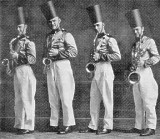
THE ROYAL DRAGONS
Like the Harmony Boys, a group of local musicians and two from Denison formed a dance band to go along with their regular jobs. They came on the scene in the late '20s and booked within reasonable distances of Manning and Denison. The original performers were Earl Jentsch, trombone; Harry Rasmussen, bass; Harry Rix, trumpet; Eddie Petersen, drums; Leland Ackley, banjo; Chester Schlumberger, piano; Arthur Rix, alto sax and clarinet; Vernon Petersen, alto sax. Ackley and Schlumberger were from Denison.
THE HARMONY BOYS ORCHESTRA
The Harmony Boys Orchestra was organized in 1934 by three of the Ohde brothers, Oliver, Raymond and Melvin. Arnold Brus joined them as the accordion player. They all had their own occupations so the orchestra never was a full time job for any of its players. More members were added as time went on. Harold "Hip" Kienapfel joined the group in 1935.
The orchestra was generally known as a seven piece band and played both old and new time music or whatever the crowd desired. Jobs were booked in an area 70 to 80 miles from Manning. In 1942 Oliver Ohde left for Washington, due to his health.
The band was reorganized in 1943 and new members who came on were George Pfoltner, Wesley Ohde, Nick Schwartzenbach and Wallace Jensen. The band did some broadcasting over KMA and KFNF at Shenandoah and over KCIM at Carroll. They disbanded in 1956.
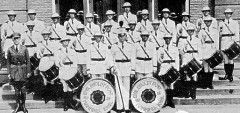
The group was known as the Drum and Bugle Corps of Emil Ewoldt Post No. 22 of the American Legion. It was organized in March, 1932, and the charter members were J.L. Barnes, R.E. Cole, Henry A. Dethlefs, George Ehlers, Ledger D. Free, Martin Fritz, Herman Grau, Henry J.M. Hansen, Peter F. Hansen, A.S. Jacobsen, Emil Jansen, Earl Jentsch, Henry Joens, Dr. R.B. Kelsey, Emil J. Kuhl, Henry Lippold, Clyde Meisel, F.J. Mentzer, Anton Mergele, H.E. Meyers, Hans Musfeldt, Robert Rudnick, H.A. Schelldorf, John J. Schroeder, W.C. Schrum, Grover Steen, Lauren Stoelk, Wm. Struve, and Herman Wunder.
Drum and bugle instructors were Earl Jentsch and Kenneth Dusenberry; drill master, L.M. Surridge; drum major, Peter F. Hansen. Uniforms were white serge with gold and black trim, black riding boots, black sam brown belts, white shirts, black ties, and aluminum helmets.
Residents remember hearing the drums and bugles and many came and sat on the slope of the old high school grounds to watch this group practice with a determination and persistence that brought them to their ultimate perfection. Practices were held several times a week in the evenings.
Their first appearance was at Westside in September, 1932. They competed at Harlan, Valley Junction, Avoca, Sioux City, Red Oak, Waterloo, and Carroll. Other public performances were given at Sidney, Ute, Templeton, Halbur, Manilla, Denison, Newton, Audubon, Rock Rapids, and Sioux Falls, South Dakota. The corps appeared that same year at the state Firemen's convention at Denison and were billed as the feature attraction on the program.
Constant practice began to pay off when, in October, 1933, the group placed second to Fort Dodge, a national champion and winner of the state meet so many times they were barred from further competition. The meet was held at Valley Junction. In July, 1934, the Drum and Bugle Corps came home with first place honors from a Fourth of July celebration at Red Oak. Others competing were Auburn, Nebraska, twice champions of that state; Harlan, and Council Bluffs. Judging was made by giving points on maneuvers, cadence, inspection, drum and bugle ability. Manning finished with 94.61 of a possible 100.
In September, 1934, the Drum and Bugle Corps participated in the state championship meet at the state American Legion convention held in Sioux City. The local group, known then as "The Aristocrats," survived the preliminaries the night before and competed against Waterloo, LeMars, Gowrie, Highland Park of Des Moines, Dubuque, Elkader, and Valley Junction. Manning placed third behind Waterloo and LeMars. Less than one point difference separated the three top scorers.
Judging of drum majors was not a part of the scoring but it was the consensus of opinion among most of the corps around the state that had there been, Pete Hansen of Manning would have been second to none.
The organization was a self-supporting group representing an investment of over $6,000 in addition to thousands of hours of time devoted to the cause.
MUSIC TEACHERS
With such a wide interest in music, this community also was fortunate to have many willing and accomplished teachers for vocal and instrumental pupils.
Complete records do not exist but early directories list Mrs. C.D. Dewing, Miss Emilie Gloe, Carl Langer, Henry Thomsen, and Hattie Leonard. Later in 1885 the list included A.D. Coleman, H.B. Vaughn, and T.E. Lockwood. Henry Thomsen also spent many years as a piano tuner.
Many residents recall some of those who followed, such as Hans Engel, a very accomplished musician who taught both piano and vocal. His first local piano student, Miss Clara Puck, later became his wife and also taught piano. Prof. Hoischen and wife came here from Germany and he spent several years here teaching piano, voice, and directing choirs. Mr. Hoischen gave his last recital in April, 1927, and then he and his wife went back to Germany.
Edna Halbur remembers the large Manning chorus that Mr. Engel organized and directed. Practices were held in the hall on the second floor of the brick building now replaced by the Manning Motor Co. Later practices were also held in the big room on the second floor above the old Bavarian Cafe on Main Street. The chorus appeared at many neighboring towns for concerts.
One of the highlights of Mr. Engel's career was the 1918 Red Cross benefit concert which he staged at the Germania Hall, later called the Opera House. Mr. Boyer, local school superintendent, gave a patriotic address and then a concert was given by a piano quartette played by Bonita Kuhl, Clara Puck, Margaret McCullough, and Mr. Engel. Admission was 50c. Reserved seat tickets could be purchased at the drug store where a seating arrangement chart was kept for all reserved seat occasions.
Before the appearance of talking pictures in 1927, movie houses hired piano players who played the right mood music on the piano placed in the small orchestra pit just below the stage and screen level. Bonita Hagedorn tells us that she and Milda Schelldorf played and sometimes changed places at the two local movie houses. Big movies furnished que sheets to conform to the scenes on the screen and most pianos had attachments to simulate the sound of a violin, guitar or drums.
Other teachers mentioned to us by former pupils were R. Essbach, who taught vocal and directed the Manning Liederkranz; C.E. Lyden, who taught trumpet or cornet and directed the town band; Wm. Schelldorf, clarinet; Paul Jentsch, violin and baritone horn; Harry Rix, saxophone, clarinet and violin; Dallas Gifford, chorus and piano; Dorothy Groteluschen, piano; Bess Moser, piano; Vera Ross, piano; and present teachers, Odessa Wycoff, Maureen Halbur, Linda Beaman, and Bonita Hagedorn, who years ago took over Hans angel's studio to teach piano and violin and at this writing, at the age of 82, is still teaching piano. For her benefit we here remind her that on February 24, 1927, she gave her third annual home recital. Her pupils taking part were: Everett Claussen Virginia Lathrop, Marie Jahn, Jewel Schluter, June Kleespies, Vera Wyatt, Edne Louise Wyatt, Margaret Kuhl, Arlene Kuhl, June Nickum, Clarence Kleespies, Alice Stuedeman, Myrtle Lake, Bernice Carsten, and Edyth Livingston.