CHAT-R-SEW CLUB
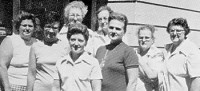
The Chat-R-Sew Club was organized in 1946, after a group of neighbors spent four days at the Iowa State Fair. The ladies bought punch work pillows and decided to work them together that winter. Their husbands helped them to make frames on which to make the pillows and a meeting was scheduled.
January, 1947, was the first meeting of these fair-goers at the home of Mrs. Virgil Genzen with Mrs. Charley Gruhn, Mrs. Alfred Spies and Mrs. Jerome Kasperbauer.
The pillows have long been finished but the meetings have been continued. They have no dues and no officers, with meetings held every third Thursday of every month and the hostess coming in alphabetical order. If a special event comes up the hostess of the month is chairperson.
Their name explains the program with emphasis on the chatting. They do fancy work, crocheting, knitting or any hand sewing or mending they can bring with them. They also exchange ideas, recipes, share family pictures and all important family events. The main purpose is to keep close contact with neighbors, something that is very essential to farmers and friends.
Present members are Margaret Spies, Florence Genzen, Margaret Kasperbauer, Mabel Lengeman, Janet Gruhn, Joan Mohr, and Betty Andresen. Deceased members are Wilhelmina Gruhn, Gertie Stuhr and Alvina Klocke.
I CAN REMEMBER---
When a farewell party was held at my parents' home when they moved to Omaha. It was also mother's birthday, so members of her Harfonia and Pleasant Hour Clubs surprised her; among those attending were Minnie Frahm, Anna Ohde, Mrs. Henry Rohr, and Mrs. Herman Hoffmann.
My father, John Frahm, was uptown, and mentioned the party to his friend, Dan Rice. Dan knew members of a minstrel show who were then appearing at the Opera House; he got a group of the players together, and they appeared at the door of our home at 610 Fourth Street.
I'll never forget opening the door to this group of black minstrel players, who stood on the porch and serenaded the ladies. The performers were invited into the house, and the ladies were all given complimentary tickets to the show that evening.
---Hilda Petersen
I CAN REMEMBER---
The days I went with my father to the Five Mile House dance with team and buggy and they had the long horse barns and old dance hall. I made my first Kinda Ball there. In 1929 my father was king, with Henry Dohse and Andrew Petersen entertaining with their German band.
---Henry Plotz, Akeley, Minnesota
DORCAS SOCIETY
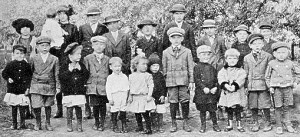
The first Ladies' Society of the Zion Lutheran Church was organized in 1904 and meetings were conducted in the German language. Realizing the need to change this situation the Dorcas Society was organized in 1920. All meetings were in the English language and membership increased rapidly. Dorcas joined the Lutheran Womens' Missionary League and are active in supporting projects on the zone and National level.
Working together with the other two sister societies of the congregation, keeping active in serving the fellowship lunches following funeral services. Also the fellowship following the Lenten and Advent evening services, collecting clothes for World Relief, giving an annual MotherDaughter buffet and closing the. year with many contributions for the needy. The Dorcas Society has 45 members this year, a small membership compared to past years.
Dorcas has the charge of Golden-Diamond Fellowship, following those services, active in collecting stamps for missions, sewing for world relief, contributing to World Hunger every month, and sending Christmas materials to a mission in Ghana and also in South India. Dorcas observed their Golden Anniversary in June 1972.
The members are willing to serve in Christian Fellowship remembering the Dorcas motto, "Serve the Lord with Gladness."
EMIL EWOLDT POST #22 AMERICAN LEGION
Manning's "Emil Ewoldt" Post No. 22 of the American Legion was founded in 1919. It was so named in memory of Emil Ewoldt, 30 year old son of William and Margaret Ewoldt. Emil was the first one from this vicinity who made the supreme sacrifice. He died of wounds received in action at the battle of "Chateau Thierry" in France, July 1918. He served in the 4th Infantry Division.
The Post's first official meeting was held July 1, 1919 in the meeting place owned by George Dethlefs above the Crystal theater. Walter Grantz was the first Commander; Roy Barnes, vice commander; R. E. Lawbaugh, Adjutant; E. D. Sutherland, finance; Henry Brandhorst, historian; and Emil Dethlefs, master of arms. A Constitution and By-Laws was drafted. Civil War veterans and Spanish War veterans were made honorary members of the organization in 1920. Meeting nights were the first Monday of each month, later changed to the first Thursday.
In an effort to become established many athletic events such as wrestling, football and baseball were sponsored. One of its first purchases was a phonograph and many dances were held by the young organization. On November 11, 1919 they started the "Armistice Dance" which was held for many years, later changing to an annual Veteran's Day Dinner served by the American Legion Auxiliary ladies honoring Veterans of All Wars.
Since May 2, 1921 the post's ceremonial team, honor guard, firing squad and pallbearers have attended funerals of service men and since 1928 presented the American Flag used to the family. Each grave is registered and kept on file. The Legion has had charge of Memorial Day services, and in the later years cooperated with other patriotic organizations in a joint service. On May 30, 1967, an "Avenue of Flags" honoring all deceased Veterans was first displayed at the Manning cemeteries. These flags have been displayed each Memorial Day since that time. For years the Ceremonial Team has visited the Templeton Cemetery on Memorial Day.
Many worthwhile civic improvements had their beginning in this active post, such as the city park. In April 1923 trees were planted in it as living memorials to service men who paid the supreme sacrifice. In October, 1923, the post sponsored the project of flags being put in front of each business house on national holidays and Flag Day of which the Legion has charge. In 1926 it campaigned for and started street lighting during the Yuletide season. As early as December 1925 they provided the hall and equipment for the Boy Scout troop and in 1929 they sponsored it completely. In 1931 the post added sponsorship of a Junior Legion Baseball team to its sports activities. "Welcome to Manning" and "Protect Our Children" signs were erected along Hiway 141 in 1931 and the post was instrumental in arranging a celebration upon completion of Hiway pavement.
In 1932 a Drum and Bugle Corps was formed of Legion members. Many prizes were won in competition.
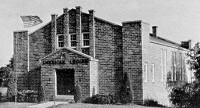
As early as 1933 a home of its own was discussed. In 1937 land was purchased and actual work began on the $15,000.00 structure in August, 1938.
The Legion has sponsored a local boy to Iowa's Boys' State since 1938. Alvan Hansen was the first Boys' Stater sponsored by the post. The Legion has sponsored a bowling teary since 1934.
Continued from page 109Supervised playground for children in the city park was one activity in 1942-43; and a "Teen Nite" in 1945. During World War II the local paper, The Monitor, was sent to 333 men in service. At Christmas time cards and gifts were also sent. The Legion has sponsored cribbage and skat tournaments, and Red Cross swimming lessons. In 1956 more picnic tables were added to the city park plus repair and paint jobs.
The American Legion State Bowling Champions came from this post in 1969. Team members were Alfred Ahrendsen, Merlin Struve, Ralph Hagedorn, Merlin Hargens and Paul Volquartsen.
On March 16, 1969 the Post celebrated their Golden Anniversary with an Open House. On April 26 of that year a supper was given honoring all 50 year members.
In 1978 the American Legion and Auxiliary started a remodeling project on their building with windows being replaced, ceiling lowered, walls paneled and insulated, plus a new heating system and air-conditioning added along with a speaking system.
Several members have held state and county offices in the Legion and the service officer has aided many service man's family whether in an emergency or other times of stress. The Legion's aim is to help keep a free democracy, to aid its service men and their dependent ones, and to always be of service to its community.
List of Commanders 1919 to 1980 were: 1919, Walter Grantz; 1920, E. Sutherland; 1921, L. Davitt; 1922, Jesse Barns; 1923, Charles Petersen; 1924, Wm. Mergle; 1925, Herb Blair; 1926, V. R. Anderson; 1927, A. E. Welliver; 1928, R. Cole; 1929, A. Jacobsen.
1930, Emil Kuhl; 1931, Fred Petersen; 1932, Pete F. Hansen; 1933, J. L. Barnes; 1934, F. J. Mentzer; 1935, Hans Musfeldt; 1936, Tony Mergele; 1937, Dr. R. B. Kelsey; 1938, Hy. J. M. Hansen; 1939, H. E. Meyers; 1940, Dr. A. F. Smith.
1941, Robert Campbell; 1942, W. C. Schrum; 1943, Jay Bingham; 1944, John Schroeder; 1945, Otto Popp; 1946, Pete Kuhl; 1947, Ray Pratt; 1948, Joe Loucks; 1949, Harold Calvert; 1950, Glen Jensen.
1951, Ed Callen; 1952, Amos Rutz; 1953, Elroy Schrum; 1954, Eldis Weems; 1955, Orren Ramsey; 1956, Joe Horbach; 1957, Don Wiese; 1958, Clarus Heithoff; 1959, Norman Kuker; 1960, Lyle J. Joens.
1961, Lyle G. Hansen; 1962. Alvan Hansen; 1963, Amos Misselhorn; 1964, Gilbert Peters; 1965-1966, Herbert Bruhn; 1967, Eugene Case; 1968, Loyd Borkowski; 1969, Eugene Schatz; 1970, Virgil Reid.
1971, Bill Nelson; 1972, Herman Ploen; 1973, John Dentlinger; 1974, Daru Ross; 1975, John Ramsey, Jr.; 1976, Dennis L. Erb; 1977, Lyle Borkowski; 1978, Gary Jones; 1979, Steven Me Collum; and 1980, Ronald Vogl.
AMERICAN LEGION AUXILIARY
On April 29, 1921, 11 women met with Commander Davitt, of the Emil Ewoldt American Legion Post No. 22, to form an auxiliary to the post. Its purpose was to render aid to veterans and their families, to assist the Post in its activities, and to participate in community affairs. The first officers were Mrs. Dan McGrath, president; Mrs. Audrey Claussen, Miss Bonita Kuhl, and Miss May Delaney.
Meetings were held in the room above the theater. A constitution and by-laws were drafted and on April 28, 1922, the Charter was signed by National and State presidents. Sixteen became charter members.
In 1923 the meeting place was moved to the hall over the John Schroeder garage. Poppy Day became the first project in 1922. Proceeds helped to care for all disabled veterans. The project continues to grow each year.
In 1927 the unit spearheaded a drive for a public library. Much dedicated work went into the effort and in 1929, in the old city hall, the library was opened. It was supported and staffed by volunteer members until 1934 when it was taken over by the town council.
The year 1930 saw the first Armistice Day dinner, given for all veterans, and is still the highlight of the year. Another project sponsored by the Unit was a Girl Scout Council.
The new Legion building became its home in 1941. The auxiliary assisted the Post in furnishing it. In 1953 the unit began sponsoring the "Blood Mobile" and is one of its continued activities. Other current activities include a Memorial "Flander's Field" of white crosses, in the local cemetery, each Memorial Day; sending a girl to Hawkeye Girls' State; sewing carpet rags, making scuffies, lap robes, quilts, Christmas gifts and money for State Hospitals. At present there are five Gold Star Mothers and 14 Juniors in the local membership.