MANNING CHAMBER OF COMMERCE
In 1887 Mayor Dewing called a meeting of business men at the Germania Hall for the purpose of organizing a Manning Improvement Club. Its object was to promote prosperity of the town. The first officers were Pres. D.W. Sutherland, Vice Pres. Henry Hoffmann, Sec'y C.D. Dewing. This organization was the forerunner of the present Chamber of Commerce.
In 1921 about 50 businessmen met at the Park Hotel for a chicken supper. Later in the evening a resolution was adopted creating a Chamber of Commerce and provided for the election of nine directors. W.B. Parrott gave an address stating the need for such an organization and all present immediately signed membership cards. The desire of the group was to make Manning a "go-getter" city. After much discussion it was decided to include in the membership farmers and all citizens of the town. They felt that in order to make Manning a prosperous town the organization needed the support of the entire population. The first president was W.B. Parrott and Sec'y, Harry Hoffmann. A contest was held to find a slogan for the town. An award of $10 was presented to Margaret Steinbecker, the winner, with the slogan, "Commercial Hub of the Mid-West". This was used for many years by the Chamber in their advertisements and promotion projects.
The Chamber of Commerce has continued throughout the years to be active and they have done much to help develop retail promotion in the town. Each November they have a membership dinner to make money to carry out their projects for the coming year. They see that the town is decorated for the Christmas holidays, they sponsor Agriculture Appreciation Day, they purchase the 4-H stock champions shown at the County Fair. A committee under the auspices of the Chamber of Commerce plans and conducts the local Children's Day Celebration held yearly. All efforts are made to promote Manning as an active and growing community.
The current officers are Pres. Randy Saunders, Sec'y Gerald Beck. The membership list in 1980 is 92 in number.
THE MANNING GARDEN CLUB
Organization took place at the home of Mrs. Henry Boysen in July, 1933. It became affiliated with the Federated Clubs of Iowa and National Council of State Garden Clubs. Membership was 33.
Objectives were to stimulate knowledge of gardening, protection of native trees, plants, and birds, and to encourage civic planting.
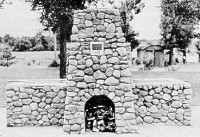
In 1934 a bird bath award was received as second place in a three-year project of state garden contests. This was placed in the city park. Members planted flower beds and a tree each year. A fireplace was dedicated July 8, 1938. A shelter house was completed in 1964.
In 1970 a $65 award was won in a civic beautification project endowed by Sears, Roebuck & Co., and sponsored by Federated of Iowa Garden Clubs. This included landscaping around the Manning Plaza.
Mrs. Cecilia Nickum, accredited national flower show judge, was active in projects. Mrs. Clethus Roberts won a state contest with her conservation slogan, "Conserve Iowa Today For A Better State Tomorrow".
Activities included observation of Arbor Day, pilgrimages to local and nearby gardens, spring tour of wildflower area near Perry, garden walks in Omaha, and sponsoring flower shows. One flower show was combined with a style show, another featured the wedding of Norma Maloy and Milford Wiese, and another featured Mrs. Yamamoto, flower master, as she demonstrated oriental arrangements.
Presidents were Mary Boysen, Edna Wyatt, Clara Claussen, Jennie Miller, Eunice Jensen, Louise Tisdale, Louise Sinn, Edna Halbur, Mildred Waltz, Gertrude Ansorge, Cecelia Nickum, Irene Fitz, Abel Welch, Florence Rix, Hilda Fischer, Alma Pahde, Clethus Roberts, Regilda Stribe, Marcella Knaack, Viola Sievert, Mildred Joens, Edna Peters, Alice Schrum, Minnie Jensen, Grace Andresen, Frances Griffin, LaVon Puck, Sara Dappen and Minnie Dales.
TURNVEREIN
Der Manning Turnverein was organized in November, 1895. Professor Wittekind was the instructor (or Turnmeister). A group of 52 members used parallel bars, trapeze, leather horse, tumbling mats and Indian clubs. They did their work in waltz time and entertained here and in other towns. They also taught folk and ballroom dancing and at times performed jointly with the Omaha Turnverein.
Continued from page 117
MANNING LIEDERKRANZ
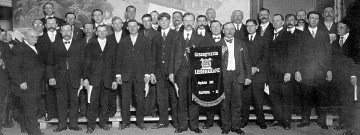
In December, 1891 a group of young men gathered at Reimers and Miller Hardware Store to organize a singing society, "The Manning Liederkranz". Charter members of this organization were H.D. Radeleff, Henry Vogt, H.D. Claussen, Joe Feldman, William Shoop, Henry Schrum, Martin Becker, Julius Brunnier, Gus Franke, J.J. Kruse, Wm. Wunrath, August Reimer, Fred Miller, and Math Jones. The first president was Wm. Shoop.
Purpose of the organization was to cultivate companionship and sociability among its members and families. Once a week singing rehearsals were held. The first director was Louie Greiner. Soon after, Mr. Greiner left Manning and Mr. Harthum from Denison took over and held the position for four years. In 1897, Mr. Lange, father of Mrs. Bert Kraus came and took over as director. After six years he was forced to resign because of ill health. In 1907, D.F. Gifford came to give piano lessons and the Liederkranz engaged him to direct and he took over for six years. The next leader, Mr. Engel, a talented musician, came to this town as a member of a show group. Under his direction a Choral Society was organized. German songs were sung at their concerts. Then came World War 1 and their spirits were dampened so activity rested for several years. After the Armistice was signed Christian Holschen, a noted musician from Germany, came to America. He established a music school and directed the group. After three years he returned to Germany. R. Essbach came to Manning from Germany, and became the next director. He stayed with the group until 1937 when C.M. Johnson took over the leadership of the singing group.
The Manning Liederkranz was a member of the Nordwestlicher Saengerbund of the U.S.A. The local singers attended concerts held in Omaha, Davenport, Chicago and many other cities.
While under the direction of R. Essbach, singers from Carroll and Dedham joined the group and rehearsals were held in all three towns. At the close of the 1937 final concert of the Nordwestliecher Saegerbundfest held in Chicago, a huge banner with swastikas and Heil Hitler was released and that ended the national organization to the horror of most of those present. After a rehearsal in Carroll in 1941, a private party was held in a Carroll restaurant. The shades were pulled and many German songs were sung. Someone reported it to the authorities and the society was asked to disband.
I CAN REMEMBER---
The Manning Liederkranz, of which my dad was a member, entered the competition for singing groups held June 2, 1935, at Convention Hall in Kansas City. The group, under the direction of Reinhard Essbach, was accompanied by the musicians from the Kansas City Philharmonic orchestra and the proud Manning group came home with the big first prize trophy.
-- Art Rix
Continued from page 118
MANNING ROTARY CLUB
Rotary International was formed in 1905 in Chicago. The second charter was given to San Francisco three years later in 1908.
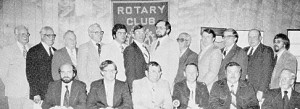
The Manning Club was formed in 1952. Henry Brunnier, a native of Manning and a member of the first club formed in San Francisco in 1908, made a special trip to his home town to present the charter to the local club. Mr. Wm. F. Ohde, a cousin of Mr. Brunnier, and the first president of the local chapter received the emblems and charter. At this time Mr. Brunnier had the honor of serving as Rotary International president and so it was an extra special honor to have him in Manning to present the charter to the local chapter.
Charter members were Wm. F. Ohde, Henry Meyers, J.R. Hansen, Henry Hansen, Paul Vollmer, Lyle Arp, John Hornberger, Charles Bennett, Peter Hansen, Max Detlefson, Alfred Paulsen, Barney Neubaum, Ralph Grundmeier, Ed. Johnson, A.H. Sanders, Ben Jones, L.J. Knudsen, Elmer Mueller, Dick Crandall, Dr. Chandler, Wm. Thetford and Eugene Zerwas.
Throughout the years the club has remained active and at present there are 23 members and dinner meetings are held every Tuesday evening. The club encouraged and sponsored the A.F.S. student exchange program. A memorial shelf in honor of Mr. Brunnier was established in the Manning Public Library and each year the club adds new books to the shelf. Operation Green was a project to replace the elm trees in the community that had been destroyed. During a period of two years 600 trees have been sold and replanted. They are now involved in a paper drive. Each month tons of paper are collected to be recycled. The club has always been very active in helping with all community projects.
I CAN REMEMBER---
That great day for the kids, "Kinderball" is coming up again. This reminds me -- the oldest king and queen to reign in the Five Mile House and the Three Mile House, the same year are living in Manning today. They are Carsten H. Jahn and Hanna Schrum Paysen. We were both 12 years old on that Kinderball date, 74 years ago.
Pete Kuhl, Sr., was in charge of the rifle target contest for the boys and Mrs. William Ruhde was in charge of the girls' contest, hitting the cymbal blindfolded. Hanna never missed, she hit the cymbal with a sharp clang, every time. The couples had to march in pairs. Each child got a sack of treats containing an orange, bag of peanuts, a sandwich and also each received a glass of lemonade. Following the contests, in the afternoon, to see who would be king and queen, the band started to play at four o'clock. The children danced until ten o'clock, then the older folks danced and this ended at two o'clock.
The following year, the king and queen from the previous year were each given a sack of treats by Mrs. Ruhde and were told to walk to the John Frahm farm and stay there until the group came to get us and escort us back. We ate peanuts for a half hour. Then, the band and kids came marching to get us and we all marched back the 40 rods to the Three Mile House. Hanna Paysen lost to Hanna Ruhde that year, but I won again.
The third year, we received our usual treats and were again instructed to walk to the John Frahm farm to be escorted back to the Three Mile House. Hanna Ruhde and I didn't know each other very well so she walked on the north side of the road and I walked on the south side of the road: not a word was spoken, but we made it.
Those were the "good old days". I will never forget them
---Carsten H. Jahn
Written in 1976