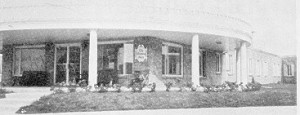
The Manning Plaza opened in 1966.
Services For Senior Citizens
In 1900, the average life expectancy of Americans was 47.3 years; by 1980, it had jumped to 73 years. Compared to the rest of the nation, Iowa is an "old" state. Until 1970, Iowa had been the leader in the number of persons 64 years old or older; only Florida now surpasses Iowa's total.
Manning has always had an abundance of the elderly. Lydia Woolman, who lived with her son Miles in early Manning, had the distinction of being Iowa's oldest woman of the time. She died in 1900 at the age of 104, after having lived in three different centuries and having seen General George Washington.
In earlier times, senior citizens were tended by their children, grandchildren, or in boarding houses. As the nation became more mobile, extended families became fewer; it was clear that new homes must be found for the elderly.
The nursing home idea was not new; when a handful of people began serious discussion in the early 1960's about constructing such a facility locally, they were able to take advantage of this fact. They investigated problems of other nursing homes, and vowed to make Manning's different. Their success is proven by the fact that the Manning Plaza has never had to advertise for its residents. Instead, there is a long waiting list of those wishing to make their home there.
Within ten years, it was apparent that a segment of the elderly was in need of a different kind of housing. These people were too healthy, too young, and too independent to demand the intensive care provided by the nursing home, yet they were unable to care for their own homes, which were often large, old, and badly in need of repairs. Manning did not, and still does not have, an adequate supply of apartments for rent; the goal was made to provide low cost rental units for these senior citizens.
Three apartment buildings, with a total of 54 units, were constructed between 1969 and 1975. These apartments have had nearly 100 percent occupancy since their openings.
Realizing that social needs may be just as important to the elderly as their housing needs, action was taken in the mid-1970's for two additional programs. Nutritious dinners combined with a social gathering have made the Congregate Meals Program a tremendous success, and transportation provided by The Red Bus has been a blessing to those no longer able to drive.
THE MANNING PLAZA
The possibility of a nursing home for the town of Manning was first conceived by the Manning Community Hospital Association.
At a meeting of the association in 1965, the subject was brought for a thorough discussion; a resources committee composed of O.R. Fink, Erwin Hansen and Robert Campbell was appointed to investigate further possibilities of a nursing home and to investigate every facet of its construction and operation. After this report was submitted, the Board decided to build a home and appointed a steering committee composed of William F. Ohde, chairman, Hubert Lamp, H.E. Meyers, Ben D. Joens, and O.R. Fink to be in charge of presenting the plan to the public and to direct local financing.
August 2, 1965, Leo Bruck, chairman of the Manning Community Hospital Association, announced the plans for the construction of a new nursing home. The original plans called for a 48-bed unit to be located at the corner of 4th and Main, but it was finally licensed for a 36-bed home.
The prevailing idea was that homes should be on the outskirts of a town, surrounded by trees, much space and scenery. It was discovered through interviews with residents of existing nursing homes that a more desirable location would be in the midst of town. This would eliminate the dependence upon relatives and friends, a bus schedule or hiring a taxi for those who wish to make an occasional quick purchase at their convenience. This also eliminates a feeling of being an isolated complex by putting the people in a location where "we can watch the action," as one resident so aptly stated.
Construction was started in October, 1965, with an anticipated completion date of March, 1966. The home was designed to meet all requirements
Continued from page 128
necessary for the approval of the Iowa State Department of Health and those of the State Fire Marshal. The A.C. Dohrmann Company of Sioux City were the general contractors. Financing was done by friends, donations by a cooperative public, and through a real estate mortgage loan guaranteed by the debt-free Community Hospital Association.
The name, "The Manning Plaza" was adopted for the new nursing home and on March 9, 1960, a meeting was held to form a Manning Plaza corporation. The following directors were appointed: Leo J. Bruck, Lyle O. Arp, treasurer, Willis Puck, vice-president, Orval R. Fink, president, and Claus Bunz, secretary.
Construction of the building was completed in May, 1966. Fountains in the two grassy courtyards were made possible by a donation of $500 from the Manning Jaycees, of which Gerald Beck was president at that time.
The first open house was held on May 20, 21 and 22. Mrs. Mary Mundt was the first resident and Mrs. Leo Bruhn the first Administrator.
In February, 1967, the Board authorized President Fink to take steps to increase the capacity license from a 36-bed to a 46-bed facility. The application was approved by the state, which brought about the present facility in operation at its capacity today.
The Manning Garden Club played an important part in the landscaping of the nursing home grounds, which occupy a space of nearly one-half of the block between Fourth and Fifth Streets and extends from the portico facing Main Street, back to the east as far as the alley.
The Garden Club contributed the 100 Eutin roses completely surrounding the front portico. They also contributed Pfitzer Junipers, Yews, Locust trees, dwarf burning bushes, and later on, dwarf-winged Euonymus and Welch Junipers for plantings on the south side adjacent to the hospital. For this project the Club received first place in the Sears-Roebuck Civic Beautification contest for the sixth district of the Federated Garden Clubs of America for 1967 and 1968.
The lower level of the Plaza building contains meeting rooms for use by the general public. These rooms are frequently used by civic organizations, committees, social groups and promotions such as the Manning General Hospital annual Health Fair. The rooms were of very great benefit to the Manning Community School District when several classes were held there because of the over-crowded conditions before the new school complex was built at the southeast edge of Manning.
The Plaza employs and average of 36 people and has a total operating budget of approximately $375, 000.
MANNING COMMUNITY APARTMENTS
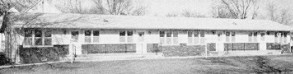
The Community Apartments of Manning is a local corporation established to construct and operate rental housing for elderly residents of low or moderate income.
The first directors and officers were Walter Baker, president; Elmer Mueller, vice-president; John Wieble, secretary; Lyle Hansen, treasurer; and Duane Monson.
The corporation was organized July 6, 1968. Stock was sold at $25.00 a share; a lot was purchased at 417 Sixth Street, and a four-apartment complex was built there. Opening day was Sunday, Nov. 30, 1969.
The project was financed through the F.H.A. Claus Bunz, a local attorney, did all the legal work at no charge. The building is a credit to the community and is proof of what can be done with a little effort and cooperation.
Present officers are Elmer Mueller, president; Duane Monson, secretary; Keith Kelderman, treasurer; Charles Rauch and Randy Saunders, directors.
CONGREGATE MEALS
The first congregate meal was served October 18, 1976, and now more than 60 people attend on an average day. The noon meals are served to anyone 60 years or older, five days a week, at the V.F.W. Hall in Manning. Along with the complete, family-style menu, Senior Citizens are offered a place to meet and socialize and enjoy many planned activities.
Dorothy Kusel was instrumental in starting the
Continued from 129
Congregate Meals program in Manning. It is subcontracted by the Low-Rent Housing Agency.
Site managers are Mrs. Bertha Ruhde and Mrs. Norma Bjorkgren. Cooks, past and present, have been Mrs. Ola Ress, Mrs. Christine Mohr, Mrs. Nadine Heinicke, Mrs. Elda Barten, Mrs. Elsie Frahm, Mrs. Ruth Schroeder, Mrs. Dorothea Musfeldt, Mrs. Malinda Grage, Mrs. Gladys Mahnke and Mrs. Amanda Martens.
Volunteers are an important part of the program. Many of them are Senior Citizens, who put in countless hours to make the program highly successful.
TERRACE APARTMENTS
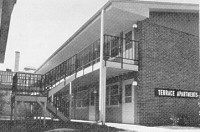
Construction of the 30 unit Terrace Apartments began in July, 1970; open house was held July 25, 1971, and by the end of August, 1971, the apartments were fully occupied.
The Terrace is located one block east of Main Street, fronting Center Street.
The $500,000 project was federally financed, with a loan repayment of many years. At the end of the loan period, the project will belong to the City of Manning. Technically known as an IA 21-1 project, it is intended as conventional housing for the low income elderly.
The apartments are operated by a city agency known as the Low-Rent Housing Agency of Manning. The five commissioners are appointed by the mayor and city council. Serving on the first board were Orval Fink, Warren Puck, Walter D. Felker, LaVerne Olsen and Robert Campbell. Erwin Hansen was the Director during construction.
Current commissioners are Felker, William G. Ohde, Charles Hughes, Art Rix and Daryl Genzen. Others who have served throughout the years were Edwin Johnson, John Falck and Leland Rauch.
Mrs. Dorothy Kusel was hired as Executive Director in April, 1971; she now serves as the director and secretary. Hugo Ress has served as Maintenance Director during most of the years since the building was occupied.
Of the 30 units, 18 are one bedroom efficiency units which may be occupied by only one person. The remaining 12 are one bedroom apartments where couples (or singles) may live. Each apartment at the Terrace includes a carpeted living room and one carpeted bedroom, a tiled bathroom with shower, and a kitchen.
The building includes a large meeting room for social activities.
ELM CREST APARTMENTS
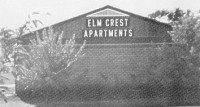
The Low-Rent Housing Agency of Manning also manages the Elm Crest Apartments, a 20-unit building located in south Manning on 12th Street. Mrs. Dorothy Kusel serves as the Executive Director.
Construction began in July, 1975; open house was held October 26, 1975, and occupancy began in November of that year. The apartments were named by Mrs. Ruby Schrum, one of the first occupants, in a contest held to select the name.
Owned by Puck Implement Co., the apartments fall under the IA 21-1, section 23 classification, and are designed for the low income elderly and the handicapped. Two of the 20 units are especially designed for handicapped persons with added features to allow for easy movement of wheelchairs.
Each apartment includes a carpeted living room and one bedroom, a tiled bathroom with shower and tub, kitchen, and dining area. The apartments are planned for either one or two occupants.
The apartments are designed for safe, sanitary, and clean living, with laundry facilities and extra space for entertaining in the Community Building. All utilities are paid, except telephone. Refrigerators, stoves, carpets, garbage disposals, drapes, mail boxes, and emergency lights and switches are furnished.
Fun-related activities enjoyed by the tenants
Continued from page 130
include potlucks, sing-a-longs, cook-outs, bingo and card games, birthday parties, weekly meetings, a rhythm band, and so on. They enjoy a garden and many beautiful flowers in front of their apartments.
THE RED BUS
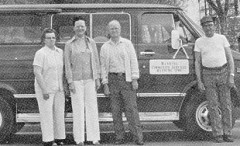
Bus services for Manning's elderly became a reality in July, 1979, when a red van known as "The Red Bus" was purchased by the Manning Community Services, Inc. The bus was dedicated by Congressman Tom Harkin August 4, 1979.
The bus transports senior citizens to the congregate meals program at noon five days a week, and is also available for their other personal needs such as doctor and dentist appointments, shopping, recreational and educational trips. Homebound meals are also delivered by the bus drivers to shut-ins.
Henry Koester is the bus driver, and he is assisted by Clinton Moore and Ralph Grundmeier.
Members of the Manning Community Service corporation are Dorothy Kusel, Wm. G. Ohde, Art Rix, Bertha Ruhde, and Ralph Grundmeier.
SENIOR CENTER
June 19, 1980, the Iowa Commission on Aging awarded $60,000 to the Manning Community Services, Inc., for the construction of a multipurpose Senior Center.
The Center, to be located on the "old" school grounds just north of the municipal light plant, should be in operation by January of 1981. Plans call for the building's dedication Saturday, June 20, 1981, during Manning's Centennial celebration.
The primary objective of the Center is to provide a modern, energy efficient, pleasant facility for the Senior Citizens of Manning, and for those from the surrounding towns of Aspinwall, Gray, Botna, Templeton, Halbur and Arcadia. All Senior Citizens living near or visiting here will be welcome.
The Center will have adequate kitchen equipment and dining space for the Congregate Meals Program, Monday through Friday. It will also serve as a depot for the M.C.S., Inc., Red Bus.
The building will be open to Senior Citizens from 9 a.m. to 5 p.m. Monday through Friday for recreation and/or study, and will serve as a rest area for elderly shoppers. A lounge area is planned for relaxing and reading, as well as a space for arts and crafts and for dancing. A shuffle board court will be incorporated into the floor tile.
The building will be available for Senior Citizen activities during evenings and weekends upon request and reservation.
The Center will also serve as a referral center for many agencies of the city, county, state and federal departments which provide services relative to better living for the elderly. It will be a focal point with programs in pleasant surroundings for older residents who befit and denote their contribution over many years to the growth and success of the society in which they live. M.C.S., Inc., hopes to fill their basic needs without restricting the activities or independence of these wonderful citizens who have chosen for their theme in 1980 :"Aging is a Work of Art."
The response to this project has been overwhelming. The equipment for the building will be purchased through funds from private donations, fund raising projects, a grant from the Carroll County Board of Supervisors, service club donations, and through donations by the Manning Senior Citizens. Tremendous cooperation was received from the Manning Community School and the City of Manning.
M.C.S., Inc., board members are Dorothy Kusel, president; William G. Ohde, vice-president; Art Rix, secretary; Ralph Grundmeier, treasurer; and Bertha Ruhde, assistant secretary-treasurer.
WE CAN REMEMBER---
On July 4, 1925, Glen Brandhorst, son of Marshal Wm. Brandhorst, had attended the 4th of July celebration at the Great Western Park at the west edge of town and was returning to his home in Manning. As he approached the railroad crossing from the west in his Ford "Runabout" he was unaware of the approaching Great Western passenger train. The car was struck squarely broadside and the wreckage carried 320 yards up the track with Glen grimly hanging on to the sloping "cow catcher" at the front of the engine. He was taken to the Wyatt hospital and released when only a few minor scratches and bruises could be found. Glen graduated from Manning high school with the class of 1926 and went on to graduate from the University of Iowa.
Glen and wife, Lydia, a son David, a brother, Ray, and a sister, Margaret (Mrs. Lee Tipton), all reside in Denver, Colorado.