1883
An independent school district was organized. It was 2 1/2 miles east to west, and 2 miles
north to south, including all of sections 17, 18, 19, 20 and half of 16 and 21. It was noted
that some public schools in Carroll County were teaching religion, which was against the
law.
1884
The yearly budget was $3,584.04.
1887
Pupils who had not whispered for one month were recognized. A county teachers' meeting was held in Manning and a county teachers' organization was formed.
1888
There were 248 enrolled in school at the beginning of November.
1889
In the February school report; the death of a student was noted. Graduation was held at the Methodist Church. One of the orations given at graduation was "The Old and New Ideas of Women's Education", which stated that women can be found in almost all professions. A new well was completed. Tuition for September and October amounted to $43.90.
1891
All classes had supplementary reading material with 268 enrolled on January 30, 1891. Woman's Christian Temperance Union was mentioned as doing a "grand work" in the kindergarten department. An alumni association was formed and graduation was held at the German Hall.
1892
High school students had a roll call and answered with such things as Shakespeare and Tennyson quotations. In February an article in the newspaper offered a Pitman shorthand class by correspondence; the cost was $12 for 12 lessons. A high wind blew off the chimney on the west wing of the building. There were 21 nonresident pupils enrolled. A state tree and flower were voted on and the results were sent to the State Superintendent; students statewide selected the oak and rose. Admission of 10 cents was charged for graduation and the proceeds went to the library.
 The brick building many of us remember as the old grade school building replaced this wooden
building in 1907 at the same location between First and Second Street on Sue.
The brick building many of us remember as the old grade school building replaced this wooden
building in 1907 at the same location between First and Second Street on Sue.
1893
The library contained 100 volumes. Primary pupils had their fingers frostbitten during the winter. There were 296 students enrolled and on March 1, 1893, the district was overdrawn $25.55. The Alumni Association gave a program June 2 in the German Hall; there were 65 members, 26 men and 39 women. The teachers visited Council Bluffs schools while Manning students attended the fair. Grades were mentioned instead of primary, intermediate, etc. The school was represented at the Iowa State Teachers' Association meeting in Des Moines.
1894
There were new mirrors in the cloak room and towels and combs were provided for the students. The school ground had 79 maple trees and five ash trees. There were 152 books in library.
1896
A large program was held for Washington's birthday and all grades participated. Mothers were "earnestly requested not to bring their babies to Commencement".
1897
Teachers were elected for a term of three months, and their salaries were determined at the time of their election. A petition for free text books was presented but it was found that of 314 legal voters, only 99 had signed and the petition was tabled because it did not contain one-third of the voters; it should have contained 105.
1898
May 3, 1898, a $3,000 bond was approved for an addition to the building; it carried 52-49. Hugo Grundmeier received the contract for $2,193 for the building. The year's heating bill was $1,000. School was suspended at noon September 15 for the Peace Jubilee.
1899
Admission for Commencement was 10 cents, with reserved seats 15 cents. An organ was purchased.
1900
German and Latin were taught in the school. A $15 limit was allowed for graduation expenses, and admission prices were raised to 15c and 20c with proceeds going to the library fund. Salaries were $40 to $45 per month. During the summer the outhouses were to be repaired. There was no school October 3 because of German Day. The local football team played Harlan at a pasture just west of town. With six minutes left to play, ball carrier Gordon Sutherland was tackled and he dislocated an elbow. The game was then declared off and Sutherland was taken to Dr. Williams' office.
1901
The principal got $90 per month. School was dismissed for the funeral of President McKinley, who was assassinated, and students were required to attend memorial services. The Board approved the purchase of locks for the outhouses.
Continued from page 35
 The brick building many of us remember as the old grade school building replaced this wooden
building in 1907 at the same location between First and Second Street on Sue.
The brick building many of us remember as the old grade school building replaced this wooden
building in 1907 at the same location between First and Second Street on Sue.
1902
The principal's salary was- now $100 per month. Drawing, music and penmanship were
added and a teacher was hired; the Board furnished the paper free. A librarian was added,
and a truant officer was hired for $1 per month.
1903
The seventh and eighth grades were separated. The School House Committee was
authorized to spend $299 for a second primary building. An organ was purchased for $16,
for the eighth grade. A telephone was placed in the schoolhouse.
1904
New sidewalks were added north of the building. All graduates had to pass a county exam.
1905
Purchase of a typewriter was considered, but no action was taken. Correspondence was exchanged with the "Iowa Institute for Feeble Minded Children" at Glenwood pertaining to three "feeble minded" children.
1907
A petition was submitted for bonds amounting to $24,000 for erection and furnishing of a building. At the March 11 bond election, which sought 10 mills on the dollar, it was shown that "More than 213 of the male vote cast were cast in favor; that more than 213 of the female vote were in favor." (The Iowa Legislature passed a bill shortly before this time allowing women to vote on bond issues for school buildings.) The two-story building with basement would cost $32,000, was to be erected at the site of the old building (between First and Second on Sue), and would be composed of brick and stone, with steam heat, electric lights, and plumbing.
In November, school was closed for one week, "on account of the prevalence of contagious disease." In December there were 354 enrolled, the high school having 77.
1908
The new building and heating plant were accepted in January. The graduates performed a play instead of writing an essay. A Commencement speaker was hired for $25. The boys could go out for football at their own expense and time.
1909
Boys were ordered to stop throwing snowballs at the little children. The school was allowed to give a musical entertainment. 200 rolls of toilet paper were purchased in April. School was dismissed at noon one day because a circus was in town.
1910
The frequent absences of teachers was noted due to "undo exposure and too frequent indulgences in social amusements." Salary was to be reduced one-half for times absent. It was unlawful to walk or drive on the school grounds. There were 455 children between the ages of 5 and 21 in the district, but the average attendance was 303.3. The library had grown to 1,525 volumes. A student was suspended for the axing of another student.
1911
Manual training and domestic science were added for girls in grades 5, 6, 7 and 8. Children through grade 8 were allowed to have a 15-minute recess morning and afternoon. Four years of German or Latin were required. Thirty credits were needed for graduation, 17 in required subjects: 4 for foreign language, 6 in English, 2 in history, 3 in algebra, and 2 in plane geometry.
1912
A sewing machine was rented for 3 weeks for grades 7 and 8. The graduating class wore caps and gowns for the first time.
 Members of the graduating class of 1912 were: front row, Erma Schoening, Lola Moerke,
Margaret Heinrichs, Wm. Reinhold, Thomas Tarpy; back row: Clara Grau, Peter F. Hansen,
Orma Long, Robert Schoening.
Members of the graduating class of 1912 were: front row, Erma Schoening, Lola Moerke,
Margaret Heinrichs, Wm. Reinhold, Thomas Tarpy; back row: Clara Grau, Peter F. Hansen,
Orma Long, Robert Schoening.
Continued from 36
1913
Application was made for a high school Normal Training course. Domestic science equipment was installed.
1914
Grade teachers had to take and pass a correspondence course known as tree Palmer Course in Handwriting. Any child who was six in September was admitted to school.
1915
The board allowed $10 for graduation expenses, such as decorations, but would not purchase any pins, rings, etc., for graduation. The vote to purchase a motion picture machine did not pass. High school students purchased their own books, while free books in the grades were furnished for the first time.
1917
An election to build a $35,000 high school building was favorable, with 296 males and 208 females voting. Bonds were sold to the First National Bank, and the architect was hired for 1 1/2 percent of the cost of the building. Hannas Hass received the general contract for $23,510, and Thomas Rinehart received the plumbing, heating and venting contract. No more than $10,000 was to be spent to complete and equip the building; $7,000 was needed.
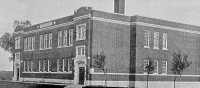 Facilities for a seperate high school building were realized in 1917 with the erection of this
new building on 6th Street between Main and Center.
Facilities for a seperate high school building were realized in 1917 with the erection of this
new building on 6th Street between Main and Center.
1918
Because of overcrowding, no new kindergarten students were allowed at the beginning of the new semester. It was noted that an Interphone system for the new building had been omitted from the general contract. High school boys who wished to engage in agriculture employment were granted a 6-week leave of absence with full credit as long as they had steady employment, their school work was up to requirement, and seniors were able to complete exams. School was closed because of scarlet fever and the Board recommended that parents have their children vaccinated against the disease. A public speaking and physical training teacher was hired. Springs were purchased for the toilet and shower doors.
1919
High school girls would receive $2 for substituting for teachers out over 2 days. This amount was taken from the teacher's salary
1920
The graduating class of 1920 was the first class to enter the new brick grade school in 1908, and the sophomore class which first used the high school building in 1917.
 The 1921 girls basketball team.
1921
The girls' basketball team included Enid Hayes Barsby, Golda Moore Sanders, Ruth Kenyon Peters, Sylvia Moore Lawrence, Elizabeth Sinn, Erma Hayes Wiese, Miss Lukin, Grace Baley Wells, and Leona Schuman Heider.
1922
In March a basketball banquet was held to honor both boys' and girls' teams. This was sponsored by the "P.K.'s" or Purple Kows.
1923
Fire escapes were purchased. A balcony was constructed on the south side of the gym, and seats were placed on the stage and in the aisles.
1924
Six Underwood typewriters were purchased for $70. Children had to be five by December 1 to enter school. The first orchestra was formed by Helen Spurrior Wiese.
1925
A new roof was put on the grade building at a cost of $700. Post graduate students had to deposit $25 when entering school, with $15 refunded on completion of work.
1926
School was dismissed for a basketball tournament in Carroll. Workman's Compensation covered all employees of the district.
1927
The district would pay no more than $300 for the salary and expense of a school nurse.
1928
Permission was granted to start a library, the cost to be no more than $200.
1931
Herman Pfoltner was granted permission to operate a motor vehicle to transport pupils to school.
1932
The Board accepted Dr. O.W. Wyatt's offer to furnish first aid to players during the football and basketball season.
Continued from page 37
1933
Manual training and domestic science were eliminated. A string bass, cello, viola and French horn were purchased for $142. Substitutes were paid $3.50 per day. Manilla severed all athletic relations with Manning High School.
1934
A petition was presented asking for $4,800 to construct and equip an addition to the high school, but the bond election failed. A contract was signed for lights for the athletic field.
1935
Lockers were constructed for children bringing lunch to school. Home economics and manual training were added, with home economics to receive aid from the Federal Government. An application was filed with the Public Works Administration to aid in financing the construction and equiping of an addition to;-and the remodeling of the present high school. The first Comet yearbook was published by the Senior Class, with Helen McGrath Pratt as Editor-in-Chief.
1936
A bond was passed for $20,000 for an addition to the high school, and money was
received from the Federal Government to help finance the addition. The bonds were sold
to the Iowa-Des Moines National Bank and Trust of Des Moines for $20,000 at 2 1/2 percent. Phones were installed in both school buildings.
1938
Land was purchased for $600 for a playground.
1939
For the second time a yearbook was published by the Senior Class. Miss Marie Perkins was the advisor, and the book was printed by the Monitor and was assembled in the basement by members of the class.
1940
Dr. Masters was to furnish first aid for football and basketball at a salary of $40.
1941
An $800 revolving fund was set aside for a defense training program.
1942
Diplomas cost $60.31.
1943
During the war years, Miss Marie Perkins, Principal, had a "B" book of gas coupons and took basketball players to out-of-town games, "following the tail light of Bill Steneker's car over miles of western Iowa."
1944
Manning and Manilla shared an agriculture teacher.
1945
School was dismissed November 11 for Armistice Day. On that day, the last football game of the season, undefeated Manning was to play Manilla. Louis Muhlbauer's father wanted him to stay at home to pick corn. Superintendent Koch went to the farm and volunteered to take his place; Koch picked eight loads with a team of horses, while Muhlbauer helped lead Manning to a 48-6 victory.
1946
The board purchased a Ford school bus from F.D. Ross and Co. and an International bus from Knudsen Implement Co. The Manning District would transport all tuition pupils, both high school and elementary, to Manning from rural schools in the territory. Two bus drivers and two substitutes were hired.
1947
A bus was purchased for $3,618.26. Parents paid $30 per year for transportation.
1948
This was the never-to-be-forgotten year that Manning won the state basketball championship by defeating the Davenport Blue Devils 43-36; the state had only one class for championship play. The season ended with 31 wins and 2 defeats.
1949
A new bus cost $4,271. Hot Lunch was first mentioned with a motion to purchase a dryer for the kitchen. A secretary was hired to assist the superintendent with clerical work.
1950
The office of Treasurer was first mentioned. This was the first mention of a drivers' training course, and it was to continue to operate. The driver training car also picked up children unable to be reached conveniently by bus. A $194,000 bond issue to build an addition to the high school was defeated.
1951
The school eliminated picking up town students except for those in South Manning; charges were $5 for the first student in a family per semester and $1 for each additional student in the family. Basketball season tickets sold for $4.50 with reserved seats for $7.50. The basketball team was the first team to remain undefeated for the entire season.
1952
Those teachers in country schools who lived in town could ride buses to their school by paying the same rate as pupils. The basketball team again remained undefeated.
1953
Principal Marie Perkins resigned after being in Manning 22 years.
1954
Mrs. Rita Swander was the first woman elected to the school board.
1955
The Ar-We-Va school district proposed a new district with Manning. Salary negotiations were first mentioned.
1957
The basketball team, rated No. 1 in Southwest Iowa, lost during the first game in the State Tournament. A man listening to the game on the radio bit a cigarette in half despite the fact that he had no dentures. The track team was 6th in the State.
Continued from page 38
1958
A TB test was required of all personnel. The basketball team again lost in the first round at State.
1959
From 1954 until 1959, disputes were handled over the proposed new boundary lines for the school district. By 1959, the district had been reorganized and now included parts of Carroll, Crawford, Shelby and Audubon Counties. The Fire Hall was rented for junior high students. Exceptional children went by car to a special county school. Rural school sites were sold to adjoining land owners for $100 per site.
1960
A foreign language was offered. Board elections were held in September instead of March. There was a proposal to buy land for a new building. A guidance director was added to the staff.
1961
Bonds of $710,000 for the construction, furnishing, and site of a new school were passed. Of the 1299 votes cast, 1026 were for the new elementary-junior high school. A board policy stated: "If a female student becomes pregnant regardless of whether she is married or single, she must drop out of school. Also, a female employee shall not begin a new semester of school after becoming pregnant." A health insurance policy was set up, and the mandatory retirement age of 65 was set for employees.
1962
The kindergarteners began going to school the entire day, every other day, instead of one-half day, every day. A full-time bus driver-mechanic was hired. New band uniforms were purchased to replace those bought in 1948.
1964
The new building was accepted February 1, 1964. Ninth graders were then considered a part of the junior high and moved into the new building which was dedicated October 11.
1965
Vocational Agriculture was dropped and an art teacher for grades K-12 was added. The low bid for gasoline was 19.9 cents per gallon. The track team won the conference championship for the second time in Manning's history.
1966
Tenth Street became a public street instead of the school drive.
1967
A mobile classroom was rented. A 2-way communication between school and a student's home was set up for the student, who was recuperating from surgery. Michael Edgerton attended the Senate Youth Program. The Student Council erected a sign board at the high school.
1968
Economics and Sociology were added to the curriculum. The Pep Club purchased red blazers which were worn with black skirts.
1969
New choir robes were purchased. Alvin Musfeldt was presented with a plaque for 30 years of service as basketball timekeeper. The band, choir, boys' and girls' glee all received I ratings at contest, and the track team won the conference title.
1970
A room in the Manning Plaza basement was used as a classroom. Monday, September 14, high school students were surprised by a general announcement stating there would not be school the next day, due to the fact that structural faults had been found in the building. During following days, engineers studied the cracks in the western half of the building,
and many preparations were made before classes resumed September 21. Three
classrooms, two offices and part of the assembly were lost in the reorganization of the
building. Three classes, the guidance office, and the study hall were relocated in the
basement of the Fire Hall, thus forming the "western campus" of Manning High. The
library was moved during Christmas vacation and a classroom was moved back to the
library space. "Many hours of hard work were put in, not only by faculty members, but by
students, who, believe it or not, got sick of having nothing to do on their four day
vacation," the 1971 yearbook read. "Plans already under way for an election for a new
high school were speeded up. Come late evening December 23, Santa left future M.H.S.
students a wonderful present when the voters voted by better than 71 percent to build a
new high school."
The student council contributed $500 to a fund to add new bleachers to the football field. The Pep Club had 101 members, all in red blazers. The football team won its first undisputed conference championship since 1950. Armin Torrico from Bolivia, a foreign student not connected with the AFS, lived with the Charles Brotherton family.
1971
Yashitaka Kawashima, a Japanese English teacher from Hiroshima, spent September visiting the school and stayed with the Clifford Johnson's. Mary Chavorria of Bolivia, who was not an AFS student, stayed with the Jerome Kasperbauer's. Abram Kirszenwurcel, an International Fellowship Student from Brazil, spent about three months with the James Mork's.
A I rating was received in Play Reading at State. The track team won the Coon Valley Conference, the District, and placed third at state. A girls' athletic program was initiated, which included basketball, golf, softball, volleyball and track. Classes were held in four places, the new elementary building, old high school, Fire Hall and Plaza basement.
1972
A work release program was approved for several students, allowing them to leave school for outside employment during the last class periods.
 The present Manning Community School District physical plant. The elementary wing on the
right was dedicated in 1964 and the remainder of the building was completed 9 years later.
The present Manning Community School District physical plant. The elementary wing on the
right was dedicated in 1964 and the remainder of the building was completed 9 years later.
Continued from page 39
The football team won the Coon Valley Conference. Randy Lohmeier tallied 38 points to break the school record for points scored in one basketball game, and the school record of most points scored in a game, 113, was set. The track team lost first place by 1 point-at the State Indoor meet and missed a first place at the State Outdoor by 2 points. The swim team, which was a cooperative effort by school and town, won the conference title for the fourth straight year.
1973
Baccalaureate was discontinued, and the senior class trip was eliminated. The Board voted to bus all town students to the new building. Because of the energy crisis, certain activities were curtailed; the auditorium was not used as a study hall and night use of the building by non-school groups was limited. The student councils of 1971-'74 purchased a new scoreboard for the new gym. Money was raised for new band uniforms. The school joined the Midwest Conference, and the basketball team won the conference title. The new school was dedicated and an open house was held in October.
1974
The school day was reduced by 30 minutes in winter because of daylight saving time. Charles H. Brotherton retired after 17 years at Manning, 10 years as principal. The football team, which won the conference and earned Coach Larry R. Miller the honor of "Coach of the Year" for Southwest Iowa, played Mount Vernon at Manning in State Playoffs. Vocational agriculture was reinstated.
1975
The Jaycees were granted permission to use the gym at the old high school for basketball at a nominal rental fee. The girls' bowling team went to the State Tournament, the boys' medley relay went to the State Track Meet, and the choir got a I at contest. For the third year in a row, a Manning player participated in the Shrine Football Game. Lynn Mork went in 1975, Keith Stribe in 1974, and Kevin Pfannkuch in 1973.
1976
Seniors were allowed to graduate at mid-year if they had enough credits. There was a girls' basketball team for the first time since 1926. Two track boys and two girls' bowling teams went to state. Doris Runge of Germany stayed with relatives, the Harold Beck's, and attended school at Manning. Senior students could attend a new trade school in Carroll, with classes offered in auto mechanics and construction.
1977
The school paper was printed on the school's new offset press instead of at the Manning Monitor. The status of the special education class was changed from elementary to secondary. The Board entered into a contract for an evaluation program of board members, administration, and faculty. The girls' volleyball team went to State, and the boys' golf team placed fifth at State.
1978
The old gym was used as a Community Recreation Center. Michael Linell was a Youth for Understanding student from Sweden. The boys' golf team won second place at State, and the girls' bowling team was State Runner-up. The Student Council began awarding a $200 scholarship.
1979
A student lounge was organized. The volleyball team went to State, the girls' track team sent the shot putter to state, and the boys' two-mile relay team went to State. Community volunteers helped prepare a track at the athletic field west of the school complex.
1980
The baseball team won the conference title for the first time since 1953. Kim Pfannkuch, in her second year of state competition, placed second in shot put, and the boys' 2-miler, Brian Joens, went to State.