WAR YEARS
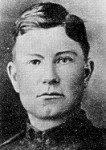
"The War" in Europe was in progress for three years before the United States joined Great Britain, France, Russia and Italy in the fight against the 28 Allied Powers. The U.S. declared war against Germany April 6, 1917, and by June, over 175,000 American troops were in France for training.
"Twas a gala day in Manning April 20, 1917, when ten young men left our town to enlist in the service of their country in the World War," reported the Manning Monitor. "Patriotism ran high and the men were escorted to the depot by the band and an enthusiastic crowd of fellow townsmen carrying flags. They left amidst the cheers and tears of the people."
The youngest of these men, 17 year old Albert Dethlefs, did not return.
The "patriotism" noted by newspaper editor Peter Rix, a German himself, was not always apparent in our community. Ill feeling developed between those recently arriving from Germany and those who had lived in Manning a number of years. The irony was that most of those who called themselves Americans had strong German ties, and that many of the newcomers had left Germany to flee military service.
Until the outbreak of the war, German was spoken in many of the homes, classrooms, and churches in this area. In May, 1918, the Iowa legislature passed a law that no foreign language could be used in public gatherings. Students and church goers were suddenly forced to learn English, while returning to homes where nothing but German was used.
It was also at this time that Rix and Werner, publishers of the German newspaper Der Manning Herold, bought the Manning Monitor, combined the two plants, and discontinued the German paper.
The "newcomers" were watched closely by the "old-timers". Threats were made, and at one point, it was rumored that Manning's German Savings Bank was to be painted yellow. The bank directors held a hasty meeting and changed the name to the Iowa State Savings Bank.
It has been said that the animosity quieted following a war bond drive, in which the newcomers proved themselves by raising more money for the war effort than their fellow townsmen. Others feel the tensions calmed as the people continued working together and quietly proved their loyalty. Or it may have been the fact that grief tends to bind people together
When the United States entered the war, there was no draft, and most of the first going to war were enlistees. But May 18, 1917, Congress passed a selective service act, and within days all men between the ages of 21 and 31 had to register. Mr. and Mrs. Hans Claussen, both German immigrants had a 4-star flag in their window signifying that four of their sons, Harry, Herman, William and Herbert were serving in the American Expeditionary Forces.
The Monitor began a weekly notice of names of Manning men who had left for the war, and as the list grew, more and more families were bound together in their vigil. The effects of the draft were felt in many homes; in one call alone, 98 men from Carroll County - nearly half with Manning addresses - were put into uniform.
Before the peace agreements were signed in July, 1921, the "War to End War" had taken the lives of 3,578 young Iowa men. At least seven were from the Manning area.
EMIL EWOLDT
Emil Ewoldt son of William and Margaret Ewoldt, was born July 14, 1888, at Aspinwall. He attended the country school near his home.
Ewoldt enlisted in the Army September 17, 1917, at Denison. He was sent to Camp
Dodge, and in May, 1918, left for Brest, France, with the 47th infantry.
Private first class Ewoldt
died of shrapnel wounds in October, 1918, during the Battle of Argonne Forest. His body
was first buried in France, but was returned in July, 1921, for burial in the Manning
Cemetery.
Manning's American Legion post was named in Ewoldt's honor.
ALBERT DETHLEFS

Albert Dethlefs, son of August and Sophia Dethlefs, was born May 5, 1899. He worked in the clothing department of the RoberWehrmann Store until enlisting in the Army April 17, He left for France November 30, 1917, and was a first class gunner. He spent several months in the St. Mihiel sector before becoming ill and was sent to the base hospital at Toul, France
Albert died of pneumonia September 14, 1918.
His sister Lillian Mohr resides in Manning.
WILLIAM WULF
William Wulf was born in 1888 in Minden, Iowa, and his family later moved to the Manning area- Wulf was inducted into the Army April 29, 1918, and served with Company K-60 Infantry.. He was in France from September, 1918, until March, 1919, seeing action on the Verdun front.
Wulf returned to the States, and died February 18, 1922, at the Fitzsimmons Hospital in Denver. He was buried in the Manning Cemetery February 24, 1922.
FRED PASSICK
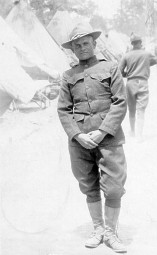
Fred Passick, son of Otto and Sophia Schmall Passick, was born May 19, 1892. He had seven brothers and sisters, Mrs. John Peterson, Detlef, Mrs. Charles Schuman, Henry, August, Mrs. Otto Hagedorn, and Mrs. Henry Arp. The family moved to Manning in 1910.
Fred was drafted in the Army February 25, 1918.
After training at Camp Dodge, he embarked from France May 15, 1918. His company landed at Brest; after taking a 10 day rest, they marched to within 20 miles of the front.
Private Passick became ill with diphtheria July 1, and was taken to the hospital at Vichy, France. He returned to the front, and died August 2, 1918 of wounds received in action. His body was returned to Manning in June, 1921, with services held at the Lutheran Church.
LOUIE ROWEDDER

Louie Rowedder, son of Mr. and Mrs. William Rowedder, was born February 17, 1896, in Hayes Township, Crawford County, seven miles northwest of Manning. He attended school at Hayes No. 7 one mile from his home.
After his father's death, he moved to Manning with his mother. He worked as a farm hand in the vicinity before being drafted into the service of his country.
Pvt. Rowedder died as an infantryman with the American Expeditionary Forces October 21, 1918, while serving in France.
ARTHUR STANG

Arthur Stang was born September 20, 1894, near Halbur. He had eight brothers and sisters, William, Margaret, Florence, Carrie, Mary, Ella, Lillian, and Lydia.
Arthur entered the service August 13, 1918, and received his training at Camp Forest, Georgia. He sailed for France September 29, 1918, with Company 468 Engineers Service.
Stang died October 21, 1918, a victim of the terrible epidemic of influenza which was sweeping the continent at the time.
His parents, Mr. and Mrs. William (Adam) Stang, moved to Manning shortly after his death. Arthur's body was the first from this area returned from overseas, and services were held January 14, 1921, at the Lutheran Church. He is buried in the Manning Cemetery.
One sister, Mrs. Emil (Margaret) Kuhn, Manning, survives.
BERNHARDT H. STUHR

Bernhardt Stuhr was born February 19, 1895, at Minden. At the age of eight, he moved with his parents, C.H. and Emma Juels Stuhr, to Manning. Here, he attended country school and two years of high school.
Bernhardt enjoyed sports, and helped his father farm before entering the service in early September, 1918.
He was in Company 46, 12th Batallion, 163 Depot Brigade.
Corporal Stuhr died of the flu at Camp Dodge, Iowa, October 8, 1918. He was not the first Manning man to die in World War I, but was the first to be returned for burial in the Manning Cemetery. Services were held in the old Opera House, and Mayor Ed Farrell issued a proclamation asking that all public businesses be closed during the day.
An adopted sister, Mrs. Mildred Lyden, lives in Manning.
JULIUS VINKE

Julius Vinke, son of Henry and Lena Vinke of Manning, was born March 22, 1890 in Crawford County. His brothers were Henry, Gustav, John and Detlef, and sisters were Dora Grimm, Amelia Martens, Laura Welsh and Julia Thiedeman.
The family moved to Manning in 1907. Julius worked on the farm two years before coming to Manning, too.
After being called in the Army, July 26, 1918, Julius became ill with the measles and mumps. He boarded a ship for Europe September 19, 1918; about half way across the Atlantic Ocean, he died; this was October 1, 1918. He was transferred to another ship and sent home for burial in the Manning Cemetery.
Nieces and nephews living at Manning are Edwin Grimm, Ernest Grimm, Dorothy Grimm Mohr, Deloris Grimm Balukoff, Lena Vinke Schwieso, Henry Vinke, Delbert Vinke, Vernetta Thiedeman Dau, and Leola Thiedeman Kuhl.