Entertainment
Manning's founding fathers (and mothers) gave us two rich traditions: an ability to work hard and an ability to have fun.
In early fall, 1881, as the first businesses and homes were being built on the former fields, the workers decided to leave their tools to hold a dance. Fred Gerstenberg volunteered to give the party in his frame building at 309 Main Street. Gus Jans had the honor of being sent to the Five Mile House, nine miles to the northwest, to haul in the band to furnish music.
"The crowd was just terrible," Jans recalled 50 years later. "There were six ladies and from 500 to 600 railroaders, but we had the dance and finished it about daylight the next morning. Everybody had a good time; as the ladies were rather scarce, many men had to be satisfied to dance with each other."
A few weeks later, amore formal event was held: a Thanksgiving hop termed Manning's first social gathering. Supper was served at the Garfield House, with 75 people attending.
The first theatrical performance was February 10, 1882, featuring home talent. Cast members were H. Foote, H.N. Morsch, W.A. Hinzman, E.B. Wilson, Paul Winter, Miss Hunter, Mrs. Winter, and Miss E. Perry.
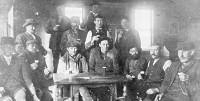
Within a year, Manning's social calendar began to fill with events hosted by numerous German clubs, or "vereins". Athletes had their Turn Verein, marksmen had the Schuetzen Verein, singers had the Liederkranz, former military men had the Kreiger Verein, and a special singing group was the "Manning Harfonia Frauen Chor von der Liederkranz Gesung Verein".
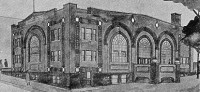
There was the "Kinderfest" for the children; the Schuetzen Park, Three Mile House, and Five Mile House for shooting contests; the Great Western Park for recreation; and the Opera House for theatricals, talent shows, dances, and fairs:
The majority of the Vereins have now disbanded, the Opera House has been torn down, and none of the early park areas are used today. Still, the feeling of comradeship and fun has not escaped this German community, as evidenced by the festivals that have survived the past 100 years, two wars with the Vaterland, and the introduction of motion pictures, television, and other "new" forms of entertainment.
SCHUETZEN-VEREIN
The Schuetzen Verein was a German shooting group organized in February, 1882, the first organization in Manning. It was a very strong organization and became the nucleus of entertainment in Manning. Charter members were Chris Grube, H.D. Radeleff, Henry Hoffmann Sr., Henry Grube, Wm. Shoop, John Albert, John Hoffmann, Henry Vogt and Carl Steffen.
The club had a beautiful park in south Manning which was the center of all family gatherings. For the men, there was a rifle range and claybird shooting; a large grape arbor shaded long picnic tables, where the women could serve lunches and visit with friends; and the wide open areas were a great playground for the children.
The park was dedicated October 3-4, 1900 with over 1,000 attending. The event was appropriately called "German Days" -and included a salute and historical parade characterizing noted men of the United States and Germany. Mayor Fred Miller gave an address in English, followed by a welcome in German by H.G.A. Brunnier and a response by W.H. Wahl.
A grand ball in the Opera House the first night was preceded by an oration in German, by Berthold Kraus, a former theatrical performer.
The second day opened with a Schuetzen Parade and speech in German by Peter Dethlefs. Shooting contests were held for the men, while the women had their entertainment at the Opera House. Another dance was held in the evening, with music furnished by the Odd Fellows Band and Orchestra and the Manning Band and Orchestra.
An announcement of the celebration in the Manning Monitor also contained the notice: "Farmers -- refrain from hauling in potatoes during the two days of the celebration. J. Brunnier, Hansen Bros., and Hy. Hoffmann Co."
Each year, the Schuetzen Verein held a king shoot, with the winner declared the king for the year. There was a parade for all those who took part in the day's activities, followed by picnic lunches and highlighted by the evening dance in the dance pavilion. The music was usually furnished by local musicians, and one of the favorites was Henry Thompson and his family.
By 1930 the Verein had a membership of 130. Any "respectable" man over 18 could join.
The park area is now full of new homes and the Verein has disbanded, but the memories linger on in the stories told to children and grandchildren.