OPERA HOUSES
In 1884, the Schuetzen Verein sponsored the building of a "Vereinhaus", the first opera house in Manning. It was named The German Hall, and was located on the site of the present Fire Station. The wooden building was large enough to accommodate public dances, performances of traveling troupes, and home talent plays.
In the basement was a beer bar where keg beer at 5c a stein flowed freely. Built around the bar was a wooden, slatted platform on which the bar drinkers stood to keep their feet from getting wet from the foam blown off the top of the beer mugs.
Upstairs, on the east side of the hall, was a balcony with several small rooms in which were large double-sized beds. On dance nights the rooms were used for a baby-sitting service. A woman was hired by the Club to care for the children of the dancing parents below.
To attend one of these dances was a highlight on the social calendar. Husbands bought corsages for their wives. Frequently midnight suppers, prepared and served by hired cooks, were enjoyed by the dancers at small tables arranged under the balcony and in the basement.
On St. Patrick's Day in 1925, a dance was planned for the evening's entertainment. The janitor over-fired the coal burning furnace and at noon the building burst into flames and was destroyed in a very short time. However, the members of the Schuetzen Verein were active, community-minded men who immediately planned another opera house on the same site. This time it would be a fire-proof building. The following news item is taken from the November 26, 1926, issue of the Manning Monitor:
"NEW $35,000 OPERA HOUSE TO OPEN ON WEDNESDAY, DEC. 2" BUILDING THEN COMPLETED WILL BE ONE OF THE FINEST HALLS IN THE STATE ...This fine building is an ornament to the town and the members deserve congratulations for their community spirit in erecting this magnificent structure. Being a club house, it is a question whether another building equal in size and artful architecture, built by a social organization, can be located in the state of Iowa today.
The dimensions of the building are 60x100 feet, basement the same size, main or dancing floor 60x60 feet, stage 20x40 feet and a balcony 20x60 feet, which has underneath the cloak and janitor room and a ticket office, all of which have splendid oak finish woodwork. A modern heating plant has been installed which is perfectly capable of heating the large building most comfortably.
The steel window frames have the capacity of opening to either side, causing perfect ventilation, qualifying the building for all entertainments in the different seasons. The outside walls are special selected, attractive colored, weather resisting pressed brick, which are lined and trimmed on top, on the corners, door frames or whatever suitable with white cement blocks. An $800 drop curtain with curtains of other sceneries of the latest models adorn the stage. Dressing rooms are under the stage and easily accessible from both sides of the stage. In brief, this magnificent structure is the pride of the community and its owners have a most beautiful home of which they can be justly proud."
For the opening dances December 2 and 3 two famous orchestras "Pete's Peerless Players" and "Cato's Vagabonds" were engaged to furnish the music.
A contest was held to name the new building. Ethel Lee, wife of Superintendent Amos Lee, won the prize by naming it the O-C-O-LA, after the OCO (Omaha Cut Off) road that skirted the east edge of Manning. However, the name never caught on, and the old-timers continued calling it The Schuetzen Hall.
Its popularity as a dance hall was unequaled in the area. Regularly scheduled were such big name dance bands as the Lawrence Welk Orchestra, Ted Fiorita's Band, Herbie Kay with famous singer Dorothy Lamour, Cato's Vagabonds, and Manning's own Pete Kuhl's Peerless Players. The Club prospered, the beautiful structure served its purpose well, and members of the community spoke of it with pride.
Among the most popular dances were the Masquerade Balls. Many people spent months designing their costumes, while others rented them from a huge stock kept by Mrs. Henry Thompson in a corner of the cloak room at the Opera House. The dance was a family affair. At midnight, masks were removed, prizes awarded for the best costume, and a big lunch was offered. The children were either sent home with older brothers and sisters or tucked among the coats in the balcony, while their parents danced till the wee hours of the morning.
But astonishing changes were in the wings. Radio and television were well on the way to take first place in the entertainment world. Attendance at the dances dwindled. It became increasingly more difficult for the managers of the Club to keep the hall operating on a profitable basis. There was little-money for necessary repair and slowly the building began to deteriorate. Eventually the Club, having incurred a debt of $10,000, sought buyers. Finally, the Fire Department, saddened at the deterioration, voted to issue bonds to pay off the mortgage and assume responsibility.
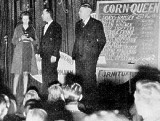
With new supervision came new life. Dances were resumed. An innovation was the battle dances, two orchestras playing for one dance. The musical battles became popular and were a big help in paying off the mortgage. Other activities such as Thanksgiving feather parties, poultry shows, trade fairs, Children's Day activities, theatricals, home talent plays, wedding dances, graduation ceremonies, and firemen banquets all helped to alleviate the weight of the debt.
But time marched on. New churches had their own large halls, more modern, comfortable, and convenient for the weddings, banquets, and entertainments. Dances were no longer profitable. The younger generation had no further use for the old hall. For a few years it stood empty. In 1960 it was converted into Junior High classrooms until the new school building was finished. In 1965 it became a warehouse for the Russco Manufacturing Company.
In 1975 the Fire Department decided repair bills were too numerous. They offered it, mortgage free, to the voters. It was refused. At last the Firemen, seeking a site for a new fire station, voted, reluctantly, to raze the old hall to make room for the new. After 50 years of service, the once "beautiful magnificent structure" had come to the end of the line.
As the old building came tumbling down, many old-timers watching spoke fondly of "The Schuetzen Hall", and the memories stirring were pleasant ones.