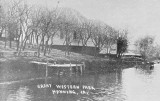
GREAT WESTERN PARK
One of the oldest and best loved pleasure parks Manning has had was the Great Western Park, located about a half mile southwest of town. It was built and developed by Mr. and Mrs. Johannes Hansen around 1901.
There were two connecting ponds which were both great for boating, fishing and swimming; August Reimers built the boats. A dance hall was constructed on the south side of the west pond and local musicians played for the dances. Just west of the dance hall was a bowling alley or "Kegelbahn", and further west was the clay bird and rifle range. There was also a lunch room and a large picnic area with lots of shade trees, grass and many flower beds all the way around the ponds and Lotus lilies blooming in the water.
Ice was cut from the ponds in the winter and stored in the ice house at the park; it was then sold in the summer. Mr. and Mrs. Hansen started the tradition at the park of furnishing fireworks for the community on July 4. Names were put in paper balloons, which were then released. One time, a balloon was found as far away as Spirit Lake.
Each Sunday the Great Western train brought many picnic lovers from Omaha to spend the day. The train would stop south of the park in the early morning to let off the passengers. They would climb over the sty in the fence and walk to the park and the train would go on its way to Minneapolis. On its return in the evening, everyone would be down by the railroad tracks to board the train for their return to Omaha.
Another attraction at the park on Sundays was the balloon ascension made by Dan Rice. He would leap from the balloon and float to the ground in a parachute that was usually made by Laura Reimer Vogt.
After Mrs. Hansen's death, the park was sold to August Dethlefs. It was later sold to Fred Schrum, then to Carsten Struve, who had it a number of years before selling it to John and Tina Steinhauer.
The bowling alleys had been torn down and Steinhauer made the dance hall into a skating rink. The picnic area continued to be an extremely popular attraction to the people of Manning, and was the scene of many club and family gatherings. John and his helper, Elmer Meyers, maintained a ball diamond for the summer's fun and kept the pond clear of snow for winter skating. There were even teams of ice hockey, but the most popular was the figure skating; reports were that Superintendent Amos Lee was the best at cutting a figure eight.
The roller rink was closed in 1940 and soon after that the park was closed to the public. Mr. and Mrs. Frank Sextro purchased the property and had a Dinner Club there for a short time. The park has been closed for some time now, but there are many who remember the park with a feeling of nostalgia.
Continued from page 92
COMMUNITY RECREATION
"Manning has always had the reputation of being a sports minded town." How many times has a person heard those words boasting of the sporting spirit of our citizens? This sporting spirit of our citizens has been demonstrated throughout our town's history.
One of the earliest and most memorable achievements of our citizens was organized on May 15, 1884. Manning Hose Company #1 of the Manning Fire Department began practicing for competition among other fire departments. For this competition, the firemen had to lay 300 feet of hose, break coupling, and attach a nozzle. Practice and hard work paid off for the firemen. In July, 1884 at Perry, Manning Hose Company #1 returned home with a world record for this competition.
MANNING DISTRICT FAIR
On January 20, 1883, J.W. Gardner organized what was called the "Manning Union Fair and Driving Park Association". This became an annual event featuring ten different horse racing events. These events included ladies driving, trotting double, three year old, three minute class, two minute 30 second class, pacing, trotting free for all, running a half mile, running mile and repeat, and the one mile dash.
In 1888, a featured event of the fair was a balloon ascension and a parachute leap. This event never took place because of the negligence of the aeronaut and an unfavorable wind.
There was an excellent display of stock and implements; ladies filled the floral hall with their beautiful flower arrangements.
Probably the greatest danger that threatened the success of the association was the freedom with which they permitted gambling, licensed shell games and fortune wheels, because where spirited speeding is made, gambling always follows. The last race meet of the Driving Park Association was held July 3 and 4, 1895. This was one of the most successful meetings that the association ever held although it was the last. Over 3000 people attended.
In 1896, the grounds were sold to Samuel Bingham. This included an area of about 50 acres which he purchased for $1700. For a time there was some agitation of converting the grounds into a park, which lacked the proper amount of support at this time.
In 1898, a one-half mile race track was under advisement by H.D. Radeleff who contemplated placing it southwest of his artificial lake, now part of Sextro's Addition to Manning. The indications were that he expected to plant a park and turn it into a general pleasure resort, something that Manning was in great need of at this time.
COCK FIGHTS
In 1892 at the express office, the sporting spirit of some of our citizens again demonstrated itself in this unusual event. Some people even went so far as to include scientific training of the game cocks, which consisted of a couple of weeks of runs before breakfast, baths, rub-downs, hurdle racing, spur practice, thrusting, dodging, advancing, retreating, posing, and saluting. In the afternoons they practiced new maneuvers and tactics. Usually a good crowd was on hand for the "battle" and they always backed up their choice of the winner with a bet.
GRIP - THE FIGHTING DOG
In the same year, 1892, J.A. Mills developed a fighting bull-terrier dog named Grip. He was matched against his full "brother" and four hours later, Grip was victorious. This gained Grip a reputation. He later fought a wildcat and succeeded in killing it in a very short time. He was then matched against the champion light weight fighter of the United States and again came out victorious. So now, the sporting element in Manning can boast of having had the champion light-weight fighting dog of the world, for the U.S. leads them all.
ALL-STAR BOXING AND WRESTLING
During the months of April and May, 1935, professional boxers and wrestlers were featured at the sales pavilion in what was to be a series of athletic shows. The shows were to be held every Monday night beginning April 15. Harold "Chub" Hassler and George Brady, local boxing promoters, presented some excellent cards, but the attendance was so poor that future shows became a matter of doubt.
POOL HALL AND BOWLING ALLEY
Benning's Pool Hall and Manning's first bowling alley were located in a wooden building on Main Street in the early 1900s that was replaced by the brick building which now belongs to Struve Motor Company. Paul Petersen was the manager of this first bowling alley which featured duckpin bowling.
In the early 1930s, Manning's second bowling alley was located in what is presently the basement of Cliff's Place. Joe Rehker was the first manager of this establishment and he was succeeded by Al Starek. Jack Vest became the proprietor through the 1940s and 1950s and Leo Wuebker was manager up until 1960. At this time a new bowling alley was built and owned by Max Detlefsen and Lyle Arp. This building is located on Fifth Street and bears the name L & M Bowl. In 1979 this building was purchased by Glen "Red" Struve who is the owner-operator. (Note: The second bowling alley was used for a time as a meeting place for many groups and organizations such as the Jaycees. A gun club was organized under the direction of Louis Mundt and the Children's Day boys' shooting contest was held here for several years.
Continued from page 93
HORSESHOES
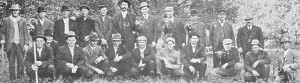
Before the days of paved roads, air travel, T.V., and long weekends, residents had to supply their own off-hour entertainment. One of the most popular sports in days gone by was horseshoe pitching. Spectators and participants alike enjoyed this past time. Manning was noted for its top ranking group of "pitchers". It is still enjoyed and played quite avidly in the city park today.
TENNIS CLUB
On May 26, 1936, a tennis club was organized. F.B. Valentine was president of this club and Bernice Dethlefs was secretary-treasurer. Members of the club were asked to pay $.75 dues to help pay for the upkeep of the courts. Nonmembers had to have permission to play from M.A. Sander, the park board president, and pay $.10 per hour. Failure to pay was considered a misdemeanor under Iowa code par. 5825 and violators were subject to a fine.
MINIATURE GOLF COURSES
In the early 1930's, Manning had two miniature golf courses. One was located one block east of the old high school on Highway 141 and owned by Fred Funk. He called his establishment the Shady Rest. A second course was located on the property where Manning Oil Company is presently located. This course and property was owned by Henry Rohr of the Green Bay Lumber Company. In 1934, Larry Polking purchased this property at the corner of Third and Elm streets and started his service station.
ROLLER SKATING RINKS
Roller skating was a popular activity in early Manning, and there were a number of rinks to accommodate the enthusiasts. A large rink was located in the basement of the present Manning Motor building, with a smaller rink later found in the first floor of the building.
Another was under a large tent at the southeast corner of Fourth and Elm Streets. Others skated at the Great Western Park.
In 1948, the V.F.W. purchased a roller skating rink that was to be owned and operated by the veterans. On December 9, 1948 it was decided to call the rink the "Mid Town Roller Rink". Glen Jensen was named as manager. The formal opening of the rink was on December 26, 1948. From 1949 to 1951 the rink was operated by Elmer Schelldorf. From 1951 to 1953 Ralph and Martha Hagedorn were the operators. Jerry Knaack and Roger "Blackberry" Vollstedt were the floor managers and had the duty of keeping order on the floor.
Skating parties and shows were quite popular with people from miles around. All different classes and styles of skating were enjoyed.
In 1953, the rink was decided to be remodeled and is now being used for the purpose of square dancing, receptions, banquets, and social parties.
I CAN REMEMBER---
Winning $5 in the contest held to name the miniature golf course at the corner of Third and Elm streets. My entry, "Orangegreen", was selected. One of my classmates, Martha Rohr, originated the course on her father's property.
--Edna Halbur