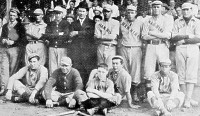
BASEBALL
(Town teams, Merchants League, Semi-pro Central States League)
The first baseball played by a Manning team was at Gray in July of 1882. Several games were played but it appears that Manning never took much interest in baseball till the spring of 1893 when it came with a vengence, and Manning soon developed a nine that was to gain for itself an enviable record (10 wins and 7 losses). In 1895 the team was broken up because of businessmen being transferred and others attending college.
In the spring of 1897, baseball enthusiasm was again revived, and a subscription was raised to defray expenses, and to hire the Coon Rapids battery, which consisted of Morrison - pitcher, and Strawser - catcher. The Manning team consisted of; Sisson - right field, Strawser - catcher, Burgett - center field, Morrison - pitcher, Triplet - shortstop, Patton - 3rd base, Sutherland -left field, and Bennett - 1st base. The most interesting game of this season was against Glidden which Manning won by a score of 7-5 in 12 innings.
Throughout the early 1900's and into the 1920s the Merchants Baseball Team continued to have success and provided many team players and fans with a recreational activity.
Into the 1930s and 1940s the Merchants Baseball League continued. Some of the players at this time were; Bill Petersen - pitcher, and others listed by their last name on the score sheets and box scores: Schrum, Barten, Petersen, Signal, Dethlefs, Brady, Hinz, Bald, Bingham, Frahm, Knaack, and Schwaller.
On August 8, 1935, an interesting twist was added to the game of baseball. The Firemen played a Donkey Baseball game. It is not known who won, but it seems that most of the time was spent trying to get the donkeys to cooperate.
Through the late 1950s Manning's town team was playing in what was considered a semi-pro league, the Central States League. Kenny Dethlefs was the manager of the team at this time. (Bob Kuhl was manager of the team throughout the 1930s.)
Throughout the 1960s and 1970s, Little League programs became popular. Boys ages 8-15 avidly participated in the summer baseball programs which were designed for recreational activity purposes in an organized fashion during the summer months. Today girls also participate in summer softball programs.
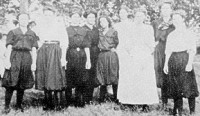
WE CAN REMEMBER---
In June, 1924, a movement was created in Iowa and Nebraska to form a league of petitioners and voters to pledge to use whatever pressure possible locally and nationally to prevent the price of gasoline from ever exceeding 15c per gallon. Headquarters of the league were in the Omaha Loan Building.
Continued from page 97
festivals and entertainments for the purpose of renewing friendships, to learn to know each other and to create a better understanding between us. I do hope that our children will maintain and uphold the traditions of celebrating as we do here today, in the same spirit of friendship and harmony as of old."
To this day, many of the members are descendents of the founders of the organization; Jurgen Ohde, John H.C. Peters, Wm. Pruter, F.W. Pruter, Louie Tolgard, John Oeser, Peter Martins, Heinrich Stender, Joachim Puck, Hans Suhr, Heinrich Hagedorn, Claus Thiedeman, Claus Strathman, Carsten Voss, Carl F. Hagedorn, Adam Schneckloth, Claus Grage, Heinrich Schroeder, Wm. Wiese, Claus Plagman, Claus Anthony, Heinrich Goettsch, Henry Rohwer, Wm. Rowedder, Louie Hannemann, Claus Hagge, Hans Eggers, Heinrich Grimm, Han. H. Kruse, Herman Jahn, Wilhelm Martens, William Hill, Timm Anthony, August Dethlefs, Heinrich Kruse, William Hanneman, Meves Schacht, Chris Lemster, Fritz Hagedorn, Herman Martens, Claus Engeland, Heinrich Joens, John Reinholt, Otto Kruse, Heinrich Greves, Ferdinand Blocker, Heinrich Vinke, J.F. Jahn, Wm. Jahn, John Groth, Joachim Lamp, Heinrich Piening, Hans Joens, Peter Clausen, John T. Ohrt, Anton Wells, Heinrich Schoenjahn, Heinrich Dohse, J.H. Mumm, Nick Schumann, John Jetter, John Ehrichs, Claus Grube, Peter Goettsch, Herman Grundmeier, Heinrich Flenker, John Rathjens, Heinrich Schelldorf, Heinrich Klingberg, John Ohde, and Detlef Wiese.
At the beginning, the group met once a month and gave prizes for the best marksman. These prizes were usually a piece of hardware or leather goods. The king's prize was often a larger piece of furniture. The monthly gatherings were later changed to annual celebrations. Other events during the year included a Children's Day, Ring Riding for men on ponies, Ring Riding for women on merry-go-rounds, harvest festivals, goose ball on Thanksgiving, dances at Easter, Christmas and New Year, and the frolicsome masquerades.
During the early years, from about 1890 to 1895, the Hayes Verein had King Shoots with Manning's Three Mile House and the Wall Lake Verein. One of the meets was won by August Rohwer, who was awarded Mrs. Potts' sad irons. Later, from about 1910 to 1939, the group met with the Manning and Three Mile House Vereins in a "Gold Medal" meet. John Oeser was king four times, in 1913, 1914, 1922 and 1939.
The verein has met every year for the past 97 years, except during World War I, when it was difficult to secure ammunition, during the World War II years of 1943, '44, and '45, and during the Korean War in 1951.
The annual King Shoot is now held on Pentecost Sunday every June. The day's activities start with a nine a.m. procession to the home of the king of the previous year, where music is provided by a live band and refreshments served. At noon, the group -- often numbering 400 to 500 people -- return to the Five Mile House for the contests. While the men shoot, the women have a ball throwing contest. The winners are named the king and queen of the year; dances are held in the afternoon and evening.
Officers elected in April, 1980, were president, Wayne Schroeder, Manning; vice-president Joe Brandt, Aspinwall; secretary, Wayne Jahn, Manning; treasurer, Gene Thiedeman, Westside; and trustees Gordell Lamp, Manning, Merlin Nulle, Westside and Robert Phillips, Manning.
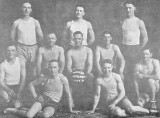
MANNING ORPHANS
In the early to middle twenties a group of former high school stars decided
to form an independent basketball team after their graduation to further enjoy the sport and its competition.
The idea was prompted by the fact that independent teams were popular throughout this area and the rest of the state and a state independent tournament was held annually.
The first consideration, of course, was raising money and getting a sponsor. The response was not what they had hoped for so in their determination to have a team they financed their own beginning and called themselves "The Manning Orphans."
First games were played at the old high school gymnasium but when the caliber of play became evident to the fans the team quickly gained their support and with their help were able to move to bigger and better facilities at the opera house. Money was raised to install baskets and the enthusiastic team was off and running. Harry Rostermundt became the manager and fund raiser for team expenses.
The Orphans played independent teams from Manilla, Gray, Denison, Fort Dodge, Council Bluffs, and many others in the area. They wound up their career as runners-up in the state tournament at Garwin by losing to Hudson in the finals. Their career record was 38 wins against four losses, one of which included the state final.
Style of play in those days was somewhat slower than that of today as evidenced by the average scoring of a game to be in the twenties and sometimes in the 'teens. The two guards were the standing guard and the running guard. The standing guard was strictly in a defensive position, never leaving his area around his own basket and consequently never scoring. It was Up to the running guard to help on both offense and defense while the center and two forwards did most of the scoring.
The going style of free-throwing was with both hands bringing the ball up from the knees. A few brave non-conformists made the two-handed shot from overhead. What was then called the five-man defense was very similar to the present day 3-2 zone.
I CAN REMEMBER---
A meeting held December 6, 1938. Agriculture instructor William Campbell
invited a group of women to talk about having a ladies night school class. We
decided there were a large number of interested ladies, and that we would meet
the same night as the men. Marjorie Keyes, home economics instructor, would
preside, and Mrs. Grover Bartels was elected president, Mrs. LeRoy Musfeldt was
secretary-treasurer, Mrs. Mayor Knudson reporter, and Mrs. William Joens, Mrs.
Otto Popp, Mrs. George Struve, Mrs. Herbert Hinze, Mrs. Ben Welch, and Mrs.
Mevis Wiese were council members. There were 40 ladies present for the first meeting.
---Emma Bartels
WE CAN REMEMBER---
The state of Iowa passed a law in 1932 that all drivers of automobiles and trucks
must pass a driver's test and pay a license fee of 25 cents. Chauffer's license was $2.00.