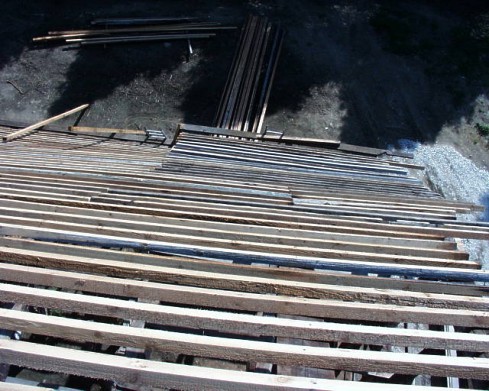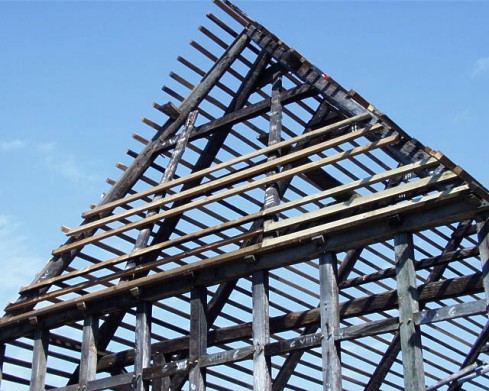
Manning boasts original Haus/barn
BY MAXINE CHRISTENSEN
N-T Correspondent
Atlantic News -- Telegraph
August 21, 1999
Manning. a town of around 1500 people situated where four counties: Audubon, Carroll, Shelby and Crawford meet has accomplished something no other town of that size has done. They have an original Haus/barn.
Ken Puck of Manning, chairman of the Manning Heritage Foundation, states, "Back in 1985, there were a lot of empty business houses on Main street - the economy was in a downswing and groups were formed to see if they could improve things."
The group was looking for something to show off their German heritage. Ron Collins had heard about the Haus/barns and presented his idea to the rest of the group. People in the area caught onto the idea and enthusiasm for the project mushroomed.
Jo Ann Phillips, a state board member for the Iowa Department of Economic Development, knew of a man name of Paul Wagner who lived in Germany, but was an employee of the state of Iowa.
Wagner called the second connection, Dr. Carl Ingwer Johannsen, who was an expert in Haus/barns and the curator for the Open Air and Field Museum in Kiel. Germany. They asked for his help.
Dr. Johannsen knew a farmer near the town of Itzehoe and knew that he had a Haus/barn on his property that he was going to destroy to make more room for farmland. However, the farmer, Klaus Hachmann, was renting his barn to some people who were not ready to move. The laws in Germany say you cannot remove tenants even if you own the building, so there was nothing to do but wait until this family decided to move. The renters finally moved out in 1996.
University students tore down the building, being very careful to number all the pieces. A blue print was made to help the people who would reconstruct the building. In the meantime, Martin Peter Hansen, a 60-year-old German, who looked to be only 30, volunteered to put the building together for the Manning residents. He paid his own transportation to America, and absolutely refused to take any money for any of his work. Hansen and four workers including his grandson, who was interpreter for the group, arrived to construct the barn.
The timbers were trucked to the coast and from there shipped overseas to the United States arriving by semi trucks in closed containers.
When reconstruction began, the blue-prints were given to Mr. Hansen, who quickly discarded them remarking that "I don't need them - I know how it goes together. I have put over 30 together." Construction which was originally thought to take six months was completed in one month.
The original cost of the project was figured to be about $800,000, but circumstances have saved them about $180,000. First the Haus/barn was given to them - then Martin Peter Hansen and his crew volunteered their services (the only expense paid out for them was a place to sleep), sever-al fund-raising events and donations poured in. One big question they had was "where will we put it?" Then the Carroll County Conservation built the Four Corners Park in the southwest corner of Manning. The park will eventually include about 500 acres.
Claus Hachmann, the original owner of the Haus/barn, stated that the actual structure of the building dates hack to 1660 when the Haus/barn was first erected. People studying a piece of the wood at the Christian Albrecht University in Kiel, Germany, came to the conclusion that 1660 is the year it was built. Many of his ancestors lived in the Haus/barns.
This Haus/barn being reconstructed will have four rooms for living quarters and the front of the Haus/barn will be for live-stock, the floor will remain dirt.
In 1996, the Heritage Foundation bought the farmland where the Haus/barn stands, and the area also includes a 1920 home, a couple of barns and several out buildings which they hope will at some time he used as a museum.
Ken Puck remarked that things are going much better than we expected and with the arrival of the thatch, the roof will probably be put on within a couple of weeks.
Timbers and joists for the Haus/barn were marked years ago during construction with roman numerals and scratches in the wood for one side, and roman numerals and dots for the other side. Wooden pegs (which had to be made here) hold the timbers together. Mr. Peck pointed out that the timbers had to be hoisted up by dragline and some weighed as much as 2,000 pounds.
A sign by the entrance to the Haus/barn reads "Foundation footings of the Haus/barn have been partially funded by the revitalization assistance for community improvement (RACI) grant by Prairie Meadow Race Track."
Concrete was poured to hold
the large stones (also sent from Germany) underneath to support beams. Concrete was poured so that there would be no chance of rotting. One large beam had got-ten wet in Germany and was rotting, so a new beam was made - that together with the pegs are the only things made here.
The Haus/barn located across from the Willow Creek County Park will have 250 of the original bricks - the rest will be purchased here and they have already found that match. The cost proved too much to ship all the bricks used in Germany. They will surround the complete barn and will go between the wooden braces - almost six-feet-high the braces and their wooden pegs will be visible all around the barn.
Thatch which will be used for the roof and which arrived here a couple of weeks ago in containers is really a grass which is grown only in the north sea. When the water freezes into ice, the thatch is cut at the level of the ice, banded together in bundles and wired - each bundle is about nine inches in diameter and there are two layers of bundles used for the roof.
These bundles are interwoven and wired to the structure and repel water. Thatch resembles bamboo and is said to last at least 75 years. They were loaded in four ocean going containers and shipped from Hamburg, Germany.
After Hansen and his workers had completed the structure, a Richtfest was held, as is the custom. This consists of a bell like structure attached to the roof with a bottle of wine inside. Someone climbs to the top and there are many toasts honoring the building and the man who erected it. It is a building festival.
This festival was held July 31. During the festival a couple of the workers engaged in Zimmermannklatsch, an old tradition in Germany which involves clapping and singing. The German natives have all returned home now, the last ones leaving Aug. 15.
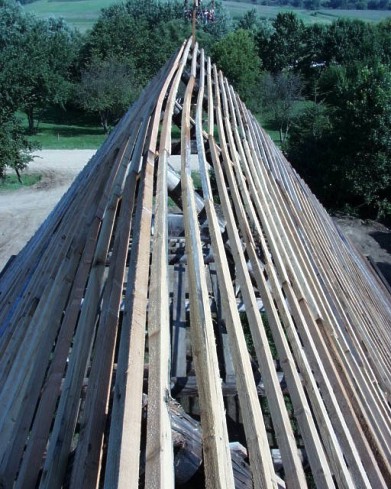
Southeast roof over the bedroom.