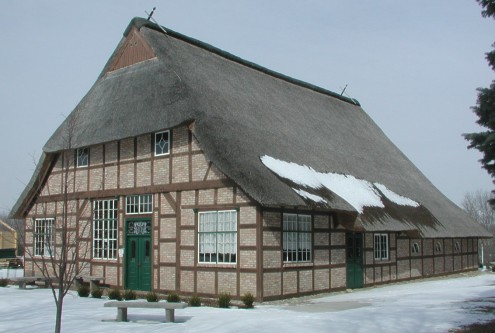
How Did We Get the Haus/barn?
The re-construction has begun on the almost 300-year old haus/barn, and the master carpenter Martin Peter Hansen, his grandson, and helpers have been pounding away, on this piece of history.
But one pounding question remains for some Manning residents. How did we ever get this haus/barn in the first place?
The story goes way back. All the way back to the Schleswig-Holstein area of Germany. A structure was raised on a tract of land almost 300 years ago, only to be taken care of many years later by the residents of Manning.
Go back about 12 years. According to Ron Colling, former haus/barn co-chairperson, the economy was "sour" and business was "very bad." He said he recalls almost a dozen empty businesses on Main Street alone. Groups were formed to brainstorm ideas, shedding light on the town's predicament. One small group flickered on to a real big idea--haus/barns.
Colling said he heard about the haus/barns in 1985, and he shined his idea on to the rest of the group in 1987.
Freda Dammann, former co-chairperson of the haus/barn, said "we were just looking for something to showcase our German heritage." The haus/barn was a good idea, and fit the bill for what they were looking for.
Dammann said they knew this could be something big, recalling what Elkhorn had done with the Danish windmill. She said she met with the man who came up with the idea to bring the windmill over from Denmark, and he encouraged them to go for it.
So they did. Manning pushed for the haus/barn, and the connections were made. Jo Ann Phillips knew one of them. Phillips was a state board member for the Iowa Department of Economic Development (IDED), and met Paul Wagner.
Wagner was the first connection. He lives in Germany, but was an employee of the state of Iowa at the time. He worked for the international division of IDED, which also represents Iowa's industry and tourism. Phillips told Wagner about Manning's situation, and the interest in the haus/barn.
Wagner was drawn into the project, and thought it was a good idea. In fact, he was so interested he even visited Manning a few times. Phillips said Wagner was intrigued with the work Manning had put into resurrecting a haus/barn, and in favor of the efforts.
Wagner called the second connection, Dr. Carl Ingwer Johannsen. Johannsen is an expertise in haus/barns, and the curator for the Open Air and Field Museum in Kiel, Germany, which is holding preserved haus/barns from all over the country. Wagner told Johannsen there were some residents in a small town of Manning, Iowa, USA, who were interested in preserving their German heritage, and asked if he could help.
Johannsen thought he could, and made contact with the third connection. His name was Klaus Hachman. Hackman was a farmer in the countryside of Germany, near the small town of Itzehoe. Johannsen is on the up and up of haus/barns, and knew Hachman had one on his property that he was going to destroy to make more room for farmland. Johannsen told Hachman the situation, and asked if he was interested in helping. Hachman thought he was, and told Johannsen he would donate his haus/barn to the people of Manning, Iowa.
So that was it, right? Wrong. Supported of the project ran into one little problem --- tenants. At the time, Hachman was renting the haus/barn out to some people who weren't quite ready to head out of the haus/barn. According to Colling, the laws over in Germany say you cannot kick someone out...even if you own the building.
Colling said the roadblock was disappointing, but it wasn't going to stop them from capturing their dream. It was all a waiting game now. The waiting period wilted when the renters finally moved out in the spring of 1996, lifting all crossbars.
The engines were churning once again, and a crew of about five to ten German men were hired to dismantle the haus/barn. According to Dan Peters, haus/barn project, coordinator, the German government hired these men "out of the goodness of their heart."
Peters was at the Hachman farmstead when the dismantling began, and the timbers were trucked to the coast. From there, they were shipped overseas to the United States, arriving by semi to Manning in September of 1996.
The haus/bam project has been a big boat to keep afloat from the beginning, but it is expected to payoff in the end. It has not only tugged in visitors from Germany with tour guide Joachim "Yogi" Reppmann, but has also pulled in some royalty. Princess Elisabeth Ferdinad came to Manning for the official groundbreaking, and was scooping U.S. soil at the haus/barn site in 1997.
According to husband LeRoy Dammann, the haus/barn will make a big difference in
the community when the tourists start spending dollars...and every dollar makes a
difference.
"It's a proven fact it turns over 4 1/2 times."
For example, if a tourist buys a meal at a local restaurant, that money might be spent on a
prescription at a local pharmacy by the restaurant owners. That same money might pay
the pharmacy's electric bills, and will eventually keep the rates in Manning down.
The year is 1999, nearly fourteen years since Colling first heard of the authentic haus/barns. How much longer will it be before the Master Plan is complete? It all depends on the amount of help and money that is donated for the project, Peters said. By the end of this year, the haus/barn will be standing, thatched roof and all. The museum, gift shop, and total restoration of the farmstead could take much longer.