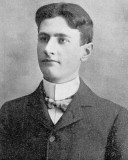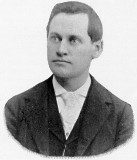
F. A. Bennett
|
Clerk Julius Ruge, Dem. |
Treasurer Wm. Wehrmann, Dem. |
Councilmen C. H. Reinholdt, Dem. W. B. Parrott, Rep. U. L. Patton, Rep. Christ Grube, Dem. J. Hoffmann, Dem. E. K. Johnson, Rep.
|
Marshal Elias Hollingsworth, Dem. |
Night Watch Frank Blair, Rep. |
|
Assessor Frank H. Long, Dem. |
Clerk Julius Brunnier, Dem. |
Albert T. Bennett, County Chairman, Rep.
Fred A. Bennett, State Bank Examiner, Rep.
Mathias Jones; Township Chairman, Dem.
L. E. Stanton, Township Chairman, Rep.
D. W. Sutherland, Com'ner of Soldiers' relief fund.
|
M. E. Epworth League M. E. Foreign Missionary M. E. Earnest Workers M. E. Sabbath School Supt. Presbyterian Aid Society Presby. Young People's S. C. E. Sabbath School Supt. Christian Aid Society Christian Young People's S. C. E. Christian Sabbath School Supt. |
Miss Clara Parker Mrs. Mary Coe Mrs. Rose M. Wilson Wm. H. Reever Mrs. H. M, Free David Summerville Chas. Redick Miss Anna Robb W. Lancelot from Gray Frank H. Long |
Mr Coe withdrew from the partnership and established a paper at Ute, Ia., and Mr Laflar continued as sole proprietor, with G. E. Ferguson as manager, till September 16, 1890. On this date he sold the plant to Martin Brothers.
The politics of the paper, up till this time, had been republican, it was now changed to democratic. In December, 1881, the plant was closed by the foreclosure of a mortgage, but soon renewed publication and continued under the name of Martin Brothers till November 1, 1893; when Mr. Laflar again became owner of the plant.
The policy of the paper was again changed to republican, while Mr. Laflar associated with him, Chas. Haworth who edited the paper and managed the job work.
The office of the Free Press was in the rear of the First National Bank till the spring of
1895, when it was moved to Lot 6, Block 7, where; Mr. Laflar also had a real estate and
insurance office.
As will be noted under the head of fires, the plant was almost completely destroyed. The
job press, a little damaged stock and a few fonts of type is all that was saved. Only one
issue of the paper was missed. The new offices were opened up in the rear end, of the
second story of the south side of Union Block. The paper was run off on the Monitor press
till November 1, 1895, when Mr Laflar sold what was left of the plant to the proprietor of
the Monitor, and the Manning Free Press was merged into that paper.
THE MANNING MONITOR was the first and is the oldest
paper in Manning. Volume 1, Number 1, was published November 17, 1881, by S. L.
Wilson.
The office was located in what was then the Farmers & Traders Bank, owned by Dutton &
Son. It is now used as a warehouse by J.W.Leonard & Co. and is situated on Lot 11, Block 3.
The press used was an old Washington Hand Press. The paper was a seven column folio, one side of which was a patent sheet. This, however, was changed to a six column quarto in April, 1883.
March 27, 1884, Seth Smith bought the plant, and retained C. S. Lawrence as foreman. Mr. Lawrence had been connected with the plant from the time of its first publication.
April 4, 1884, the paper appeared under the proprietorship of Smith & Smith, W. F. Smith being the new member of the firm.
In June, 1884, the ownership of the plant was transferred to Lawrence, Salinger & Brigham, while the size of the paper was increased to a seven column quarto. The firm members were, C. S. Lawrence, B. I. Salinger and L. P. Brigham. The office of the Monitor at this time was in the rear rooms of the First National Bank.
In November, 1884, C. S. Lawrence became sole owner of the plant and in April, 1892, changed the form of the paper to a six column quarto. During Mr. Lawrence's proprietorship of the paper, the only libel suit recorded, in the columns of the paper, was commenced against the editor for malicious libel. It appears that a Rev. Paden invited Mr Lawrence to make a temperance speech at Irwin, and, during the discourse, Mr Lawrence made some unpleasant references about D. S. Irwin, who filed an information before the justice of the peace of Greeley Township, Shelby Co.
Mr. Irwin withdrew the charges when Mr. Lawrence waived preliminary examination and gave bond to appear at the next regular session of the District Court. Probably a few spicy articles in the Monitor, following this, convinced the informant that "discretion is the greater part of valor" and what Mr. Lawrence said might have been correct.
In October, 1893, on account of ill health, Mr. Lawrence sold the plant to A. L Heiks, who sold the plant to Salmen & Funk in December of the same year. The firm was Frank Salmen and E.M. Funk.
Mr. Salmen disposed of his interest to Funk & Funk, Irwin Funk, son of E. M. Funk being the new member of the firm. For the first time since the installation of the plant, was the politics of the paper changed. Heretofore it had been republican and was now changed to democratic. During the management of Funk & Funk, the plant was enlarged by the purchase of the presses a rd stock that was left of the Free Press after the fire of 1895. They also traded their old press for a new Hoe Cylinder press. They moved the plant from the middle rooms of the second story of Barber Block to the second story of P. M. Loes Block in 1896, at which time they got the new press.
In April, 1896, Bennett Brothers purchased the plant and moved the same from the Loes Block to the basement of the Bennett Bank, where it has remained ever since. During the ownership of Bennett Brothers, the paper was managed and edited by Charles Coe, who has spent nearly all of his business career in Manning, in connection with some of its papers. The firm of Bennett Brothers consisted of F. A. Bennett and C. S. Bennett. They both receive mentions under other beads.
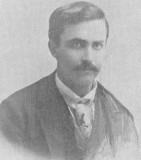
In September, 1897, Bennett Brothers sold the plant to W. E. Sherlock of Sigourney, Iowa. During Mr. Sherlock's management of the paper, he associated with himself Charles Haworth who, a number of years previous, had been associated with the Free Press acting as manager and local editor. Under the present management, Mr. Haworth is acting as associate editor; the paper has been enlarged from a seven column folded quarto to an eight column quarto with cut sheets; the name of the paper has been changed from "The Manning Monitor" to "The Carroll County Monitor" and the first page, for the first time in a number of years, was devoted to editorials. The Monitor is also mentioned under the head of Fires.
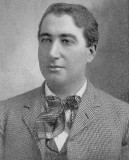
Mr. Kraus received his education in a Staats Gymnasium or Latin School of Austria, which
is a national institution where the students obtain a preparatory classical and universal
education. Previous to the establishment of the Manning Herold, Mr. Kraus had been
engaged in the theater business for twelve years. Playing a great deal in german.
It was only an accident that he launched into the newspaper business in Manning, the
circumstances are, that he visited the town with a German Troup and severed his
connection with them at this place. On looking the ground over and some persuasion by
the germans who wished a local paper in their native language, he was prevailed upon to
establish a paper at this place. He entered into the enterprise with his usual zeal and
energy, and in a short time had a font of type, and a bale of paper ready to go to work.
Some of his cases were impromptu, composed of cigar boxes and lots of cases he
extemporized himself.
His office was located in the Wm. Ruhde building and as soon as he had time to get fairly
settled in his new profession, things began to assume a more progressive object. New
cases replaced the old ones, and new type was substituted for the old, and the marred
and pied type was returned to the foundry. For a time the notorious Free Press
mimeograph was rented for printing the paper, and when this was destroyed in the fire of
1895 Mr. Kraus invested in a Washington Hand Press of his own. Previous to this he had
invested in a job press and entered for competition in English and German Job Printing.
He now has two job presses and makes a specialty of job work of all kinds.
In 1897 he moved his plant from the Ruhde building to the second floor of the Carpenter
building.
He has been publishing annually since 1898 a city directory of Manning.
THE MANNING NEWS was started in March, 1883 by T. E. Palmer, editor and publisher.
He published the paper till March 1885 when he was succeeded by W. J. Marrow, who
published the paper as long as it existed.
The office of this paper was over E. C. Perry's
store and the plant was destroyed in 1888 during the fire that destroyed the building.
The paper was never re-established. It was a seven column folio and its politics were
democratic.
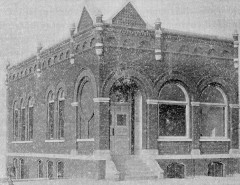
THE BENNETT BANK was erected during the summer of
1898, at the cost of $4500, and $1500 for fixtures. It is fitted up with the law offices of
A. T. Bennett and bank rooms on the first floor, and a basement which
makes an excellent printing office. The bank was organized by A. T. Bennett,
as a private institution, April 14, 1897, with a cash capital of
$20000, and a responsibility of over $50,000.
The officers of the bank are, A. T. Bennett,
President; W. F. Carpenter, Cashier; and W. F. Kempf, Asst. Cashier.
These parties are mentioned in other parts of the work.
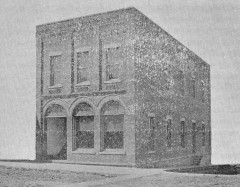
The location of the bank has always been in Lot 1, Block 7, except in 1895, when the building was destroyed by fire. The business was then conducted in the north room of the Freelove Block till the new bank building was completed.
The entrance of the old building was on the street corner. The rear of the first floor was used for offices and was for a time the home of the Free Press. The basement is said to have been at one time the home of the Monitor, but at the time of the fire, was used by W. B. Parrott for butter and egg storage. The second story was occupied by the Masons and Odd Fellows. The present building was erected in 1895, at a cost of about $5000, it being larger than the old building. The occupancy of the building remains the same, with the exception of the basement which is used for a furnace room and coal storage. The rear of the grade floor is still used for office rooms.
D. W. Sutherland has been president of the bank from the time of its organization, up to, and including, the present time.
O. E. Dutton was cashier from February 11, 1886 till July 1, 1892, when he was succeeded by L. C. Sutherland. W. D. Sweesey succeeded Mr Sutherland as cashier in January 1894. O. E. Dutton succeeded Mr Sweesy January 1, 1895 and has continued in that office ever since.
As vice president, Mr. Dutton served, from 1892 to 1894; J. L. Wilson from 1894 to 1898, when the office was abolished.
The number of directors was changed in July, 1893, from seven to five. The present directors are, D. W. Sutherland, O. E. Dutton, Chris Grube, Henry Kuhl and L. C. Sutherland.
D. W. Sutherland located in Manning, March 30, 1882. He first bought Jacob Nodle's interest in the lumber yard of Wolfs & Nodle. The firm of Wolfs & Sutherland established yards at Aspinwall, Astor and Earling. In the second week of October, of this year, Mr Sutherland became sole proprietor, and in January of 1883, sold his yards to Tank & Hoffmann. During the winter of 1883 he bought and shipped grain. In August of this year, he bought the Farmers and Traders Bank of O. E. Dutton. From this on, he remained president of this bank till the First National Bank was organized.
O. E. Dutton came to Manning in 1882, and started a private bank, known as the Farmers and Traders Bank. In August, 1883 he sold the bank to D. W. Sutherland, and for two months sought a more desirable location. He bought back a half interest in this bank, in October and has been connected with it and the First National Bank ever since. His connection with the schools and other prominent local offices will be found under their respective heads.
September 1, 1886, A. T. Bennett bought the bank and placed W. F. Carpenter as cashier. The name of the bank remained the same as before.
November 15, 1888, Mr. Bennett disposed of the business to a corporation, known as the State Bank of Manning, thus, merging the private bank into a state bank, the controlling interest of which, was held by C. D. Dewing and G. W. Umphrey. The new bank was organized with the following officers: President, G. W. Umphrey; Cashier, C. D. Dewing, Asst. Cashier, W. F. Carpenter; Directors, G. W. Umphrey, C. D. Dewing, F. Moershell, J. B. Henshaw and A. T. Bennett. Of Bennett and Carpenter, mention is made under the head of, Bennett Bank. Dewing and Umphrey previous to the organization of the State Bank, had been for a number of years, partners in the real estate and insurance business. Mr. Dewing came to Manning in 1882, and up till 1895, did contract work.
September 3, 1889, G. W. Wattles and F. A. Bennett purchased a controlling interest in the bank. G. W. Wattles was installed as president, and F. A. Bennett as cashier. March 30, 1891, C. S. Bennett succeeded his brother, F. A. Bennett, as cashier, and served in that capacity till December 1, 1896. On that date, S. F. Fry succeeded Mr. Bennett as cashier and has continued in that capacity up till the present time.
April 1, 1892, Fred Moershell purchased the interest of G. W. Wattles, and served as president till March, 1891. On this date, C. D. Dewing purchased a controlling interest from Moershell and B Bennett, and became president.
December 1, 1893, he disposed of his interest to D. W. Sutherland, J. A. Lewis and S. F.
Fry. Mr. Fry wag elected president, and acted in that capacity till December 1, 1896, when
he was succeeded by J. A. Lewis. April 1, 1893, by vote of the stock holders, the bank
was again changed to a private institution, while the shareholders remained the same.
D. W. Sutherland was elected president of the new bank, the name of which, was changed
to the Bank of Manning. It is conducted under that name and management at the present
time.
C. S. Bennett after severing his connection with the bank, engaged for a time in the real
estate and insurance business. In 1889, he was appointed cashier of the Doon Bank, at
Doon, Ia. He has also been connected on the Monitor, and will receive mention under that
head.
F. A. Bennett will be mentioned under the head of Attorneys.
S. F. Fry, formerly a prosperous farmer of this community, launched into the banking business on the date above written, and bas been connected with the one bank ever since, either as president or cashier. At the present time he occupies the latter position. He has been assisted in his administration, in succession, by assistant cashiers, F. W. Kemp, W. H. Pollock and R. E. Sutherland, the latter being the present incumbent and a director.