HOTELS.
CLIFTON HOUSE:
This building was located on Lots 5 & 6, Block 3. It was built by W. M. Tingle & Son and
occupied by them as a hotel, which they operated for two years. At this tithe it was called the
Garfield House. They were succeeded by Chas. Knox, in 1882, who operated the same one
year as the Knox House.
Mr. Fuller succeeded Mr. Knox in 1887 remaining two years, after
which he was succeeded by Mr. Roark. In 1891 Mr. Roark took possession of the hotel and
operated it for two years as the Clifton House. J. F. Williams bought and remolded the
building in 1893, and after operating it for six months sold it to Whitmore & Son. Mr.
Burmaster (could be Burmester) was the last one who occupied the building for hotel purposes.
He came into possession of the property, in August, 1893, but soon left with it heavily encumbered. In
1891, it was occupied, for a short time, as a Keeley institute, after which it was used as a
tenement house, however, it was vacant a great deal of the time. It was condemned in 1897
and in 1898 Charles Brent purchased the lumber in the building and raised it to the ground.
There is probably no building in Manning that has harbored more disorder, and to which
its patrons can look back with strange recollections and say, "that it was a typical western
hotel of the early days". Its rooms were small and would not accommodate more than a
three quarter bed stead, and, in the earlier days, guests very seldom saw a bed stead at
all, but were very thankful if they were allowed two blankets and a quiet place to sleep.
There is hardly an "old timer", both young and old, but what could tell some very
interesting stories about their experiences in this place.
CITY HOTEL:
This building was built by Cal. Callison, and at the time of its erection, was one of the
largest buildings in the town. For some time, it was occupied by the owner for a barber
shop, while the second story was used as a public hall. The rear room was used, for a
time, as a school room, and the hall was used for all public gatherings. About 1881, Mr.
Strong bought the property and converted it into a hotel, for which purpose it has been
used ever since. In 1885, Mr. Strong was succeeded by B. E. Vaughn who was succeeded
by Mr. Fish, who remained one year. In 1889, Peter Noble became owner and proprietor
of the hotel, and in 1891, sold his interest to John Noble, his son. Shortly after this, Mr.
Simmons purchased the property and continued the business for two years. He was
succeeded by Mr. Christensen who continued the business for one year. In 1895, Mrs.
Hagen took possession and continued the management of the hotel, until June, 1896,
when she was succeeded by G. W. Ohnsman, who is the proprietor of the same at the
present time.
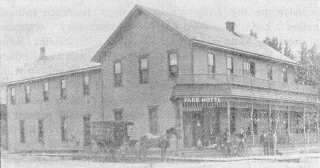
PARK HOTEL
Facing Main and Fifth Streets -- Looking South East.
PARK HOTEL:
This building was constructed in the winter of 1892-3. The land was owned by James
Crandall. The site for the hotel was furnished by the business men of the town. The
building cost $1500. It was called Noble's Hotel, and John Noble, the proprietor,
established for the house a reputation that brought to him an enviable reputation, however
he was no novice at the business, as he was in the same business in partnership with
his father when they kept the City Hotel.
In August, 1893, W. N. Rugg succeeded Mr. Noble in the hotel, by buying the furniture and
fixtures and renting the building Mr. Rugg changed the name, when he took possession,
to "Park Hotel". In 1896, he bought the building and made improvements to the amount of
$500, by adding a new heating plant, water and sewerage system. The hotel has gained
a wide reputation among the traveling public as the best two dollar house, of any town in
the state of the size of Manning.
W. N. Rugg, the proprietor, has received the best kind of schooling in his chosen
occupation. His ancestors, to at least five generations back, have followed the hotel
business. His great-great-grandfather kept a roadside tavern at Sangsfield, Vermont,
while M. N. Rugg, the father of our subject and an assistant in the general management
has spent all but ten years of his business career in the same business. Before starting
out for himself, W. N. Rugg received excellent training in some of the largest hotels and
dining cars from Illinois to Colorado sometimes as clerk then as manager. He spent three
years as head clerk in the Burke Hotel at Carroll, just before locating in Manning.
STRONG'S HOTEL:
was opened up by Henry Strong after he had disposed of his interest
in the City Hotel, which is mentioned in another part of the work. This had originally been
built by a store building and belonged to Mrs. Thomas Barbee. Mr. Strong leased the
building and converted it into a hotel which he operated very successfully till in 1831
when the building and most of the fixtures and furniture was destroyed by fire. When the
building was rebuilt it was used for a store building and is now occupied by Fry &
Grundmeier, hardware dealers.
THE WETHERLY HOUSE:
was situated across the street west of the Methodist church, and was operated by J. N.
Wetherly who also operated a livery stable in connection with it. This was in 1881.
BREON'S HOTEL:
was opened by Benj. Breon in the fall of 1881, and was operated by
him till 1888, when he returned to Pennsylvania. He was then succeeded by Mrs. Dick,
Mrs. Breon's mother, and Mrs. Mary Hagen.
Mr. Breon and family returned from Pennsylvania in 1895, and again assumed the
management of this hotel which commenced on April 1st and has continued up till the
present time.
UTHOFF HOTEL:
Mr. Uthoff moved to Manning in 1891, He ,fitted up and opened his hotel shortly after
coming here, and has continued the same as a one dollar house ever since. He caters to
the general traveling public and keeps regular boarders. He also runs in connection with
the hotel a small supply of confectionery and fruit. He serves suppers on short notice, and
serves ice cream and short order lunches on special occasions. He sustained a small
loss in the fire of 1895, which is noted under that head.
OHRT'S HOTEL AND RESTAURANT:
This place was opened by L. L. Lightfoot when Manning was in its extreme infancy. Mr.
Lightfoot was a victim of the fire of 1891, but rebuilt with a two story brick known as the
south half of Barber Block. This he operated as a hotel, restaurant and bakery till March
6, 1896, when he sold the building and business to Johannes Hansen, who substituted a
saloon stock for the restaurant and bakery, and operated the same as a saloon, eating
house and lodging. This, he operated for about a year, when it was again changed to a
hotel, restaurant and bakery, and operated by (Johannes) Hansen & (John) Frahm. In the
early summer of 1898, Hansen & Frahm were succeeded by William Ohrt, who now
operates the same as Ohrt's Hotel and Restaurant.
Mr. Ohrt was raised in this community, on a farm, and in later years, devoted much of his
time to the operation of traction engines, and the carpenter trade.
A. F. McENTURFF came to Manning in 1882. In 1885, he bought G. W. Cossen's harness
stock and continued in that business till 1887, when he closed the stock out. After this, he
entered the wholesale harness shop of Beckman & Co., of Council Bluffs, where he
remained a year. In 1894, he opened a saloon and billiard room in the Freelove building.
At the end of six months, he closed out the saloon and run a temperance billiard hall, and
lunch room in its stead. He is at present located in the Loes Block, where he has a lunch
room and billiard parlors. He also, keeps regular boarders.
MEATS.
SIGNALL BROTHERS:
In 1881, this market was operated by Howard & Co., of which L: L. Lawrence was the junior
member of the firm. In 1882, the firm was changed to Lawrence Brothers & Pattison, Mr.
Howard retiring. In 1883, Mr. Pattison withdrew and the firm was changed to Umphrey,
Lawrence & Co. In 1885, Mr. Umphrey withdrew, and the firm name was again changed to
Lawrence & Co. This last firm sold to Blohm & Polzin in 1894.
In January of 1896, Mr.
Blohm withdrew and Gus. Polzin became sole proprietor. In January, 1898, Boss & Co.
succeeded Mr. Polzin but the latter was retained as manager. In March, 1898, George
Schmitt succeeded Boss & Co. In August of this year, Mr. Schmitt disposed of the business
to Signall Brothers, who are operating the same at the present time.
The present firm
consists of James and Robert Signall while the sales are managed by Charles Signall.
Robert does the buying and prepares the stock for the market. James Signall, the other
member of the firm, is more of an educational turn of mind, and at the present writing,
holds a position as teacher in the public schools of this city.
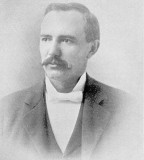
Asmus Boysen
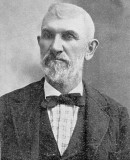
U.L. Patton
H. H. NUPPNAU:
What is now the Nuppnau Meat Market, was first owned by C. O. Frazer, who was succeeded by Hockett & Barber. The latter were succeeded by
Barnes & Hilsabeck who, about a year after, disposed of the same to H. H. Nuppnau in the fall of 1894, Mr Nuppnau has continued the
business ever since. He first went into the business at Aspinwall, in 1893, where he remained till he came to Manning. He was one of the
unfortunate victims of the fire of 1895, however, he started up a new shop in the Loch building, where the Bennett Bank now stands, and
supplied his customers till his new building was completed.
GROCERIES.
J. W. LEONARD & CO:
J. C. Young was among the pioneer grocers of Manning, selling his stock to A. W. Leonard
& Co. In 1893, A. W. Leonard disposed of his interest to J. W. Leonard when the firm
name was changed to J. W. Leonard & Co., Francis Leonard being the other member of the
firm.
Francis Leonard and family moved to Manning from a farm which he traded for the stock of
groceries mentioned above.
GENERAL STORES
KARSTENS & HANSEN:
John Karstens was among the earliest settlers in Manning,
opening up a general store in 1881. This, he operated as sole proprietor till he disposed
of a part interest to P. and A. Dethlefs, when the firm name was changed to Karstens,
Dethlefs & Co. The two junior members of the firm had served for a number of years in the
store as clerks.
December 9, 1893, Mr. Karstens bought back the interest of the other
members of the firm and continued the business alone for about a year, when he took in
John Tielman for a partner, and the business was operated under the name of Karstens &
Tielman. February 9, 1895, Theodor Hansen bought Mr. Tielman's interest and the firm
name was changed to Karstens & Hansen, which it is at the present time.
This stock sustained a heavy loss in the fire of 1891, as will be noted under the head of
fires.
Neither member of the firm needs introduction, as Mr. Karstens is an old resident and Mr.
Hansen was reared on a farm in this community.
P. & A. DETHLEFS:
These gentlemen, after dissolving partnership with Mr. Karstens, bought the hardware
stock of Arney Brothers (F. W. & L. E.) & (H. W.) Crawford, who were successors to Arney
Bros. the last named firm, having opened up one of the first hardware stocks in Manning,
in 1881. The firm, P. & A. Dethlefs succeeded Arney Bros. & C. Crawford February 10,
1894; but, as will be noted under the heading Fire of 1895, they lost nearly the entire
stock and the firm discontinued the business.
E. C. PERRY opened up a general store in January, 1885, and continued the
same until January 1, 1899, when he sold the stock to Henry Hoffmann & Co. and the
building to Henry Hoffmann. He is mentioned in other parts of the work, especially that
which is relative to fires.
HOFFMANN'S CASH STORE:
This stock was opened in 1882, under the firm style of (Henry) Hoffmann & (William)
Schoop. The stock consisted of a general ' stock of merchandise on one side of the store
and furniture on the other. The furniture stock was closed out in the early 80's. May 6,
1891, Mr. Hoffmann bought out his partner's interest and has continued the business
under the style given in the heading, above. Mr. Hoffmann is too well known to need an
introduction, as he is among the old timers" and has witnessed Manning's growth from the
year 1881 up till the present time.
THE MANNING MERCANTILE COMPANY:
This company was organized in the fall of 1897, shortly after a compact had been entered
into by some of the business men of Manning to erect and operate a new elevator at the
North Western tracks later, to be known as the Patton Elevator.
This project, the owners of the existing elevators considered as antagonistic to their
interests and an imposition on their rights. They claim that they were conducting a strictly
legitimate business, in an honest and business like manner, extending justice and favors
to all alike, paying the top prices for grain and enjoying the confidence of their patrons.
That those who were antagonizing them, did so for their own personal gain.
The North Western Elevator was owned and operated by S. B. Fritz, and the Milwaukee,
by Grantz & Gloe. These two firms entered into a compact to antagonize the promulgation
of this new enterprise in every possible manner, by taking orders, by sample, for
merchandise of every description. These orders were taken, for a time, at their respective
elevators, while a man was also hired to travel through the country and solicit orders.
In November, 1897, they entered into a co-partnership to operate a sample store, known
for a time, as "the pea nut stand", where they sold from samples and kept a small line of
groceries. This was located in Lot 11, Block 7, as illustrated in a cut opposite page 4. The
business style, at this time, was: The Manning Mercantile Company, J. B. Grantz, S. B.
Fritz, J. Langenfelt and J. F. Gloe, proprietors.
They gradually increased their stock and April 23, 1898, incorporated under the above
name. At this time the two elevators were consolidated and were turned over to the
corporation for so much stock. The capital stock of the corporation was placed at $20,000.
The first officers were: S. B. Fritz, President; J. F. Gloe, Secretary; W. J. Miller,
Cashier; S. B. Fritz, J. F. Gloe and J. W. Miller Directors. The stock was moved into Union
Block, March 1, 1898.
J. A. F. BRUNNIER entered the mercantile business in Manning Dec. 1, 1887. A greater
part of the time, he has had associated with him, his brothers, H. G. A. and Martin
Brunnier. They are among the early settlers of the county having settled in the west
central part long before Manning was in existence. They had spent a number of years as
clerks in stores of the neighboring towns before opening up a store on their own
responsibility. They have held many honored and responsible positions in the town, as
will be noted under their respective heads. This firm suffered heavily during the fire of
1891 as will be noted under that head.
JOHNSON BROTHER'S:
What is now, Johnson Brother's General Store, has been the outgrowth of a "Racket Store"
owned by G. F. Long, who occupied the south room of the Freelove Block. In August,
1893, (W. W.) Carpenter & (O. R.) Judson bought the stock, and after running in this
building about three months, increased the stock and moved to the Wright Block, which
was also a frame structure. This building was replaced with a brick in 1897, In the autumn
of 1894, Mr. Judson sold his interest to Mr. Carpenter who then became sole proprietor.
Mr. Carpenter, in 1896, bought Lot 6, Block 7, of G. W. Laflar, and erected thereon a two
story brick. After the completion of his new store building, Mr. Carpenter moved his
stock to the same, and, adding to it, made it a general store. In February of 1898, Mr.
Carpenter sold his stock and store building to Johnson Brothers, of Armour, South Dakota,
who are extensive bankers and real estate dealers. H. F. Addy, who clerked for Mr.
Carpenter is now managing the business for Johnson Brothers.
CLOTHING.
JAY & GRELCK:
This firm was first known by the name of Mallery & Jay. Their headquarters was at
Audubon, with a branch store at Manning. The stock was opened in Manning in 1883, and
in August, 1884, Mr. Jay became sole proprietor of the Manning store. In May, 1898, John
Grelck purchased an interest in the store, and the firm name was changed to Jay &
Grelck. Mr. Jay suffered a severe loss in the fire of 1891, an account of which will be
found under that head. The stock is composed principally of Gents Furnishing Goods, the
value of which, at certain seasons of the year, runs as high as $8000. They also represent
a first class laundry firm of Council Bluffs.
In the past few years, Mr. Jay has devoted some time to politics and in the year 1895 he
was elected to the legislature, on the democratic ticket. He was again elected to the
legislature in 1897, and has served on some important committees in that body.
John Grelck, the junior member of the firm, entered the store of John T. Jay in February,
1890, as an unexperienced clerk but in a short time was promoted to manager with
practically the full control of the business.
ROBER & HOFFMANN:
J. P. Emig, who opened up this stock, located in Manning in the fall of 1894. March 11,
1896, the stock was sold for $1800 to satisfy a mortgage of $2300. The stock was bid in,
for the firm, and invoiced $3418. It appears that Mr. Emig was unfairly dealt with. In
March, 1897, Ives & Hoffmann bought the stock, and, adding more to it, continued the
business in the same place. February 16, 1897, E. L. Ives disposed of his interest to
G. A. Rober, and the firm name was changed to Rober & Hoffmann, which it has remained
ever since. The stock consists exclusively of Gents Furnishing Goods.
Mr. Ives entered the mercantile business in Manning, April 10, 1894, when the firm of
Russell, Son & Sharp was succeeded by Ives & Sharp. The firm was again changed to
Ives, Sharp & Co., which was again changed to Ives Brothers in February of 1885. The firm
took in another member and changed the firm name to Ives, Dunning & Co. In February,
1889, G. S. Dunning bought the interest of Ives Brothers, and for about a year continued
the business alone. In 1891, Ives Brothers succeeded Mr. Dunning, and were victims of
the fire of that year. They closed out, what was saved, soon after the fire.
G. A. Rober moved to Manning in 1897, when he became the senior partner of the firm of
Rober & Hoffmann. He received his schooling, in the mercantile business, in one of the
largest wholesale and retail stores in eastern Iowa, which was located at Davenport.
Henry Hoffmann, the junior member of the firm, we will mention under another head.