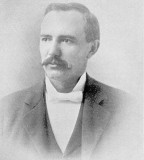
Asmus Boysen
THE NORTH-WESTERN ELEVATOR, one of the old land marks of Manning succumbs to the
flames. Following is a description of the conflagration as chronicled in the Monitor,
bearing the date of September 29, 1899:
"One of the most terrific, yet grand, scenes that was ever witnessed in Manning was the
burning of the Manning Mercantile Co's elevator, warehouse and cribs, in the
Northwestern yards, at 1:30 Tuesday morning. The successive tooting of the mill whistle
gave the people the first intimation that there was a fire. The fire boys responded
promptly, but the fire had gained such headway before being discovered that no power on
earth could have saved the property. Then the boys turned their attention to Leake &
Sons' elevator, standing about 50 feet south, which was saved by lots of hard work. The
elevator was one of the largest in the country and had stood there in its loftiness for
seventeen years. The grain house immediately south, and the corn cribs and office, east,
were also reduced to ashes."
Considerable machinery, which has been stored in the grain house, was consumed. Over
7,000 bushels of wheat, and some other grain, contained in the elevator is nearly a total
loss. A great mound of the grain is still smoldering on the ground. The estimated loss at
this time is about $8,000, which is partially covered by insurance.
Just the trucks is all that is left of a freight car, which contained soft coal and stood near
the elevator.
It was with difficulty that the Northwestern depot was kept from taking fire at times,: A
brigade of water-carriers saved it.
Such is the end of one of the old land marks of Manning.
It would appear, from the place where the fare was first discovered, that an incendiary
had, again, satisfied his mania for the destruction of property.
It is claimed, that the stillness of the atmosphere is all that saved the adjoining buildings
and possibly the town.
Ascetyline Gas Machines was the first thing in this line introduced, and Fred Miller instituted a plant for lighting his store and furnishing the gas for the barber shop of John A. Sexton. This was in the summer of 1888, and in the fall of the same year, the Manning Mercantile Company also instituted a plant. Others followed suit, but not being entirely satisfied discarded them and tried other kinds of lights.
A Gasoline Lamp was introduced in the latter part of 1898, by Joseph Feldmann, and appeared to give satisfaction. It is now used by several firms in the city. In this, each individual lamp generates its own gas, somewhat on the principal of a gasoline stove. They are lighted by a small alcohol lamp which is used to heat the gas generator.
A new style of gasoline generator was introduced by Henry Hoffmann & Co. in May of 1899. The tank and generating apparatus is placed under ground at a safe and convenient distance, and the gas is conducted through regular gas pipes and ordinary gas jets; so, that all that is necessary, is to turn on the gas and light it. This kind of generator, light, and fixture, is said to be superior to the others in density and quality of light, cleanliness, simplicity and safety. In fact, the quality of light is superior to that of electricity in some respects, especially, as relates to color. All of these generators produce a white light when the gas is ignited. Ascetyline gas is generated from a carbide which is manufactured for this particular purpose. Ordinary gasoline is used for the other style of light. Among those who are adopting the gasoline light, are the Manning Mercantile Company, Lewis & Grau and others.
This was completed between Manning and Audubon in July, 1899. It was put in principally for the use of private parties, although the public is permitted to use it and transfer messages are taken from the Iowa Telephone Company. The line was put up by F. M. Leet and Prof. F. P Hocker, Audubon, Asmus Boysen, Gray, and A. T. Bennett, Manning. The line connects the German Savings Bank of Manning with the Commercial Bank of Audubon. It is tapped at the Boysen and Brookfield ranches situated between here and Gray.
THE "Town OF MANNING" was laid out in July, 1881, and the lots were placed on sale
August 2nd of this same year. This plat included Blocks 1 to 7 and Block 8 un-subdivided.
THE "FIRST ADDITION, AND SUB-DIVISION OF BLOCK 8"
was laid out November 17, and 18, 1881, by Mr. Hess, a civil engineer for the
Northwestern Ry. Co. This plat set forth: the subdivision of Block 8; Blocks 9 to 17;
Out Lot "One"; Out Lot "Two".
BLOCK 17 mentioned above, is situated north of Block 1, and is bounded on the north
west by Front Street, east by Center Street, and south by First Street.
THE "WESTERN TOWN LOT COMPANY'S FIRST ADDITION" was the
subdivision of Out Lot "Two" into Blocks 17 to 20; Out Lot "A"; and a parcel of land 21
by 278 feet which lay in the north west corner of Out Lot "Two" west of May Street.
The parcel of land just described above was, later, platted as a part of Block 21.
OUT LOT "A" of this addition, should not be confounded with Out Lot "One"
Which will be mentioned later.
BLOCK 17 of this addition, is bounded on the north by Julia Street; east by
Sue Street; south by Second Street; and west by May Street. This block must not be
confounded with Block 17 in the "First Addition"
"OUT LOT Two" it will be noticed, has been merged into the addition above
named, although, since then, both terms have been used, and, for convenience, I shall
retain the term "Out Lot Two".
THE "SUB-DIVISION OF OUT LOT ONE, AND OUT LOT All (of "Out Lot Two")
was filed January 19, 1889.
OUT LOT "ONE" was sub-divided into out lots and un-numbered lots, which,
afterward, were platted as follows:
OUT LOT "A", all of that part of Out Lot "One" which lay north of Blocks 23
and 24;
OUT LOT "B", afterwards, Lots 3, 4, 5, and 6 of Block 21; and,
OUT LOT "C", afterwards, Lot 1 and 2 of Block 22.
OUT LOT "D", that part of Out Lot "A" which lay south of Third Street extended.
"Auditor's Re-subdivision of Out Lot 'A' (of "Out Lot "Two"); part of the N. E. 1/4 S. E.
1/4; part of the N. W. 1/4 S. E. 1/4; part of the SE 1/4 S. E 1/4; part of the S. E. 1/4 S.
W. 1/4, all of Sec. 17-82-36; part of NW 1/4 N E 1/4 o f S e c. 20-82-36."
This was made in accordance with Section 548 of the Code of Iowa, and for the purpose of
overcoming the difficulty in locating and describing the various parcels of land located in
this tract.
OUT LOTS "B" AND "C" OF OUT LOT "ONE" were sub-divided and the lots
numbered.
THE SOUTH PART OF OUT LOT "ONE"not included in Out Lot "A" of Out Lot
"One" was sub-divided into Blocks 21, 22, 23 and 24, and these into lots.
BLOCK 24 contains, on its east side, 21 feet of what was formerly a part of
Out Lot "Two".
BLOCKS 25, 26, 27 AND 28 is that part of the S E 1/4 S W 1/4 of Sec. 17,
which lay west of the "Town of Manning" and had never been platted.
BLOCK 29 is that part of the N W 1/4 N E 1/4 of Sec. 20 which lay east of
Center Street and north of the Milwaukee right of way.
BLOCKS 34 AND 36- lay in the N W 1/4 S E 1/4 and had never before been
platted.
BLOCK 35 lay in the S E 1/4 S E 1/4 of Sec. 17, and had not been platted
before.
GARDNER'S ADDITION was filed October 1, 1891.
It was laid out with reference to the south line of Section 17, with the south half section
post as a point of commencement. It contains Blocks 1 to 8, and is bounded on the north
by Fourth Street; east by unplatted tract of land belonging to E. A. Liddle; south by Sixth
Street; west by Center Street.
GARDNER'S SECOND ADDITION was filed June 20, 1882. It was laid out with reference to the east and west half section line of Section 17, using the center section monument as a point of reference. This addition was laid without reference to any previous or adjoining plats or additions. This addition contains Blocks 1 to 3 and is bounded on the north by the half section line; east by Block 36: south by Madison Street; west by May Street.
GARDNER's THIRD ADDITION was filed April 12, 1886. Blocks 1, 2 and 3 are bounded on the north by half section line road.
GARDNER's FOURTH ADDITION was filed for record October 7, 1886. Blocks 2 and 3 are bounded on the north by the half section line road. Block 1 of this addition is somewhat separated from Blocks 2 and 3, being bounded on the north by Madison Street. On the east, Blocks 2 and 3 are bounded by Blaine Street while Block 1 is bounded by Block 1 of Gardner's Fifth Addition. This addition is bounded on the south by Block 34 and an un-platted tract, and is bounded on the west by Block 32 and April Street.
GARDNER's FIFTH ADDITION was filed for record December 17, 1887. It is bound 1 on the north by the half section line road. Blocks 2 and 3 are bounded on the east with the east section line and an unplatted tract. On the south, Block 3 is bounded by un-platted tract, Block 2 by First Street, and Block 1 by un-plated tract. On the west this addition was bounded by Gardner's Fourth Addition.
SOUTH MANNING was filed May 6, 1892. Its point of commencement is 85 rods south of the northeast corner of the north west quarter of Sec. 20. This addition is 399 feet east and west by 793 feet north and south. It contains two blocks and is laid out with reference to the north and south half section road of this Section.
Blocks 1 to 7:
Town of Manning
Blocks 8 to 16:
First Addition and Sub-division of Block 8
Blocks 17 to 20:
Sub-division of Out Lot "2" of the Western Town Lot Company's First Addition
Blocks 17 to 20:
Out Lot "2" of the First Addition to Manning
Blocks 21 to 29,30 D, 31 C, 32 B, 33 A, 34, 35 and 36:
Auditor's Sub-division of Out Lot "One" and part of Sections 17 and 20
Blocks 21 to 29, 30 D, 31 C, 32 B, 33 A, 34, 35 and 36:
Auditor's Sub-division of Out Lot "A", part of Out Lot "One", and part of Sections 17 and 20.
Blocks 21 to 24 and 30 to 33:
Auditor's Sub-division of Out Lot "A" and part of Out Lot "One"
Blocks 21 to 24:
Out Lot "One"
Blocks 30 to 33:
Out Lot "A'"
Gardner's Addition contains eight blocks, numbering 1 to 8.
Gardner's Second Addition- contains three blocks, numbering 1 to 3.
Gardner's Third Addition- contains two blocks, numbering 1 to 2.
Gardner's Fourth Addition- contains three blocks, numbering 1 to 3.
Gardner's Fifth Addition- contains three blocks, numbering 1 to 3. South Manning
contains two blocks, numbering 1 and 2.
Blocks 1 to 17:
Town of Manning.
Blocks 17 to 20:
Out Lot "2" to the First Addition of Manning.
Block 21:
Auditor's Sub-division to Out Lot "A" and Out Lot "One".
Block 22 to 24:
Auditor's Sub division to Out Lot "One" and Out Lot "Two".
Blocks 25 to 36:
Auditor's Sub-division to Out Lot "A" and Out Lot "One".
Gardner's Additions are the same as entered on the Auditor's Books.
Blocks 11 to 17:
First Addition.
Blocks 17 to 20:
Out Lot "Two" to First Addition of Manning.
Block 21:
Auditor's Sub-division of Out Lot "A" and Out Lot "One".
Blocks 22 to 24:
Auditor's Sub-division of Out Lot "One" and Out Lot "Two".
Blocks 26 to 36:
Auditor's Sub-division of Out Lot "A" and Out Lot "One".
Gardner's Additions are the same as entered on the Auditor's Book.
The reader will, undoubtedly, notice the discrepancies which occur in the different record
books, as given above, which set forth the different blocks and additions into which
Manning has been setoff. These discrepancies were caused by the town having been
setoff into additions which contained out lots that were not sub-divided until later, and, as
a result, some of the lots and blocks appear on the abstracts under half a dozen different
descriptions, which requires the assistance of the Plat book and an experienced person to
trace them out.
Block 30 is given to illustrate the different descriptions under which it may appear, which
are as follows:
Un-divided portion of Out Lot "Two" of the First Addition to Manning.
Un-divided portion of Out Lot "A" of Out Lot "Two" of the First Addition to Manning.
Out Lot "D" of Out Lot "A" of Out Lot "Two" of the Re-subdivision of Out Lots "One" and "A"
of the First Addition to Manning.
Block 30 D of the Auditor's Sub-division of Out Lot "A" and part of Out Lot "One".
Block 30 D of the Auditor's Sub-division of Out Lot "One" and part of Sections 17 and 20.
Block 30 of the Auditor's Re-subdivision of Out Lot "A" and part of Out Lot "One".
Block 30 of Out Lot "A".
As there are two Blocks 17 ----
Block 17 lying north of Block 1 might be designated as "Block 17 of the First Addition to
Manning", and
Block 17, adjoining Block 18, might be designated as "Block 17 of Out Lot "Two". For
convenience in making out descriptions, following those that have been made, and in
searching the records, the writer suggests that nothing but the name of the block be used
with the exception of Blocks 17 and Gardner's additions. The latter should appear as
given in the Auditor' Book.
The following descriptions would be amply sufficient in the majority of cases.
Blocks 1 to 16 of Manning.
Block 17 of the First Addition to Manning.
Block 17 of Out Lot "Two" of Manning.
Blocks 18 to 36 of Manning.
Blocks 1 to 8 of Gardner's Addition to Manning.
Blocks 1 to 3 of Gardner's Second Addition to Manning.
Blocks 1 and 2 of Gardner's Third Addition to Manning.
Blocks 1 to 3 of Gardner's Fourth Addition to Manning.
Blocks 1 to 3 of Gardner's Fifth Addition to Manning
If these simple descriptions were used, there would be no trouble for the Auditor to list your property for taxation; no trouble for the Treasurer to ascertain the amount of your taxes when you go to pay them; no trouble for you to tell whether your tax receipt is correct or not; and no trouble for you to tell whether you have a clear title to your property or not when an abstract is presented.