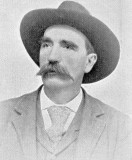
H.D. Radeleff
The bonds were issued under the following Statute of the code of Iowa: "Loans may be negotiated by any municipal corporation in anticipation of the revenues thereof, but the aggregate amount of such loans shall not exceed the sum of three per cent upon the taxable property". "The foregoing is amended by striking out the word three, and inserting the word five, provided, that the provisions of this act shall not apply to cities having over six thousand inhabitants, or less than one thousand inhabitants, and in all other cases such loans shall not exceed the sum of three per cent on such property."
The state census of 1885 showed Manning to have 954 inhabitants, and the taxable
property is said to have been $104,000. If the population was below 1000 in 1884, three
per cent on the taxable property would be $3120, the largest amount for which bonds
could have been issued legally.
At the present time the case has bean set for trial, and demurrers have been submitted to
the court and taken under advisement, while the case is so far from a final disposal that
the final decree is too uncertain for one to venture an opinion as to what it will be. Even
should the town win the case, yet, it could never point with pride to its pest history end
say that we as a corporation have been strictly honest and upright in all of our dealings,
for the stigma of refusing to pay a just debt shell remain as long as the town exists. And
the town can never join a church and precise hypocrisy to mask its pest end brighten its future.
It might have been well had this league continued its good work up till the present time,
especially, from '94 to '97, when one of the saloons was turned into gambling den and
drugging counter, a sort of a notorious Bender's resort. It appears that the proprietors of
this joint stooped so low as to not only permit gambling, but, pocket picking, hold ups,
drugging and other crimes which were practiced by foot pads, highwaymen and thieves of
the slums. The principal victims seemed to be transients. One old gentleman was
enticed into the saloon drugged, and an attempt was made to over power him and take his
money by force. This attempt, however, was frustrated. In another instance, a drummer
was enticed into the saloon, drugged, relieved of $100, and sent on his way rejoicing, in
the buggy of Asmus Boysen, the team being tied to a post in front of the Park Hotel.
They were turned loose and started towards home with the semi-comatose victim for a driver.
The carriage capsized a few miles out of town spilling its occupant into the ditch, and
parting company with the team left them to complete the journey alone.
Manning never has been free from light fingered shoplifters; overcoats, money and
jewelry still disappear, occasionally, through the mysterious, magnetic touch of local
talent, and oft-times the coarseness and boldness displayed ought to be sufficient ground
for at least a reprimand by the peace officers before whom some of these magicians have
been summoned to appear, but a return of the property squared the matter, while the
culprit was set at liberty to perfect his art.
The writer, by the way, has had a little grievance in this line, to complain of, as have many other victims living in Manning, some of whom, have become so of very recent date. The writers new overcoat, only three days from the store, was apparently spirited away through the ticket window of the Germania Hall, or perhaps through the door, admission, through which, might have been gained by means of a skeleton key. The suspected magicians were seen during the evening, snooping around-places where they were not supposed to have business and it was, only, some one well acquainted with the premises, that could have taken the goods, without being discovered. Numerous other cases could be brought home to one of the same parties. It is too bad that officials get so precarious of their position that they will hesitate to protect the public against such impositions.
When the appointed day for the match came, a goodly audience had assembled to witness the combat, each having a choice, and tacked it up with a few duckets. For a time the contest was heated and close. Each combatant did his share towards extracting the feathers of his opponent, and occasionally drawing a little blood. The first few rounds were consumed in maneuvering, passing, posing, saluting and feeling for weak points; but Dwight's hero reserved his strength and by a wall directed thrust, planted his spur in his adversary's ear injuring the drum so that the latter perspired and expired shortly after with the earache.
Among those who indulged in these fowls were: Probert, Lightfoot, Loes, McMurry, Norris, Patton and others whose names we were unable to obtain. Although, there are still a few of these fowl in the town, game fights are a thing of the past.
Headed by Wilson on his charger, the company proceeded to the scene of rattle. The
Colonel with rusty sword in hand jumped upon an old wagon, and, after assigning each
man to a place, proceeded to give the boys a genuine Kelly talk, which was received with
much enthusiasm and shouts "on to the wolf". Every man marched to the place assigned
him. Wilson started for the creek, followed by Dr. Williams who had a pocket full of
stones. Then came A. T. and Fred Bennett with their guns.
On the east stood the invincible,
Fry holding an old army repeater, while a short distance south was stationed Henry
Hoffmann. He, too was armed to the teeth. About half a mile north were Ed Ives, Ben
Brookfield, Wilson Rugg and Will Heitman. Ed Ives was loaded for thunder bumpers, but
not for wolves. Ben Brookfield had an ax, while Rugg and Heitman carried concealed
weapons, probably gatling guns. Soon Wilson had his wolf on the run, and immediately
gave chase.
The canine started up the hill, but Joe's horse got tangled up in the weeds
and thus lost too much time to ever catch up. Fry fired and wounded Mr. Wolf, but as his
repeater was loaded with bullets no longer than a thimble, he could not expect the animal
to fight the dust. Though Ives was half a mile distant he saw the wolf limp and had it not
been for a thunder bumper obstructing his vision would have fired the fatal shot. As it is
all of the braves returned home unharmed and will soon file the applications for a
pension.