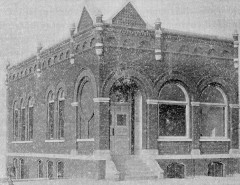
Bennett Bank
When it comes to Inoculating Science, Philosophy, Logic, Drama, Theology, Comedy, Tragedy, Chorustry, and "Tricks of all Trades" into base ball, The Leaguers are "Not In It".
Resner spent much time, driving spikes into a tree with a wagon rod he had read the first part of "Kelly at the Bat", his wife also got much good service out of him by having him handle hot flat irons without a holder, however, this availed him little in holding sky scrapers; he says that his hands never were adapted to heat and that was the hottest ball he ever saw. Rogers was too fully engaged lining up his team to practice much, however, he held down third better than he held the ball. He said that "to catch Stephany's under toss was sure death, and he would rather be a coward for five minutes than a coward the rest of his life". He displayed great tact, however, in interpreting the rules. Sam Boylan was always at his post when he was not chasing those compound worming ins and outs, and cork screws. Stephany's final and supreme effort, while in the box, won for him the applause of all lovers of the national game. The twisters he sent in seemed to puzzle Captain Hansen and two strikes were called on him by the umpire quid erat ecclesiastic.
Then he cracked the ball feebly, Tom Boylan bumped his lip against it and Hansen got to
first. Pitcher Stephany struck out the next man amid loud cheers from those who were
holding down the empty kegs, and the out field, while Tommy started to throw a
handspring, but only got half way, changed his mind and spit on his hands vigorously as
Henry Hoffmann came to bat.
Henry thought that he had solved the mystery. By this time
the supreme moment had arrived for Pitcher Stephany, as hits had been scoring against
him, and he stirred himself for a coup. He twined his left leg all around his right, doubled
half way over and with a majestic swing of his arm sent in the ball. Henry ducked, the
sphere caroned off his bat and caught the umpire where it didn't do him any good.
Stephany had an arm of steel but it heated and warped before the game was through. Robb pushes the ball after that when he touched the ground long enough to make a delivery. Sam Boylan resigned and Wood's magnetism came into good play, however, his stem winders to third, made it somewhat dangerous in the loafers gallery at the left of the diamond. The rotary motion of his arm preparatory to a stinger for third, made it rather difficult to judge the course that the ball was likely to take.
Such was the case, when the tangent to the circle he was cutting with the ball, lead in the direction of one Dillingham reaching point of contact on his bump of combativeness and reduced it, for the time being, to a minus quantity. Tommie Boylan made an elegant censor and chased the ball rapidly. A. T. Bennett grinned and split the air with his bat, frequently cracking the ball and making two circles of the diamond before it lit. Robinson and Boos kept an eye out for cavaties and broken teeth. Kempf was as busy as a bee and always in front of the ball. Sutherland's rubber arm did good service, but stretched before the end of the game, however, his objections increased with the opposition's scores. Old steady Joe stamped first, gritted his teeth and 'pounded' sand.
Kenyon intersected many balls, but his feet and arms seemed to be more numerous than
his hands, however, his faculty for interpreting the rules made up for this deficiency.
Hansen made a crack third on account of his intimidating faculties, most of the time he
was in the air raised by the force of the wind and the objection to an adverse ruling. Grau
and Rober surprised the band with their long reaches and high jumps for the ball. But
Ruge is the batter! ! ---- the air was fairly red and blue, and he fanned so fast, that sun
strokes were impossible.
He run out of puff in the fifth and the business men were
doomed. The game was well patronized and applauded, every body having a choice and
taking more or less part in the discussions at the end of each side out. The umpire
Blakeslee and Steele did treble duty-making rulings, sustaining rulings and dodging balls.
The band rendered music in the grand parade and during the progress of the game, their station was at one end of the empty kegs. The score was 43 --- 36 in favor of the professionals. The business men claim that the bright reflection from Pitcher Stephany's checkered bloomers dazzled their eyes while at bat, and it was difficult to see the ball.
A LADY'S CLUB was organized soon after this, however, only two games were played. It appears that the victory did not depend so much on the fielding as it did on the side that had the fastest sprinters and best wind. It is vouched for, by several young men, who paid fifty cents admission fee that the ladies as a class are sprinters.
Ladies as Foot Ball Enthusiasts, made a good record in 1887, when they used J. W. Gardner's meadow as a practice ground. Mr. Gardner soon became aware that the top boards on his high board fence was more or less splintered or loose and bore evidence of feme shoe heel marks. He was compelled to pass restrictions on such destructive amusement, thus, putting an end to the sport. Hen parties are resorted to, for such gymnastics, now.
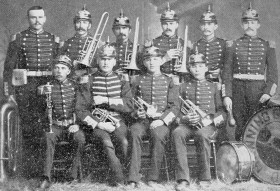
A NEW BAND was organized in August, 1884, and consisted of the following members and instrumentation: Frank Arney, B. Frazer and W. J. Marrow, Ef. Cornet; G. C. Hunt and Frank Tidd, Bf. Cornet; Paul Winter and Fred Grossman, Ef. Alto; D, W. Patton and E. Smith, Bf. Tenor; H. W. Reed, Baritone; E. L. Ives, Tuba; Charles Coe, Bass Drum; Frank Guild, Tenor Drum.
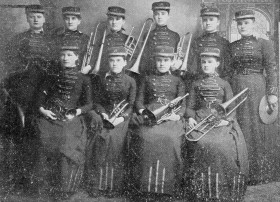
A LADIES BAND was organized in August of 1888, with Prof. Blocker as instructor and leader. The members and instrumentations were: Adora Smith, Bf. Cornet; Gertrude Bell, Ef. Cornet; Effie Lathrop, 1st Alto; Clara Branson, Solo Alto; Maude Rogers, 21 d Tenor; May Benson, Trombone; Kate Phillips, Baritone; Millie Blair, Tuba; Edna Lathrop, Tenor Drum; Jennie Blair, Bass Drum.
The ladies displayed great musical talent, and gave a number of concerts that were highly
appreciated. Their support was sought at nearly all public entertainments, and always
received hearty applause.
It appears, However, that cupid's heart was not susceptible
enough of tempering by the sweet cords of their enchanting art to stay his hand that held
the dart and leave their many admirers to continue in the enchantment of their musical
environment, nor would he spray upon them the fountain of youth that never fading blush
of maidenly beauty and leave them as the one muse who vibrated the life strings that,
respond in melodious enchantment to the soul; but with a flinty heart and a quiver full of
darts, cupid waged merciless and vigorous war against their susceptible hearts. So much
so, that but few of the fair it ones survived his terrible onslaughts.
As a result, petty
jealousies, and later, family dissentions arose and the enrollment began to increase so
rapidly that disbandonment became imperative. The organization ceased in Sept., 1890.
THE MANNING STRING ORCHESTRA was organized June 10, 1896. Following are the members and instrumentation: C. Langer, Leader- 2nd Claronet; Charles Schmidt, Manager 2nd Claronet; Paul Jentz, 1st Violin; Joseph Loch, Cello; Charles Lyden, 1st Cornet; John Vossbeck, grid Violin; Chris Larson, 1st Claronet. At the present time Charles Schmidt plays 1st Cornet and is manager, Charles Lyden plays 1st and 2nd cornet and is leader, and William Schelldorf plays 2nd Cornet, C. Langer has withdrawn. They play, principally, for dance and opera music.
THE I. O. O. F. BAND was organized in December of 1896, with the following members and instrumentation: John Hoffmann, Ef. Cornet: H. Claussen, 1st Alto; John Schnoor, Tuba and Tenor; John Vossbeck, Cornet; Charles Schmidt, Cornet; C. Langer, Claronet; F. Wendel, Tuba. John Hoffmann and Fred Wendel have withdrawn. The following are new members: Louie Johnson, 2nd Alto; H. Hoffmann, 1st Cornet; Gustave Kuehl, 2nd Cornet; H. Thompson, Baritone.
A BOYS BAND was organized in the winter of 1894. embers and instrumentation: Graham Young, Solo 13f.; Peter Loch, 1st Cornet; Henry Opperman, Solo Alto; Guy Marnett, 1st Alto; Charles Dickson, 2nd Alto; Clarence Sprinkle, Baritone; James Sutton, 1st Tenor; Charles Signall, 2nd Tenor; Honnas Ohrt, Tuba; George Dau, Tenor Drum; Guy Jenson, Brass Drum. Owing to the expense of sustaining a band, and some of its members withdrawing, the organization did not exist more than a year, however, they acquired a good knowledge of music and displayed good musical talent. They were instructed by C. E. Lyden, who is said by musicians, to possess great musical talent.
A DRUM CORE was organized by Alec Young, in April of 1893. The money, to defray the expenses, was raised by subscription. The core was composed of the following members, with Cap. S. D. Priest, as leader and instructor: Fifers --- Floyd Freelove, John Jenson, Charles Smith. Edward Breckenridge, Guy Jenson, Edward Garrels, Joe Ross and Bert Johnson; Drummers --- S. D. Priest, George Dan, John Reimer, Edward Denny, Guy Marnett and F. Schoening. Drum Major Louis Knapp. The core was organized for Decoration day exercises, and did considerable playing throughout the summer. THE TOWN BAND is composed, principally, of other musical organizations which met and practice together, only, for special occasions.