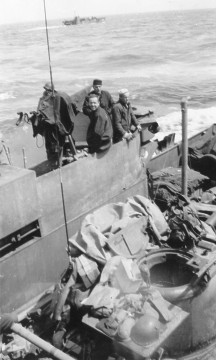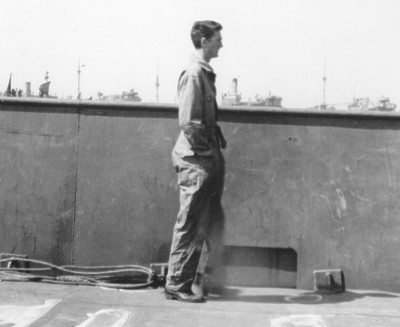
Above is the Skipper of the 537
He was a ticket taker at the Paramount Theater in New York, N.Y. before entering the Navy.
|
Full speed ahead The 537 was the first boat to land on Omaha Beach about 5:30 a.m. But Mohr's craft wasn't supposed to hit the beach. The invasion was timed so the boats could lower their ramps over barbed wire which the Germans had lined between the points of high and low tide. As the 537 approached the wire, its skipper ordered full speed ahead. He was supposed to have the engines reversed so the boat could stop before the wire. "I could see the barbed wire and the posts, but you don't disobey an order," Mohr said. The boat plowed through the wire and slid onto the sand. The tanks and Jeeps were unloaded as dawn broke. The troops were ordered to get off the ship and dig foxholes. That was difficult, Mohr said, since sand kept caving in and the holes filled with water. |
Other memories of Bud:
Flares were shot into the night sky when the LCTs got close to the wire barricades so they
knew when to stop and drop their ramp over these barricades to allow the tanks and
equipment easier access onto the beach.
The lead amphibious tank that left their LCT during the initial landing was hit by a German 88 which killed all of the U.S. soldiers inside. Bud said these 88 shells would superheat the tanks along with shattering the steel hulls.
Another common scene was of fellow U.S. soldiers seriously wounded within a few yards of
Bud and the crew of the 537 but they did not dare get up to help them or they would have
been shot and killed too.
Bud remembers seeing one U.S. soldier who had his arm completely blown off
only yards away but no one could get to him to put a tourniquet on him so he bled to death.
Above is the Skipper of the 537
He was a ticket taker at the Paramount Theater in New York, N.Y.
before entering the Navy.
|
Bird's-eye view Huddled in his hole, Mohr could see all that went on at Omaha Beach the entire day. He watched soldiers get cut down as they ran down ramps from LCTs (landing craft infantry). Some body piles were 10 feet high. "It was the damnedest mess you ever saw," he said. "As the tide came in and went back out, the foam off the English Channel was rose-colored because of that many people getting killed." Fortunately, the Germans believed the LCT had been abandoned so it didn't draw much fire, Mohr said. But bullets and 88-millimeter rounds from the heavily fortified coastline still whizzed overhead. Behind and to either side of the 537, the battleships Nevada and Iowa pounded German positions inland. "You hear D-Day called 'the longest day.' Yeah, that was sure true," Mohr said. "Some people you know you could help by shutting their blood off if their arm was shot or something. But if you got out, you got hit. And to see them laying all around kind of gets to you. Now I often wonder how the hell I ever got through that." The 537's screws had gotten tangled in the barbed wire and that night the captain ordered the motormacs to crawl back and chisel it off. The wire was wound so tight it had to be cut strand by strand, Mohr said. When the tide came back in, it floated the ship "and we got the hell out of there," Mohr said. That was about 1:30 the next morning. Several days later, the 537's skipper was demoted for beaching his boat and jeopardizing the lives of his crew. |
Other memories of Bud:
The constant explosions, bullets whizzing by and bombs falling was deafening.
A sound that Bud will never forget.
3800 U.S. troups were killed during the first 5 hours of battle.
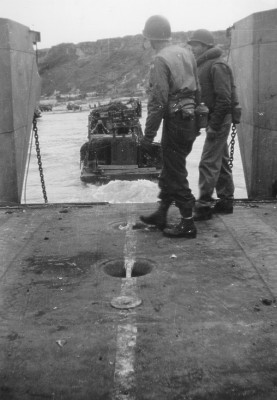
The picture above shows a troop truck with supply trailer leaving the 537 on D-Day +2
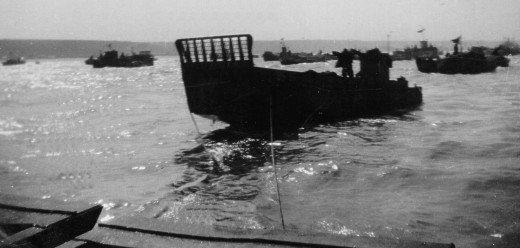
Above --- a PT boat landing
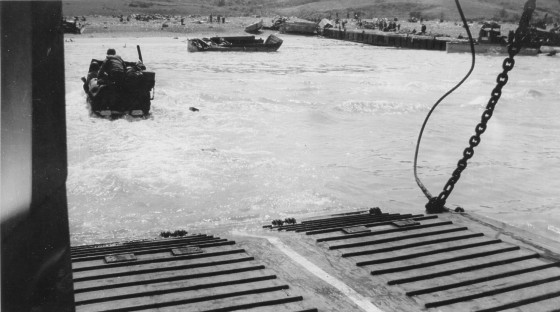
Above --- a Jeep leaving the 537.
|
|
The 537 with a tank on the deck and in the distance on the waters of the English Channel is a transport ship. |
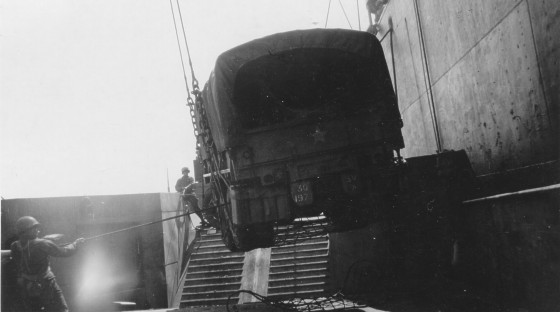
Unloading a troop truck from a transport ship onto the 537.
These large transport ships carry 200 jeeps & 300 troop and cargo trucks.