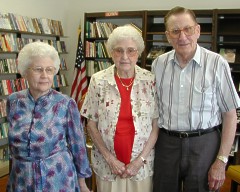
Marge Kienapfel (Hip's sister), Eileen (Hip's wife) & Hip
July 13, 2002
WORLD WAR II ACTUAL COMBAT
In October of 1993 I announced that I would not seek a fifth term as mayor of Carroll, Iowa. My term ended December 31st, 1993.
Shortly after January 1st, 1994 I started receiving letters and telephone calls asking me to do various things. One of which was to write up my 24 year military career (1941 - 1965). I'm not trying to rip as many people as I can; I just want to set the record straight, give credit where credit is due and tell it like it really was. Some people will have their doubts but if a person has not been in actual combat and face to face with the enemy it's very difficult for a person to understand why we did some of these things.
In 1939 the Federal Government passed a law that all male citizens age 18 and older (I don't remember the top age) had to register for the draft.
I signed up for the draft and was drafted, along with 9 other men, on March 26th, 1941. We were the first group of all draftees from Carroll County. Before this the County always had mostly volunteers along with a few draftees to fill their quota--(one of the few things I ever won).
We were inducted in Omaha, Nebraska and sent to Fort Levenworth, Kansas where we stayed for three days. On the third day I volunteered for KP to watch and fill a large potato peeling machine. No matter how big the potatoes were when I put them in the machine they all came out about the size of a golf ball. I was never asked to do KP again.
It must be remembered that this was very early in the draft and people hadn't paid much attention to the military because during the depression Most of us were mostly interested and concerned with making a living and saving the farm.
Two of the men that left Carroll on March 26th failed their physical. The remaining 8 were sent to Fort Riley, Kansas. I went to the 14th Horse Cavalry Regiment. We started basic training and two weeks later about 500 head of remounts arrived. Two men and myself were detailed to put a saddle on each one of these horses and ride them to determine which would be used for pack-horses and which would be riding horses. These horses were not broke. Some had not even had a halter on. The three of us tried to do what we were asked to do but we spent much of our time on the ground where we landed after we were bucked off. One of the men was bucked off and the horses hoff caught his right ear and nearly tore it off. We took him to the hospital where it was sewed on. On of the horses stepped on my left foot and smashed my big toe. It split the toe nail and now, many years later, the split is just about grown out.
On June 1st I was sent to Midland Radio and Television School in Kansas City, Missouri to become a radio operator. I graduated on August 22nd. Instead of going right back to Fort Riley I took a short cut through Carroll; got married to Eileen Peters, the young lady I had been courting for 4 years, and I returned to Fort Riley on August 24th. We had planned to be married in June but those plans were changed when I was drafted. (Eileen is still waiting for the honeymoon). This was before the United States was in the war (peace time). My salary was 21 dollars a month as a Buck Private and I was to have permission from War Department to get married because they thought that you could not raise a family on $21 per month.
EILEEN EUNICE PETERS---my wife---was born in Crawford County, Iowa located about seven miles northwest of Westside, Iowa. When she was five years old she and her parents moved to a farm five miles southeast of Arcadia. Iowa. She attended rural school and graduated from Carroll Public School Carroll, Iowa in 1937. She worked as a legal secretary in Carroll until March 1942 when she joined me and we went to Fort Riley and then on to Camp Shelby, Mississippi.
When I returned to Fort Riley the 14th Cavalry went on maneuvers in Louisiana. I was promoted to Private 1st Class and assigned to he tie Chief Radio Operator for the 14th Cavalry Regimental Commander. Now I was paid $32 per month instead of 521 per month. During the course of maneuvers .the Regimental Commander asked me if I would be interested in attending OCS (Officers Candidate School). I told him that I had been drafted for one year and had not given any thought to a military career.
After maneuvers we went back to Fort Riley. Everyone was elgible for a 30 day furlough but I was asked to go on the Carolina maneuvers because they were short of Radio Operators. If I agreed to go I would be promised a 30 day furlough at Christmas. On December 7th, 1941 the Japs bombed Pearl Harbor and all furloughs were canceled and promises were off. On December 9th the 14th Cavalry received orders to prepare to move to Australia. We left Fort Riley in an ice storm on December 11th. That night we spent in the baseball park in Wichita, Kansas. The temperature was 10 degrees above zero. When we arrived in Tucson, Arizona we were held up because there were not enough ships in San Diago harbor to take all our horses and equipment to Australia. We were assigned the task of boarder patrol because there were about half a million Japanese in Old Mexico. I was put in charge of a detachment and moved to the Papago Indian Reservation at sells, Arizona. That's right on the Mexican border.
On the trip to Arizona I was still the Regimental Commanders Radio Operator who asked me again if I would be interested in going to OCS because now it seemed that no one would get out in a year. It was quite obvious that I would be in for more than a year so I agreed to meet with the board to see if I would be approved. On December 26th I was ordered back to Tucson to appear before a review board and on January 5th I was on my way back to Fort Riley to go to OCS. The class had started on January 2nd but I didn't get there until January 7th. There were 178 candidates in our class. Classes ran from 6:30 AM until 10:00 Pit. Of the 178 candidates that started about 75 were washed out the night before graduation.
I was commissioned a 2nd Lieutenant on March 26th 1942 Gust one year to the day that I was inducted into the army as a Buck Private. We were all given a three day pass. I went back to Carroll, picked up my bride and we went to Mannhatten, Kansas; rented an apartment and I reported for duty at the Republican Flats, a part of Fort Riley. About two weeks later I received orders to report to the Commanding Officer of the 85th Reconniassance Troop in Cane Shelby, Mississippi. which was part of the 85th Infantry Division. The Reconniassance Troop works with the Division G-2 Intelligence Section. All Officers and Enlisted Men, except those that worked in the kitchen or motor pool, had to have an IQ (Intelligence Quotient) of 125 or better.
The following year, 1943, the 85th went on maneuvers in the California Desert. We were 17 miles west of Yuma, Arizona where the temperature got up to 132 degrees. We lost a lot of good men because of the heat. We were being trained for desert warfare someplace but we didn't know where. Before maneuvers got a good start we were ordered to go to Fort Dix, New Jersey. After we arrived at Fort Dix we received orders to go to North Africa.
Eileen was pregnant and had gone back to Carroll to live with her parents. Our son, Bruce, was born December 23rd, 1943. I was already in Morocco, North Africa with the forward echelon of the 85th Infantry Division. Bruce was two years old the first time I saw him in 1945 when I returned to the United States). Bruce and I had a very difficult time getting acquainted because I had lots of problems with children in North Africa and Italy. If we didn't kill them they would give our position away to the Germans. Now I had a child of my own. This was the most difficult transition I ever made. It took several years for Bruce and me to get acquainted. Eileen went through HELL during this period. We have talked about this a number of times and I don't know how she ever put up with me. It's not difficult for me to understand why couples break up after the husband has been in combat for a long period of time. I had a total of 278 days of combat---This includes reconnaissance patron, combat patrols and front line combat from a fox hole. My problem with Bruce was that every time he would do some little thing that I didn't like---the first thing that would go through my mind was "where's my gun". For that reason I do not own a gun and probably never will.
While I was in Morocco waiting for the main body of the 85th Infantry Division the 1st Ranger Battalion asked me to help them by joining their unit until the main body of the 85th Infantry arrived because the replacement officers they were getting were not trained in reconnaissance work and some were killed or wounded on their very first patrol. Some of the replacement officers were killed by their own men because the new officers did not know what they were doing and the veteran rangers were not going to put their life on the line with a leader that was bluffing his way.
The Rangers were interested in me because I have a Top Secret Security Clearance, I speak both High German and Low German and my top military asset is tactics. I have the reputation of getting the mission accomplished with the least number of casualties and losing a very small amount of equipment.
The third time they begged me to help them, I agreed. I was attached, unassigned to the First Ranger Battalion. They were fighting both the German Army and Italian Army In the Morocco and Algerian Desert. The enemy was still very strong; they had Air Superiority and we had very little equipment. He built things that looked like tanks out of tar paper and large posts for muzzles. The Luftwaffe would fly over during the day and take pictures. Later, after dark, they would bomb our home made tanks. The next day we would build more tanks.
We had half-tracts but the sand in the desert would grind out the bogie wheels in no time. We didn't get armored cars until early 1944. I was asked to take the first armored car patrol. The torut, which had a machine gun and an anti-tank gun mounted in it, would traverse 3G0 degrees. I pointed the weapons to the rear and moved around the mountains in reverse because the armored car would only go about 6 miles per hour in reverse but 00 miles per hour forward. I didn't care how fast we moved toward the enemy but if we were spotted I wanted to get away fast.
The enemy had very well planned mine fields and we did not have mine sweepers or any equipment to clear them. We ran sheep or goats through the mine fields to blow up the mines. When we did not have goats or sheep we ran Arab men, women and children through the mine fields to blow then up.. This was shortly after the United States got involved and we were desperate. The Rangers had 82 per cent casualties before they left North Africa mainly due to the lack of equipment.
Then came the invasion of Sicily---then the invasion of Italy. By this time the allies were gaining Air Superiority and we were getting more equipment along with a lot more missions.
(I might mention here what it's like when you are asked to take out a patrol. It usually starts with a meeting at Division Headquarters. After which you go back to your own headquarters and head straight for the latrine because at this point you are so scared that you can't hold it any longer. Then I would go back to my men, explain the mission and ask for volunteers to go on patrol with me. I never asked anyone to go; I only took volunteers).
The Salerno, Italy invasion was a complete surprise to the enemy but it wasn't long until the Germans were moving toward Salerno. We called for air support to strafe the enemy columns moving toward Salerno. To do this we would radio our Troop; they would radio Division Headquarters who would contact the Air Corps; they would contact the Squadron who would notify the pilots. They would get themselves oriented, get their planes warmed up get off the ground and on to where we wanted their support. By this time the enemy was already in position and shooting hell out of our invasion forces. Sometimes when we called for air support it took so long for them to get there that we would already be in the area where we needed their help. We would get strafed by our own Air Force. At times it was difficult to tell who caused the most casualties--the Germans or our own Air Force. Because of these situations it is not difficult to understand why the ground forces and the Air Corps did not always get along.
By this time the Germans had brought up so much fire-power that our troops wouldn't move off the beach. General Montgomery, a British Officer, was the Supreme Commander. He ordered our Officers to shoot some of our men to get then to move. Our Commanding Officer told us to just stay calm. He sent a Combat patrol around the right flank to knock out the machine-gun nest and our men were able to advance. Our Commanding Officer saved lives but he was relieved of his command because he did not follow General Montgomery's orders.
When the Anzio Invasion started the Germans moved some of the troops that were fighting in southern Italy to the Anzio area and that gave us some relief so that we could move on toward Naples. While we were in Naples area I flew some artillery observations in Piper Cub airplanes. The Germans still had some air craft and they liked to chase us because they knew that the Cubs had no fire power.
We continued North until we connected up with Anzio. The Americans had the west sector of Italy because that's where the larger cities are and that's where General Montgomery expected the most resistance. The British had the east (less resistance) sector but they got stalled because the German Forces were to strong and then General Montgomery had us change sectors until we had the area secured and then we switched back, to the west sector.
Now I was with the 85th Reconnaissance Troop again. The Italian Army had given up but some of them were still fighting with the Germans who were retreating. We moved on toward Rome. I was on a patrol along with two of my men and we have the distinct honor of being the very first Allied Troops in Rome. About two weeks later we were asked to return to Rome to have an audience with Pope Pius XII. When we arrived at the Vatican we were met by the Swiss Guards who ushered us to a location where we could observe the Pope while he stood on the balcony and spoke to the group of several hundred people. Then the Swiss Guards ushered us to a room where the Pope came, walked up on a little platform, spoke to us in very good English; thanking us for being the very first allied troops in Rome. He shook hands with each of us and gave us each a medal with his blessing.
We continued North to the Minterno River where we met with some resistance but we were able to save the bridge which the Germans had prepared for demolition. We did this by having two of our men swim up the river under the cover of dusk and cut the wires that were hooked to the demolition charge. We waited until the German, that was to set off the charge, came out of his hole to check why the charge didn't go off. We shot and killed him and saved the bridge.
We continued North across the Poe Valley to the Poe River where we captured about 1000 Germans because the Germans had blown the bridge. The Italians were ferrying the Germans across the river. We ordered them to come back but they kept going until we blasted them with machine gun fire. That changed their minds. We had the prisoners leave their weapons at the river and I had one of my men march the prisoners back to our POW area. The German prisoners were ready to give up and didn't give us much trouble. They knew that we didn't like to take prisoners because we had to share our rations with them. If they gave us trouble they knew they'd be shot.
It was from these prisoners that we first learned about the Invasion of Western Europe that was to take place in the next several days. We asked these prisoners what was going on because we had noticed less resistance and they told us that some of their troops were moved to Western Europe because of the invasion that would start soon. Eisenhower and his command had advertised where and when the invasion would be. If you don't have lots of casualties you don't get publicity. A good example of this is the invasion of Sicily and Italy where there were less casualties because of the total surprise to the Germans. Yet those invasions were as much a part of the success of the war as the invasion of Western Europe or Pearl Harbor. History books don't even mention the invasion of Sicily or Italy.
We continued North across the Poe Valley to the foot of the Alps Mountains where I spent 28 days in a foxhole and eating K rations. The Germans had fortified the mountains very well. They had built concrete emplacements "Pill Boxes" that housed machine guns and large, long range artillery weapons (called railroad guns) that could fire a projectile up to 12 miles. The only way we had to knock out these pillboxes was to go in after them. The Germans did everything by the clock. From our position we could see when they went to eat or when they went to do anything. There were six or eight men in a pillbox crew. They would leave one man on duty at or in the pillbox and the others would go to eat their evening meal exactly 8 PM. We went in with hand grenades, killed the man they had left; blew up the guns and got out as fast as we could. To this day I do not like mountains because they bring back memories that I want to forget.
When we were fighting in the Alps it rained just about every day. When I was hit I had to walk about five miles to get to an ambulance because the roads were either washed out or bombed out. I was put in a field hospital; stayed there four days and went AWOL because I had nothing with me and the hospital gave one blanket. I nearly froze to death. From all the rain there was a stream of water running under my cot. The Red Cross provided nothing. I went back to the 85th Reconnaissance Troop Headquarters with our ration truck. The Troop Headquarters was located in a Housebarn with a fireplace.
About the same time as the Normandy Invasion was going on we invaded Southern France but no one heard much about that invasion because it was a complete surprise to the Germans and we had very few casualties and of course that invasion didn't get any publicity. If you don't have lots of casualties you don't get much ink.
After V.E. day I was asked to go to Pisa, Italy because I had been in the horse cavalry. We had about 5,000 head of horses that the Germans had confiscated from Arabia, France , Morocco and other-places. The Germans had used them to pull their artillery and other equipment. We shipped them out of the port of Leghorn, Italy. We returned all the mules that were left of those that we had on lend-lease from Great Britain and we replaced the mules that had been killed with horses. Vie sent other horses back to Arabia, France, Morocco and other places where the Germans had confiscated them.
I had enough points to come home with the 85th Reconnaissance Troop but I was declared essential because I could speak German and the 5th Army did not have enough help to interrogate all the German Prisoners. I was ordered to report to the 5th Army Headquarters to interrogate German Prisoners in Italy. I was the Officer in charge and I had one enlisted man to help. The two of us interrogated 250 German POW's a day because that was what the train would hold, depending on how many bed-fast patients we had.
We were in what had been a resort area and all the hotels were being used for hospitals. We had a total of about 10,000 German prisoner/patients to process. One ward was all women. Most of them had some type of venereal disease. We were looking for members of the German SS. Most of them had SS tattooed in their left arm-pit. When I was told about this interrogation job I was told that it would be for about 6 weeks but after 6 months I was still there. I went to the 5th Army Headquarters and talked to General Mark Clark; told him my story. In three days I received orders to return to the United States.
I arrived in Carroll on November 11, 1945. Eileen met me at the Highway Cafe and we went out to her parent's farm, where she had been living and I met my two-year old son for the very first time.
I requested to go on inactive status and did so in March, 1946 (just 5 years to the month from when I was drafted in 1941). I stayed in the ROC (Reserve Officers Corps) and joined an Infantry unit in Carroll. When I was commissioned I was Branch Qualified in the Horse Cavalry. I went to Mechanized Cavalry unit and was Branch Qualified in the Mechanized Cavalry. Now I joined an Infantry unit and had to become Branch Qualified in Infantry. The Infantry unit left Carroll so I joined an Artillery unit in Ames. Iowa and then I had to become Branch Qualified in Artillery. After 24 years of service I retired in 1965 with the rank of Lieutenant Colonel, two Bronze Stars, a Purple Heart and a life time membership in the ROA (Reserve Officers Association), In the second paragraph I stated that I would tell it just like it really was and I want to give credit where credit is due.
Just recently the Federal Government has been questioning the value of Government owned Military Schools like Annapolis Academy, Air Force Academy or West Point Academy because the cost is much greater to put a student through one of these academies as compared to paying the student to take ROTC in a College or University. The Officers that get their training in
ROTC (Reserve Officers Training Command), OCS (Officers Candidate School) or Officers that come up through the ranks in National Guard do an excellent job. They all start as Second Lieutenants and they are the Patrol Leaders and Platoon Leaders that come face to face with the enemy. During the 278 days that I was in combat or on patrol I never saw a General, Colonel, Lieutenant Colonel or Major up where the actual fighting is going on and there were only a very few Captains up there.
I never saw a Captain on a Reconnaissance Patrol. I never saw a West Point graduate up there either. During WWII I was told that the West Point graduates were members of the WPPA (West Point Protective Association). Yet when a person reads the news or listens to the radio or watches television the high ranking officers get the credit. I will agree that all the high ranking officers were 2nd Lieutenants once but those that were high ranking officers during WWII were 2nd Lieutenants during peace time.
There aren't very many soldiers with lots of combat time that come back healthy. I was one of the more fortunate ones and I attribute that to Prayer. It has been said and I know it's true that there is no such thing as an atheist in a fox hole. Prayer has been the greatest help I have had in making projects successful. Anyone that has been on a Combat Patrol or has been in a foxhole under enemy fire and says that he didn't pray is not telling the truth.
The vast majority of those killed or wounded in combat are Lieutenants and Privates but these are the people that you never hear about. The high-ranking officers get the credit. None of the invasions or combats are easy and those that give their life in any war have paid a tremendous price so that we can continue to live in freedom.