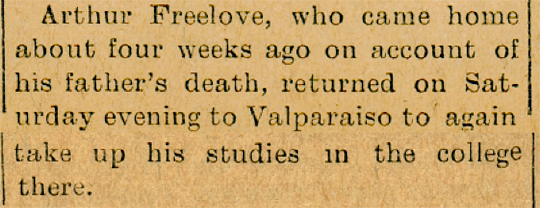
December 18, 1896, Manning Monitor

July 18, 1900, Manning Monitor
Arthur Lloyd Freelove was born at Arcadia, Iowa, on November 24, 1873. His parents, Mr. and Mrs. Matthew Freelove, while Arthur was yet an infant, moved to Manning, Iowa. Here Arthur spent his boyhood, entered the public schools and later the high school, graduating in 1891.
At school Arthur was a good student. He also took an active part in athletics and distinguished himself as a baseball pitcher and as a foot racer. His soul and body thus grew hand in hand - a rare combination.
After graduation Arthur began to look out upon life and its possibilities. Like many others he used teaching as a stepping stone to advancement. In the school room he gained some or that knowledge in dealing with others that he missed as a student and as an athlete. He taught two years, worked summers and thus saved some money.
Arthur now began to feel that the school room did not give him sufficient opportunities for advancement. He therefore entered the law school at Valparaiso, Indiana. He longed to pursue that mysterious subject, the law. To his credit, he completed the law course without financial assistance from home or from his friends. His strong mind and strong body enabled him to put in long and laborious hours. Aside from his lessons he ventured out hunting jobs with which to earn a competence. The year 1897 witnessed his graduation from the law school, admission to the bar in the states of Indiana and Iowa, and also admission to practice in the United States Circuit Court of Indiana.
The University now no longer looked attractive to him. He began practicing law in a small town. The young lawyer hung out a shingle at Rolfe, Iowa. He was very active but soon saw greener fields and moved to Britt, Iowa, and entered the practice of law there. Here he remained a little over a year and then opened a law office at Pocahontas where he remained until 1901. He then moved to Sioux Rapids, Iowa, to engage in the practice of law.
In the first four years of practice of law after graduation, young Freelove had gained much valuable experience that was of great benefit to him in later practice. This period witnessed the passing of the boy, as such, into ripening young manhood. He was now no longer an experiment, but a product of success.
This transition period, 1897-1901, was marked by a very important event in the life of A.L. Freelove, It was at this time (1899) that he married Miss Alma Dorothea Franke (1892 Manning High School graduate). Miss Franke had been a brilliant student in school and at the time of her marriage was a young teacher of marked ability. Miss Franke was a good match for him in keenness of mental perception and acumen. It is seldom that two young persons start out so evenly matched in mental attainments. Miss Franke was also a young woman of strong religious convictions and a home maker. By the time A.L. Freelove moved to Sioux Rapids his home had been blessed by the arrival of a son in the person of Arthur Franke.
On April 14, 1903, a second child was born, Dorothy Louise. These are the only children.
It was at Sioux Rapids, Iowa, that A.L. Freelove rounded out his career of young manhood as a professional businessman. Here he was counsel for the First National Bank and in this capacity came in touch with some of the big business men of his state. He also ventured out into the land business and at the age of thirty-four, when he moved to South Dakota, he had accumulated much for a man of his age.
During this period Mr. Freelove also took active part in politics. He united himself with the Cummings forces and was one of the young men in that state who assisted in the nomination and election of A.B. Cummings for Governor of Iowa. He was also twice elected mayor of his hometown - Sioux Rapids.
On moving to Lyman County in 1908, A.L. Free-love retired from the active practice of law, as such, and followed the banking and real estate business. However, he still kept up his studies and was admitted to the South Dakota bar in 1908. For the first few years he had considerable practice in probate and land matters but banking and real estate business interested him most. At various times he also operated large farming interests in conjunction with his partners. During the World War, and until the spring of 1923, the First National Bank of Kennebec occupied his entire time. He retired from the office of President of the bank at this time and devoted his entire time to real estate transactions. At the time of his death he had disposed of considerable real estate.
For many years after coming to South Dakota Mr. Freelove took no active part in politics. However, in 1919, without solicitation on his part, he was tendered the nomination for State Senator for Lyman and Jones Counties, by the Republican party and was later elected. While in the State Senate Mr. Freelove took a prominent part in debates. To him duty, not polities, came first and he was considered a poor politician. If a measure looked bad to him, he opposed it, no matter whether it was popular to do so or not. Naturally he came into conflict with the administration in power. He was made chairman or the cement plant commission and also held positions on important committees. Before the end of the term he had become well known over the entire slate as a brilliant debater and an able legislator.
During his legislative period, Mr. Freelove won such distinction that many of his friends began to urge him to become a candidate for governor. He talked this over with his friends and associates but never got far enough along to make any definite announcement. Could he have lived and been elected he would have put better business administration into the state government and some of the present duplications would have been eliminated.
What were the outstanding characteristics of this man Freelove - Kennebec's foremost citizen? What were the attainments that gave him this first place in the lives of his townsmen? They are many. No one knew him completely. Like others, Mr. Freelove did not show all of his inner self even to his most intimate friends. He left one to arrive at conclusions from an analysis of that part of the inner man that came to the surface. Deep rooted in his mind were many problems that he tried to fathom and solve, but on these he did not seek aid from others. Yet he was considered a most frank and outspoken man.
As a banker Mr. Freelove combined the rare quality of being a booster and yet a safe banker. He had fundamental confidence in humanity and knew a good risk. This enabled him to start many young men and yet not lose anything to his bank. He had the happy faculty of combining public and community welfare with good and safe banking. He took a prominent part in the affairs of the State Bankers Association and was an active member of that body.
Mr. Freelove's integrity and honesty was never questioned even by his enemies - if enemies he had. To him it was a disgrace to dishonor one's signature on an obligation. He had great confidence in those with whom he associated in business. Unkindness and unfairness were foreign to his nature and he disliked contentions. So much did he dislike contentions that he would often allow himself to be greatly wronged rather than stir up strife.
Mr. Freelove believed in living and let live. He was always willing to liberally compensate those who assisted him in consummating any of his business transactions. He had a good word for his competitors in business and never tried to enhance his own interests by effecting the downfall of someone else. He stood aloof from cold-blooded business methods - a rare quality in a man of active business affairs.
Mr. Freelove was a great lover of his home and family. He was never happier than when playing with his children and he was a constant pal to both of them. This friendship grew closer and dearer with the passing of the years. While thus kind, as the kindest father, to his children, he did not forget the wife and mother. His devotion to her was constant, true and kind at all times.
Arthur Freelove
Arthur was the second child born to Madison B. & Mary (Goundry)
Freelove. He attended the schools of Manning, Iowa, and graduated from the
College of Law of Valparaiso University at Valparaiso, Indiana, in 1897. His
first practice was at Britt, Iowa, for a year and a half, after which he
removed to Sioux Rapids, Iowa, practicing there until 1908. He also became
connected with banking and real estate and proved successful in those lines. He
came to Kennebec, South Dakota, in 1910 and purchased the controlling interest
in the Security State Bank, which he converted by charter into the First
National Bank of Kennebec in 1911. He was also president of the First National
Bank of Oldham, which he purchased in 1911 and of the Reliance Savings Bank of
Reliance. He also served as vice president of the State Bankers Association.
He was also a member of the Freelove & Costner Land Company, who owned extensive land tracts and operated the largest ranch in the county, devoted to stock-raising and alfalfa growing.
He was united in marriage, January 11, 1898, to Alma D. Franke and to this union, two children were born: Arthur Franke and Dorothy Louisa Freelove.
Mr. Freelove was a member of the Methodist Episcopal Church and contributes liberally to its support.
HEART FAILURE TAKES FREELOVE
Ex-State Senator A. L. Freelove Dies Suddenly While Visiting in Kennebec Home
Shortly after he went whistling up the stairway at the home of Judge Albert
Williamson, of Kennebec, where he was a guest, ex-Senator A.L. Freelove, a
prominent resident of Western South Dakota, dropped dead at 12:30 this
afternoon in his room, of heart failure.
Up to the time of his sudden death he apparently was in good health.
Hearing a thud on the floor of his room, Miss Dorothy Williamson went to the
scene, finding his dead body on the floor.
He was born in Iowa in 1873, and in 1902 was elected a member of the State Senate.
Argus Leader, October 26, 1923
A.L FREELOVE, KENNEBEC, DIES
Was Prominent Booster of West River Country
Ex-Senator A.L. Freelove of this city passed away suddenly Friday noon at the
home of Judge Albert Williamson.
Mr. Freelove had been in good health, apparently, and had been engaged in
packing some furniture during the day. He went across the street to Mr.
Williamson's home, where he and Mrs. Freelove were staying while some changes
were being made at their own home, and went up the stairs, whistling as he went.
At the top of the stairs he stumbled and fell. His niece, Dorothy, went to him
Immediately but he was dead when she reached him.
Senator Freelove was one of the respected builders of Lyman County and the entire west river country.
His name is associated with many Philanthropic endeavors. He endowed a
scholarship fund at Dakota Wesleyan.
During 1921, he was chairman of the cement products committee in the state
senate at the time when the second million dollar issue of bonds was authorized for
the plant located at this city. Paul Bellamy, then secretary of the
cement commission, reports that Mr. Freelove had a great deal to do with securing the additional appropriation.
Rapid City, South Dakota, Journal, October 28, 1923
DEATH SENATOR FREELOVE OF LYMAN COUNTY
Ex-Senator A.L. Freelove of this city died suddenly Friday noon at the home of Judge Albert Williamson.
Mr. Freelove had been in good health, apparently, and had been engaged in
packing some furniture during the day. He went across the street to Mr.
Williamson's home, where he and Mrs. Freelove were staying while some changes
were being made at their home, and went up the stairs, whistling as he went.
At the top of the stairs he stumbled and fell. His niece, Dorothy, went to him
immediately, but he was dead when she reached him.
Senator Freelove was engaged in the banking business and was prominent in
affairs of this section, business, political and philanthropic. He endowed a
scholarship fund at Dakota Wesleyan University at Mitchell, South Dakota.
Black Hills Weekly, Deadwood, South Dakota, October 29, 1923
SENATOR FREELOVE DIES AT KENNEBEC
Was Well Known in Western South Dakota Figure
Ex-Senator A.L. Freelove, died suddenly at the home of Judge Albert Williamson last Friday noon.
He happened to be staying at Williamson's home for a short time. He was
apparently in good health and was whistling as he carried some things up the stairs.
At the top he stumbled and fell, his niece, Dorothy, coming to his assistance, found him dead.
Senator Freelove was a pioneer of Lyman County, and was widely respected. He
endowed a fellowship at Dakota Wesleyan University. In 1921, he was chairman of
the cement products committee in the State Senate, when the second
million dollar bond issue for the plant at Rapid City, was authorized.
Lead Daily Call, South Dakota, October 30, 1923
STATE SENATOR DIES SUDDENLY
A.L. Freelove Passes Away While Visiting at Home of Judge Albert Williamson
Kennebec, South Dakota November 8
State Senator A.L. Freelove, who died suddenly while a guest at the home of
Judge Albert Williamson in this city, was born November 24, 1873, at Arcadia,
Iowa. When a child his parents moved from Arcadia to Manning, Iowa. Here he was
educated in the city schools and graduated from the Manning High School in
1891. After graduating he taught school for two years near Manning. He then
entered a law office at Manning and studied law and practice in justice courts of the county.
In 1894, he entered the law college of Valparaiso, Indiana, and graduated in 1897.
In that year he was admitted to practice law in the state of Indiana and in the U.S. circuit court of Indiana. In October of that year he was admitted to practice in the state of Iowa.
In June 1893, he was admitted to the bar in South Dakota by the supreme court.
Admitted to Bar
After graduation in the law school of Valparaiso he returned again to his home
state of Iowa, and commenced his practice of law in the city of Ralph, where he
remained until 1898. At that time he moved to Britt,
Iowa, and remained there until April 1901, when he moved to the city of Sioux
Rapids, Iowa. Here he remained until moving to Lyman County, South Dakota, in June 1908.
As a young lawyer Mr. Freelove was very active and during his period of practice handled many cases of importance. He was counsel for the State Security, now the First National Bank of Sioux Rapids, Iowa.
He was married to Alma Dorothea Franke, on January 11, 1899, at Manning, Iowa. To this union were born two children, Arthur Franke and Dorothy Louise Franke, both of whom now resided in Glendale, Los Angeles, California.
After coming to Lyman County in 1908, Mr. Freelove retired from the active practice of law and engaged in the banking and real estate business. He was very active in the real estate business and disposed of more land than any other man in the county from 1908 to 1910. Since that time and up to the spring of 1922, he was president of the Security State Bank and later of the First National Bank of Kennebec, South Dakota, when it was nationalized. During this period, however, he was also engaged in the real estate business and made many large deals.
From 1919 to the spring of 1923 he devoted practically all of his time to affairs of the First National Bank. After retiring from active management of the bank he again gave his time to real estate and closed numerous deals during the spring and summer.
His Public Record
A.L. Freelove was never a seeker of public office. However, he always took an
active part in the public affairs of his home town county and state. While at
Sioux Rapids he was a delegate to the Republican convention that nominated Cummings for Governor of Iowa.
He joined hands with the reform crowd. He stood for honesty in politics and was during this period twice elected Mayor of Sioux Rapids. He instituted reforms in that city, particularly in that he had the streets graded, graveled, and parkings taken care of and made attractive.
For a number of years after moving to South Dakota, Mr.
Freelove took no part in politics as such, yet he always took an active part in
the affairs that concerned his home town and county. In 1917, without any
solicitation on his part he was given the Republican nomination for state
senator and was elected in the forthcoming election. As Senator he was chairman
of the cement plant commission, and was largely instrumental in passing the
bill for a state cement plant. In the Senate he took an active part in the
debates and was considered one of the ablest speakers of that body.
Argus Leader Sioux Falls, South Dakota, November 3, 1923
I'm occasionally adding the actual scanned image of the obituary I make using my VERY expensive - large commercial scanner,
and/or also other articles about the deceased person that were published in the Manning Monitor.
I want to also comment about people who are taking my obituaries, pictures, and/or other articles about a person/family and posting them on other websites.
You do NOT have permission or the right to do this - you are stealing my historical work.
Buy your own scanning equipment, pay for memberships to other commercial websites,
and spend decades working on your local history like I have - then you'll understand why I'm making these comments!
Thank you for your attention to this matter - Dave Kusel
July 18, 1900, Manning Monitor