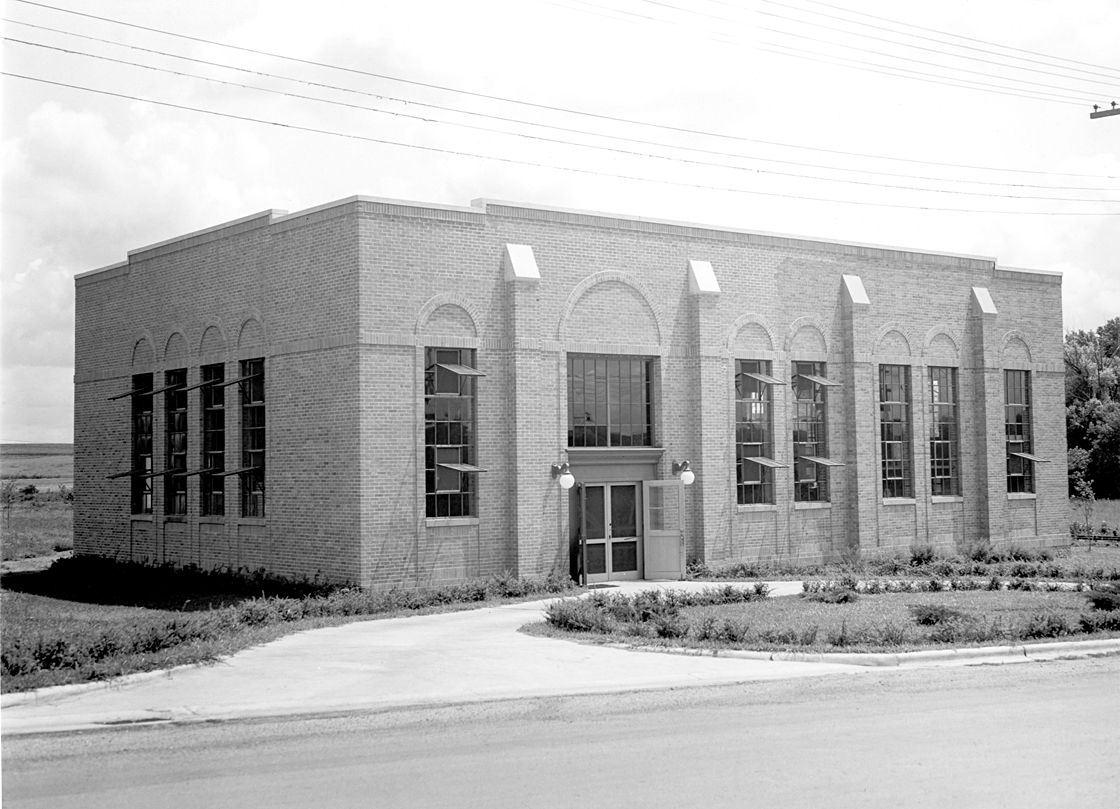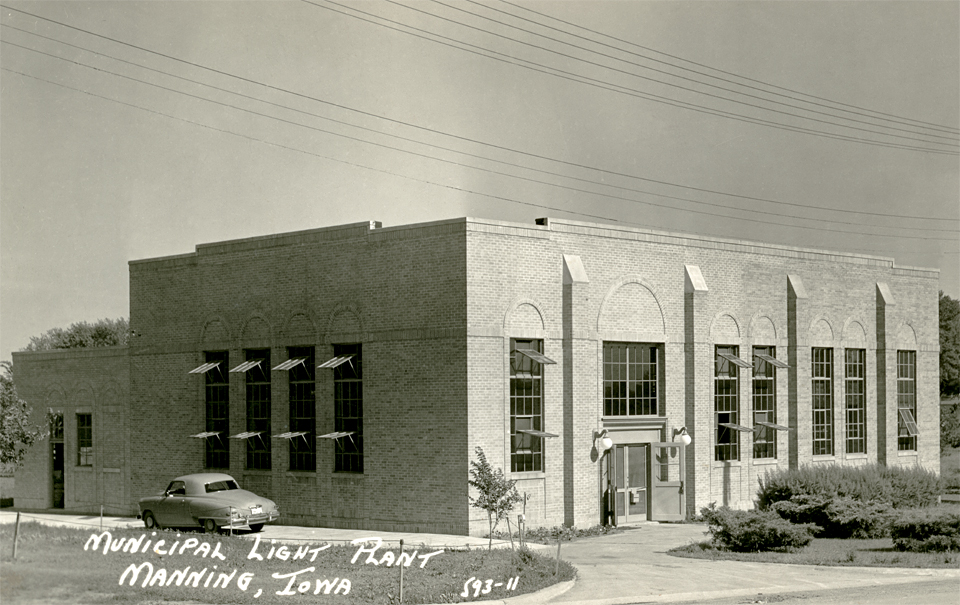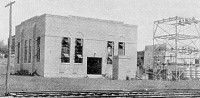
The south side of the light plant in the early 1930's.
Some history of the Manning Light Plant from the 1981 Manning Centennial history book
UTILITIES AND MUNICIPAL DEPARTMENTS
Histories of our utilities may be found elsewhere in this book, but the governmental procedures establishing them and the other various municipal departments are as follows:
Lighting
Lighting for our town in the early years created problems when six suitable oil street lamps were installed on Main Street in October 1885. These had to be lighted and turned off at midnight. In 1896, C.H. Reinholdt ordered one dozen additional oil lamps. Fred Miller furnished the oil at 13 cents per gallon. By October 1899, and continuing from time to time, street lamps were placed on various important corners around town. In May 1900, the Council hired someone to attend to the lighting, filling and extinguishing of the lamps, at a salary of $16.00 per month.
Telephones Appear September 30, 1900, an ordinance was enacted which covered the franchise with the Audubon Telephone Company to set up poles and install telephone lines. Their lease continued until the business became the Independent Manning Telephone Company.
The next ordinance called for an electric light plant and at an election March 1, 1901, the town granted a 10-year franchise to W.B. Swaney and Peter Ohrt, who established the Manning Electric Light Company. June 6 the town rented 10 arclight fixtures at a cost not to exceed $8.00 each from the Manning company. The lamps carried 2000 candle-power and were to burn all night. The company's franchise was again renewed in 1911.
MANNING MUNICIPAL LIGHT PLANT
Cities across Iowa began receiving electricity in the late 1880s; when Carroll opened a plant in 1887, a number of Manning people made a plea for a plant here. The question was put to a vote in 1897, but lost, some say, due to the businessmen who refused to support it.
Several of the businessmen turned to finding a way to produce a good, inexpensive light which could be operated on a small scale. By the summer of 1888, several businesses began receiving light from an acetyline gas machine. This was not entirely satisfactory, and other methods were tried in 1898 and 1899. The lighting was tried in Manning on a small scale basis, and limited to the downtown business district.
In 1901, the first electric light franchise was granted to W.B. Swaney and Peter Ohrt, for the span of ten years. Half of the present plant building on south Main Street was constructed by the Iowa Public Service Co. The plant only ran when it was needed by its customers. Mondays, the demand was light, as the women were outside doing the weekly wash; Tuesdays, the plant resumed operation, as the women stayed inside to do their ironing.
The plant building was completed in 1928 at an estimated cost of $100,000. The pressed brick structure, trimmed with cruscon stone and ornamental windows in the north, south, and west, was termed "one of the beauty spots of the city".
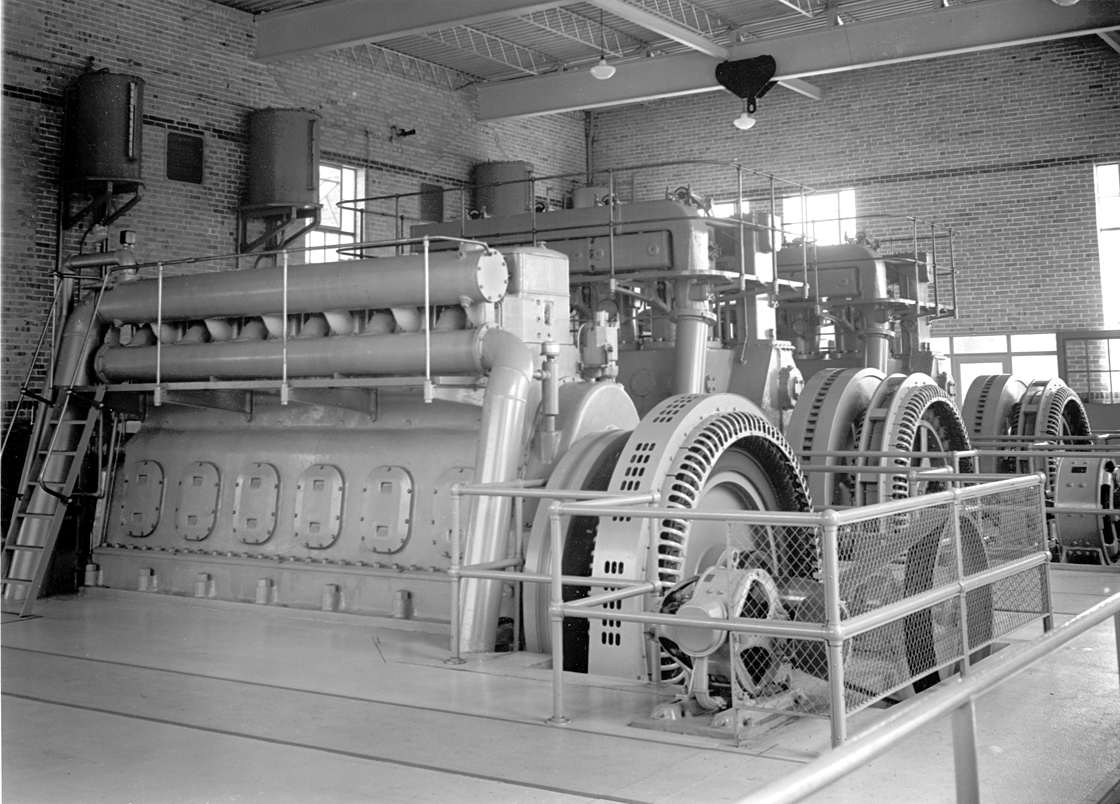
Two 400 horsepower oil engines, with a generating capacity of 500 kilowatts, furnished Manning with all of its light and power needs for 13 years. Maurice Heider was the chief operator of the plant, and Louie Suhr was the assistant. Uptown offices were at 315 Main Street.
The Manning Municipal Light Plant was started in August, 1937, with R.G. Sutherland as board chairman and O.W. Wyatt and P.H. Jones serving as board members. The plant and distribution system were purchased from IPS and the Manning Electric Light and Power company for $135,000. At the time, there were about 800 meters (two per house).
In 1938, the first full year of operation by the city of Manning, the system had a demand of around 300 kilowatts, used 951,109 kilowatt hours, and $35,146.78 was collected in revenues. In 1959, the system demand was around 1,000 kilowatts, with the 4,966,938 kilowatt hours sold for $136,289.79; in 1979, the system demand was 3,579 kilowatts, with the 13,469,297 kilowatt hours sold for $518,343.34.
To keep up the increasing power demands, a number of additions have been made to the plant. In 1941, an addition was constructed by Herbert Hass, and a 750 horsepower, 500 kilowatt engine was purchased, at a total cost of $79,725. Another 880 horsepower, 610 kilowatt engine was added in 1948, at a cost of $116,000. The distribution sysem was updated in 1953, costing $18,000; a $25,095 cooling tower addition was made in 1955.
In 1956, voters in Manning gave approval for the Municipal Light Plant to purchase power from the Northwest Iowa Power Cooperative (NIPCO) and the Bureau of Reclamation. To make this major change, a 69,000 volt tie line and a substation at the light plant were constructed, at a cost of $140,500. The tie-in was made at 6:22 p.m. Monday, June 10, 1957.
For the first three years, the Bureau furnished the first 800 kilowatts, and the local plant was used for demands peaking over that amount. In the spring of 1960, as more Bureau power became available, the local plant was closed down, to be used for standby purposes only.
Until 1960, a man was needed on duty at the plant 24 hours a day; in 1959, the utility recorded its largest work force of 11 employees.
The demand for power increasingly grew, and in 1966, a building program totalling $78,500 was needed for improvements at the plant, an addition to the building, and a new switchboard. An addition to the sub-station was approved in 1968 at a cost of $46,762, and the same year, improvements to the distribution system were made at a cost of $178,115.
From 1970 to 1979, electric lines were moved underground and equipment was replaced. This project has cost $630,000 and today is 98 percent complete.
The tremendous increase in electric usage, by local industries, businesses, and homeowners, has kept the fees down while the improvements have been made.
In 1937, customers were charged 6c for the first 60 kilowatt hours, 4 1/2 c for the next 90, 3c for the next 135, 2c for the next 500, and 1.6c for the balance used. In 1979, they paid 7c for the first 100 kwhr., 4c for the next 400, 3c for the next 500, and for more than 1000 kwhr., 2c in the winter and 2.5c in the summer.
Manning is one of the first towns to have its electrical lines underground; it is also one of the first communities in Iowa to have mercury lighting in both the residential and business areas. Before 1960, the residential areas had only one 69 watt light at the corner of each block; Main Street and Highway 141 had 295 watt lights. During the 1960's, the residential areas were changed to the present 175 watt mercury system, and Main Street and the Highway were given 400 watt mercury lights.
The utility is presently run by a staff of four. Gerald Beck, manager, began in 1959 as an operator on the night shift; when the plant was closed in 1960, he went on the line crew. From 1968 until 1971, he worked in the office, and was then named the utility manager.
Verl Wurr, assistant manager, was hired in 1955 as an operator. He later worked on the line crew, and now also serves as the line foreman.
Keith Pfannkuch began in 1971, and works both at the plant and on the line crew. Kathy Popp has worked in the office since 1978.
The employees and the board of trustees, Orval Fink, Eddie Fischer and Ken Fogleman, have witnessed many changes in recent years. Many stemmed from new regulations from the state and national utility associations.
MANNING LEADS IN FORMATION OF WIMECA
Probably the biggest development in the Manning Municipal Light Company - and the one least recognized by its customers -- was the creation in 1973 of the Western Iowa Municipal Electric Cooperative Association (WIMECA).
WIMECA is a cooperative association which includes six Iowa municipalities, Manning, Anthon, Aurelia, Hinton, Mapleton, and Onawa. It was formed for the purpose of securing "an adequate, economical, and reliable source of energy and power for its members".
Through the determined efforts of Orval Fink, who has held the office of president since WIMECA's formation, the association was approved by the state of Iowa May 16, 1975. The first association of its kinds in Iowa, it has status similar to a rural electric cooperative, and receives benefits never before granted to a city electrical system. It is the only such association in the nation to have a contract with the Rural Electric Association.
Each of the six towns represented has its own utility system to distribute power; the members purchase all of their energy needs from WIMECA, which in turn purchases all of the energy needs of the members from NIPCO through a wholesale power agreement.
This is important to the customers of Manning, Fink explained, because "it assures along-range source of energy at a stable price."
SOUTH CRAWFORD RURAL ELECTRIC COOPERATIVE
South Crawford REC had its beginnings near Manning in October, 1935, when farmer Alfred Lage called together a few neighbors who were also interested in receiving electricity. Present were Louis Stammer, H.E. Kuhl, William Kruse, Louis Ranniger, E.A. Wiese and Lage.
Lage had done extensive reading on how to organize rural electric cooperatives under the new Rural Electrical Administration (REA) program, which was started in Iowa that year. At the time, only 24,000 Iowa farms, or less than one in nine, had electric service.
In December, 100 farmers battled a blizzard to attend a meeting at the Five Mile House south of Westside. Lage announced that the city of benison had agreed to furnish power up to 500 kilowatts at two cents per kilowatt hour.
However, plans lagged for a time due to a period of drought and low prices.
September 21, 1936, 20 Crawford and Carroll County farmers met in Denison and incorporated the South Crawford Rural Electric Cooperative. Signers were E.A. Wiese, Alfred Lage, Louis Ranniger, W.J. Kruse, Julius Ranniger, Herman Lage, J.W. Anthony and Louis Stammer, Manning; H.E. Kuhl, J.W. Vennink and B.R. Dentwiler, Manilla: Louie Bauer, John Schuman, Hy Schumann, H.H. Kruse and Henry Hagge, Westside; Harry W. Frank, Arcadia; and Louis Heiden, Con Heiden and William Nehls, Denison.
The following month, the REA approved a loan of $127,500 to the new cooperative. A membership charge of $2.50 and a minimum monthly bill of $3.50 were established.
Construction of 92 miles of line was started April 5, 1937. The first line ran from Denison to the Five Mile House. The lines were completed in September, and on the 29th the lines were energized.
About 300 people met at the Five Mile House to celebrate the event and to witness the formal throwing of the switch by E.A. Wiese, the first president of the board of directors.
"It was just wonderful," recalls William Kruse. "We could hardly believe that electricity was coming to us."
Now 87, Kruse is the only original board member still alive. He said that his home north of Aspinwall was wired for $35, and that most people first joining the system used the electricity for their homes.
Like many businesses, the REC encountered some problems in its early years.
The incorporators had a difficult job convincing farmers of the need for electricity. Money was scarce in the 1930's, and many felt electricity was an added expense they didn't need.
Others thought that rural electrification was not feasible and some were told that if they signed up for membership, their farms would be taken away because they would be liable for the obligations.
Construction was slow during World War II, but by its end most farmers wanted electricity. Now, instead of attracting customers, the problem was getting lines constructed because many needed materials had been used during the war and were not always available.
The office, originally located in Manning, was moved to Denison in 1939. The current building along Highway 39 has been used since 1970 and is the fourth location for the office.
The REC has grown from 382 members and 123 miles of line in 1938, to more than 2000 members and 1,060 miles of line in 1978. There are more than 2,900 meters in use today, with M & I Dehy, Manning, and Iowa Beef Producers, Denison, using REC service as well as farmers.
The number of employees has risen from three to 22. The total payroll in 1978 was $361,775.
The average number of kilowatt hours consumed i n 1936 was 21; i n 1978, it had increased to 1,358, which did not include the large industrial users.
The first power was purchased from the city of Denison. Later, it was purchased from Iowa Public Service; then, it came from the Bureau of Reclamation. Now, power comes from Basic Electric and starting in July, 1979, the REC receives additional power from a plant near Sioux City, of which it is part owner.
Frank Jorgensen has managed the REC since 1967. Dennis Lindberg, Odebolt, has been president of the board of directors since 1963; Elmer Reimer, Schleswig, is vice president; and Vernon Neumann, Denison, is secretary-treasurer. Vernon Ehlers, Arcadia, has been named to the recently created position of assistant secretarytreasurer.
E.A. Raun, Denison, has been attorney for the REC since 1936.
Various pix I've scanned over the years...