A Soldier's Story
By: Jon Vogel (son of Pastor Daniel &
Paula Vogel)
1999 Sophomore School World History project
This is a story about a man that fought for America during the Second World War. He fought in some of the worst battles in the Pacific against the Japanese. He spent all his time during the war on islands trying to free them from the Japanese control.
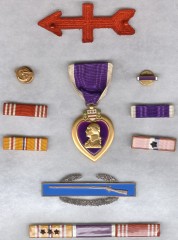
Paul Vetter was born on March 27, 1910 and he lived in Iowa most his life. He had a normal life of working on farms and things like that, until February 4, 1943 when he was drafted into the army. By the time he was drafted the war had all ready been going on for quite awhile and Mr. Vetter was already about 34 years old. He was one of the older men to go into combat, but they needed everyone. He was sent to Fort Dodge in Texas. He trained there for about three months. Then from there he went to San Francisco for more training. After that he got on a boat and was on his way to the Philippines. It took three weeks just for the boat to get there. When they got off the boat one of the things that he remembered was having to take off the Red Arrow Badge that they wore on their uniforms. It was a sign of what battalion he was in, but the Japanese would see it easily making them a easy target for snipers. However, one of the commanding officers did not take it off, he also left all his pins and decorations on. Before he could even get into battle he was shot right in the head by a sniper. Yes, as soon as Paul got to the Philippines it was time to fight. The weapon he used was a M-1 rifle with an eight shot clip. He was a rifleman and was in a group with twenty five other men.
He described the living conditions as horrible. He said it would rain all the time, all day and all night. There was lots of sickness and Paul even got malaria. He said sometimes while you sat in your fox hole and the rain would fill it up and you would have to sit in water up to your chest and you would just have to stay there.
He also talked about the food, they always ate, K-rations and they did not contain much food and they weren't that good tasting either. He said that you would only get one package for two weeks and no more.
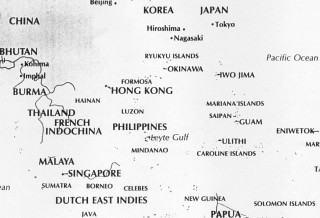
The Japanese took over many, many Islands in the Pacific. At its largest in 1943, when Paul entered the war, the Japanese controlled all of the Philippines, Korea, Manchuria, Burma, Thailand, French Indochina, parts of China even Beijing and Hong Kong. They also controlled all of the smaller islands shown on the map on the last page. Each one of these islands they fought for with everything they had and they would not surrender or retreat. It was the job of soldiers like Paul Vetter to free these islands. Paul was in some very dangerous battles on these Islands in the Philippines.
The Japanese did not want to give the islands up and they would rather die than surrender or retreat so they used tactics like tying themselves up in trees with their guns. They would also do things like set up their machine-guns in small caves or in what Paul called a "pill box", a little concrete box with only one hole for the machine-gun. No one could get in or out, not even the Japanese soldier. These pill boxes were covered with leaves and brush so they were very hard to see and very deadly.
The Japanese also used Kamikaze or suicide pilots. These pilots would fly the plane stuffed with explosives. They would receive only enough gas for one trip and they would fly their planes straight into an American or allied boat. They would try to hit larger ships but they would take what they could get, especially when they had already been shot. The Japanese did not have a shortage of these pilots either. Thousands of young men would volunteer for these suicide missions. They usually sent inexperienced pilots. A good pilot was too valuable to waste.
So you can see how hard the soldiers had to fight to free all the Islands. When Paul entered the war in the Philippines he and the other soldiers fought to free the islands and the captured American troops that the Japanese were holding. Paul saw lots of action and put his life in danger many times. The time he says the closest he came to death was when he was on a ship being taken to fight on another island. There he watched what he called a "dog fight", American and a Japanese fighter planes battling in the sky. Then the Japanese plane got shot and started going down, so it steered straight for the boat but at the last minute crashed into the ocean. He said that it got so close he could see the pilots face.
On another occasion while he and the rest of the troops were out patrolling an island they came across a Japanese pill box. It started shooting at them so they started to run the other way. Soon they met another group of U.S. soldiers who asked them why they running. So they told them about the pill box. Then a guy with a flame thrower asked them where it was and they showed him. He sneaked around to the side of it, got about fifteen feet away from it and started to blow fire at it. Then he walked right up to it and sprayed fire right inside. And that took care of the problem!
Another of his memory was when he was sitting in a fox hole with his gun when he fell asleep. He was awaken by a noise of rustling brush. He woke up and emptied his gun on a Japanese solder, all 8 bullets.
One of the things Paul and the other solders did was to try to free the prisoners.
The Japanese treated their prisoners of war just as badly as the Germans treated the Jews. They looked about the same, a Jewish prisoner in Germany and a prisoner of war over in the Pacific, both starving and tortured.
One of the biggest and worst battle he was in was on the Philippine island called Luzon. It was one of the biggest battles on the Philippine mainland, it is also were he was shot. He said, "we were marching up a hillside under fire and it took about three hours to get to the top. When we were at the top of the hill my job was to cover the other troops as they went around the hillside. This is when I was shot in the leg by a Japanese machine gun. I didn't even realize I was shot until it was time to go down the hill. By this time it was bleeding and very swollen. I started to go down the hill but my buddy "Joe" (Paul said that every soldier's name was Joe that was what every one would call each other) saw my wound and helped carry me down the hill. So I was probably bleeding for a couple of hours before I got any medical attention".
It was 1945 when Paul Vetter was shot in the leg. He had been at war in the Philippines for more than two years now fighting battles on different islands sitting in wet fox holes, not being able to talk or the enemy would hear, going to different places to try to free fellow Americans and during all that time his family did not even know if he was alive. He had only one chance to write home during the war. Now he was shot and they did not even know. Then one day they got a package in the mail. It was Paul's Purple Heart medal, they never even knew that he was hurt and they wondered now how badly he was injured.
Paul was shot in the leg, the bullet severed many nerves and tendons. It also bled a lot. One of the nurses said she had never seen that much blood. He remembers a nurse sticking his leg with needles and asking if it hurt at all. He said no. The nurse said we can put it back together but we can't put the feeling back in. Paul still has no feeling in his leg to this day.
Paul went to three different hospitals after he was shot and sent back to the U.S. The first was in San Diego, from there he was sent to Tennessee, and then back to Colorado where he was discharged.
While he was in the hospital he had a chance to write home and tell them what had happened, and that he was OK. He was also in the hospital when we dropped the bomb on Japan, and also was in the hospital on V.J. day in August 15, 1945, victory in Japan.
He said that there would have been no other way to win the war because the Japanese would have fought to the last man, woman, or child alive.
When he was discharged in Colorado he received his pay 300 dollars for two years nine months and two days of war in the Pacific. He also received some special awards: he was given a good soldier medal, Pacific ribbon with four battle stairs, and a Purple Heart. Paul is a very brave man. He made many friends over in the war and was there when they died. Out of the twenty five men he went with only ten survived to return home. Paul put his life in danger many times to protect America and the other countries like the Philippines were he was stationed.
This is a map of where the war in the Pacific was going on. The Japanese controlled all of the circled area at its largest in 1943.
I would like to thank Mr. Paul Vetter for the interview and for what he did as a soldier.