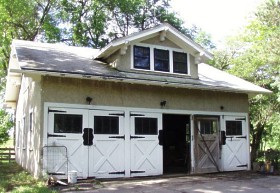
Click here for more pix of the garage
• House and garage constructed in 1916 for William and Ann Leet by masons and
plasterers, Detlefsen and Thoms with the likely help of carpenter, Herbert Hass, or his
father Hannes Hass. The garage was specifically built to house cars and not "carriages,"
thus its proper label is a garage and not a carriage house, although it is not your ordinary
garage even for the times in which it was built.
• Barn was built in 1917 by Detlefsen and Thoms while Leet was still owner but under Fred Hassler's direction.
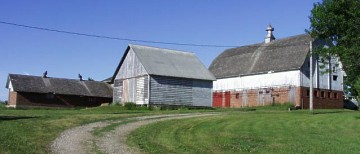
In general, the barn is of plank frame and masonry (tile block) construction, with the
framing of the loft being a classic Shawver Truss configuration, which dates from the
1880s into the 1930s.
• Scale House and Hog House -
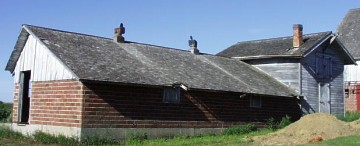
It is suspected that these two buildings were built 1917 by Thoms in likely association with Detlefsen under Fred Hassler's direction and/or ownership. They were probably built around the same time as the barn because of the use of similar tile block types in their construction. The hog house also incorporates a frame railroad structure (freight house?) into its construction. The railroad structure would have been moved to this location and joined with the hog house structure. As such, it could date from 1917 in its move, although it could have been moved at a much later date and added to the hog house. The railroad structure served as a loafing shed after it was moved.
• Chicken House and Boar House - Both were probably built 1918 to early 1920s when Fred Hassler was owner, with the boar house built to house his prize boars. Both of these buildings use a similar type of tile block and brick in their construction, a type different from that in the barn, hog house, and scale house.
• Corncrib - Built in 1943 by Chris Pfoltner, thus post-dating the period of significance for this farmstead. If desired, this structure could be removed without adversely impacting the integrity of the farmstead because it is considered a non-contributing building to the farmstead district.
Poland China Hog Operation
The Fashion Herd
The purebred Poland China Hog operation of Fred Hassler, which characterized the farming operation of the Leet/Hassler farmstead during its period of significance (i.e., 1915-1936), was known by the 1920s as the "Fashion Herd," a name which appears in faded painted lettering on the loft of the barn on this farmstead. Hassler was among "four widely known Poland China hog breeders" in the Manning area in the early 20'' century. The other well-known breeders were Bob Halford, Charley Lyden and Bill Timmerman. Hassler was also reportedly "the largest hog breeder in this area of that time". His Fashion Herd hogs "were sold throughout the country and were the basis of many famous herds".
The first sale barn in Manning opened in 1906 and was operated by George Wilson. Sellers of both purebred Duroc Jersey and Poland China hogs were frequent customers. In 1921 and 1923, Fred Hassler sold spring boars from his then-champion boar, "Bombe," at the sale barn. Another of his champion boars was "Grand Master. According to a history of Poland China hog breeding in the United States, Hassler acquired Grand Master on August 8, 1913, selling it to W.A. Leet, then of Omaha, Nebraska, on December 1, 1915. This is interesting timing given that Leet had just acquired title to the future farmstead property in Manning in November 1915. Grand Master was subsequently acquired by Osbert Allender and Sons of Mount Pleasant, Iowa, although the date of sale is not recorded in Davis and Duncan (1921:43).
Grand Master first came into the limelight in 1914 [when Hassler was his owner], when he won the special prize offered by another breed exponent, for the largest boar of any breed on the Iowa State Fair Grounds. Grand Master weighed 1,070 pounds the day of the weighing and exceeded by over 100 pounds his nearest rival. He later weighed 1,120 pounds. As a breeding boar, he ranked first class, especially as a sire of brood sows. Probably his greatest son was Masterpiece, the sire of the renowned Fashion Girl. His gilt had always been in demand.
Other hogs of note in Hassler's Fashion Herd included "Designer" farrowed on January 1, 1918, bred from Fashion Girl and sold to William Ferguson of Nebraska for $5000; "Liberator" also farrowed on January 1, 1918, from Fashion Girl and sold to L.H. Glover of Missouri for $3000; "Archdale" farrowed in 1919 by Chieftan; and "Checkers" purchased after March 1919 and sold by Hassler to Joe Bloemendaal of Alton, Iowa, in March 1920.
It was said of Liberator that:
Perhaps no other boar of late years, so completely captivated the entire Poland China world as did Liberator. As soon as he was sold at the remarkable price of $3,000, as a six months old pig, he had begun to make history and for the past two years many pages have been inscribed. After a most brilliant advertising campaign, a sale held on November 16, 1918, with ten sows sold with breeding privilege to the pig, made a record sale of about $600 per head.
Detailed information on Leet/Hassler Farmstead